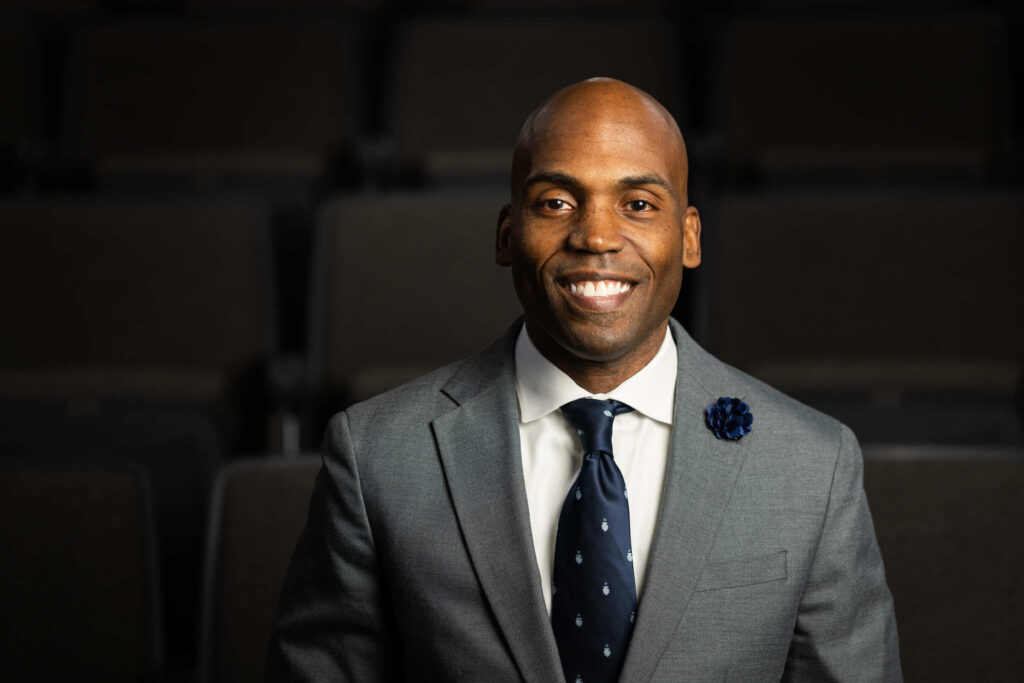
As America reflects on the fifth anniversary from the date of George Floyd’s murder, Dr. Yohuru Williams, founding director of the Racial Justice Initiative at the University of St. Thomas, has appeared with multiple media outlets discussing the implications from the history of police brutality and racism in the U.S. to where we go from here.

On the morning edition of MPR News with Cathy Wurzer, Williams, a Distinguished University Chair and history professor at St. Thomas, said, “A lot of people labor under the assumption that what happened to George Floyd was an anomaly. But for the Black community in particular, this is the echo of decades — generations — of Black people complaining about this type of disproportionate treatment.”
Williams spoke to Wurzer again on TPT’s Almanac, this time about the federal government vacating the consent decrees that were in place with the Minneapolis Police Department.
In the episode, Williams said:

“I think part of the challenge in this moment is that people are really still hoping for the tragedy with the happy ending. We don’t have a happy ending here. We have the work that remains to be done and we continue to write that story. And again, I hope community will continue to stay in that work; follow the work of people like Communities United Against Police Brutality, the Minnesota Justice Research Center activists like Nekima Levy Armstrong. I mean, we all need to stay in this work and be vigilant and to support the work of the police.”
The Native America Calling show had Williams on as a guest for a 15-minute segment to discuss the federal government withdrawing the Department of Justice (DOJ) oversight for police departments in Minneapolis, Phoenix, Louisville, and other cities and why oversight is needed.

Williams said, “You really would have to reimagine policing around the model of public safety and acknowledge the historic roots of policing in this community. Minneapolis police were formed in 1867 in the aftermath of the civil war and what people often forget in terms of how that calculus works is that a big part of their mission was basically policing Black and brown bodies – Indigenous people and Black people.”
He added, “the stories that our communities tell about police brutality, about unfair treatment, about a denial of justice, ultimately come from a place of experience. These aren’t things that we made-up. These are actually the lived experiences of people in community.”
He also discussed police morale.
“In the aftermath of the murder of George Floyd there was a drop in morale and a decline in morale among the officers within the department because who at that point wanted to be associated with the most notorious Police Department in the country? In fact, if we think about the global reaction to the murder of George Floyd, Minneapolis became kind of, for lack of a better term, synonymous with the brutality that we saw that occurred against George Floyd. At the same time there were those within the department who resisted and who were opposed to the types of reforms and the transformative change that many in community were demanding at the time.”

From Womens Press article, quoting Williams:

“Beware of reform that doesn’t involve re-imagination. Beware of reform that has metrics that are determined by people who are more invested in mission accomplished rather than the hard work of achieving substantive change.”
He quoted from the Tina Turner song, “We don’t need another hero.”
Out of the ruins
Out from the wreckage
Can’t make the same mistake this time
I wonder when we are ever gonna change,
Living under the fear, ’til nothing else remains
We don’t need another hero
Related Content