

Nobody knows or defends the remote pockets of the South better than the people who live there. For this community survey project, teams of impacted residents, environmental advocates, students, and SELC staff across the region went door-to-door collecting neighbors’ concerns about living near wood pellet pollution, a byproduct of making dirty biomass energy. The movement to protect Southern people and places by stopping biomass production is still heating up, but the data Dr. Bell recorded supports years of anecdotal evidence from community residents.

Commissioner ErNiko Brown
Greenwood, South Carolina
When you’re raised in community, taking care of each other becomes second nature.
“I come from community, so I believe in community,” says Commissioner ErNiko Brown, an equally simple and powerful way to describe how she arrived at organizing against pellet mills across the Southeast.
But her collaborative spirit and attention to relationship building runs much deeper. Commissioner Brown was raised by her grandmother — who birthed nine children and mothered so many others — in one of her family’s most sacred places, their rural South Carolina homestead passed down through generations for more than 200 years. The land was a solid foundation for her family to thrive and enjoy the benefits of sharing time and space. It was a place to nurture and be nurtured in return.
“You can’t overlook the essence of community Black women have built in these spaces,” says Commissioner Brown, speaking from a life shaped by the intimate relationships her ancestors have historically cultivated with the land and between themselves.
Sustainability is just a 10 dollar word for survival that Black folks have been doing for over 400 years
Commissioner Erniko Brown
She’s been front and center on building opposition to unjust pollution, from organizing on the ground in several Southern states to holding various leadership roles at multiple organizations, including founding and becoming CEO of Organized Uplifting Resources & Strategies, or OURS, a nonprofit focused on environmental justice for rural communities.

Her grassroots organizing has spanned internationally and nationally including across 14 states and involved educating community members and identifying local leaders who have continued the fight today. This work has connected her with many other Black women building the movement against the toxic biomass industry.
She’s touched by the way her elders carry on the spirit of her grandmother, who has passed away since Commissioner Brown started organizing.
“There’s this beautiful thing about older women in the Black community,” says Commissioner Brown. “They’re not just the people leading the work, they’re nurturers and wisdom holders. These are our elders who are nurturing our relationships and livelihoods in the process of passing the torch down.”
Commissioner Brown is quick to praise Belinda Joyner of Northampton County, North Carolina.
“She has become this fixture in my life where I can’t go too long without talking to her,” Commissioner Brown says, drawing on a recent phone call where Joyner said, “‘I’m so proud of you, ErNiko. I know your grandma is up there in heaven shouting.’”

Debra David of Richmond County, North Carolina, was another person to love on Brown from the beginning. This staunch community organizer with nonprofit Dogwood Alliance was known for her loving and humble spirit and world-class cakes and pies. Some say her banana pudding is the best they’ve ever eaten.
David participated in the survey project and passed away from cancer July 10, 2024, before the findings could be published. She was on the frontline of the fight against wood pellet pollution for many years and is personally responsible for hooking Commissioner Brown deeper into the work by laying out the ways the industry was harming Commissioner Brown personally.
“When she was out in the field doing this work, even when she was sick, she would give 110 percent,” Commissioner Brown remembers. “She was a humble giant and any time someone needed to speak out about biomass or how her community was impacted, she was definitely there.”
It’s a true testament to the strength of a Black woman. And I thank God every day for being one.
Commissioner Erniko Brown
This survey project is a way to honor the many environmental justice champions who lead the way for today’s emerging leaders, including David and Joyner.
“Being able to produce these survey results is a tangible way to pay homage to the many people who have taken on this fight,” Commissioner Brown concludes. “Now these people’s daughters and granddaughters are taking over. When I think of myself as the little Black girl from South Carolina, I am truly amazed at all we’ve been able to accomplish so far.”
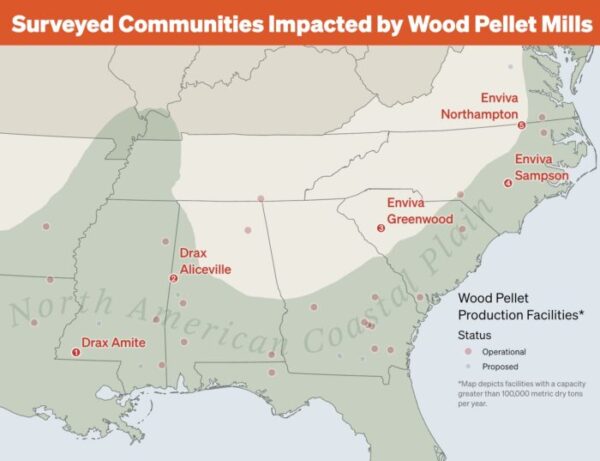

Here’s where we surveyed for wood pellet pollution


