


Southside Cultural Monument celebrating Black history in Spartanburg
Southside Cultural Monument celebrating Black history in Spartanburg
Mark Susko for the Herald Journal
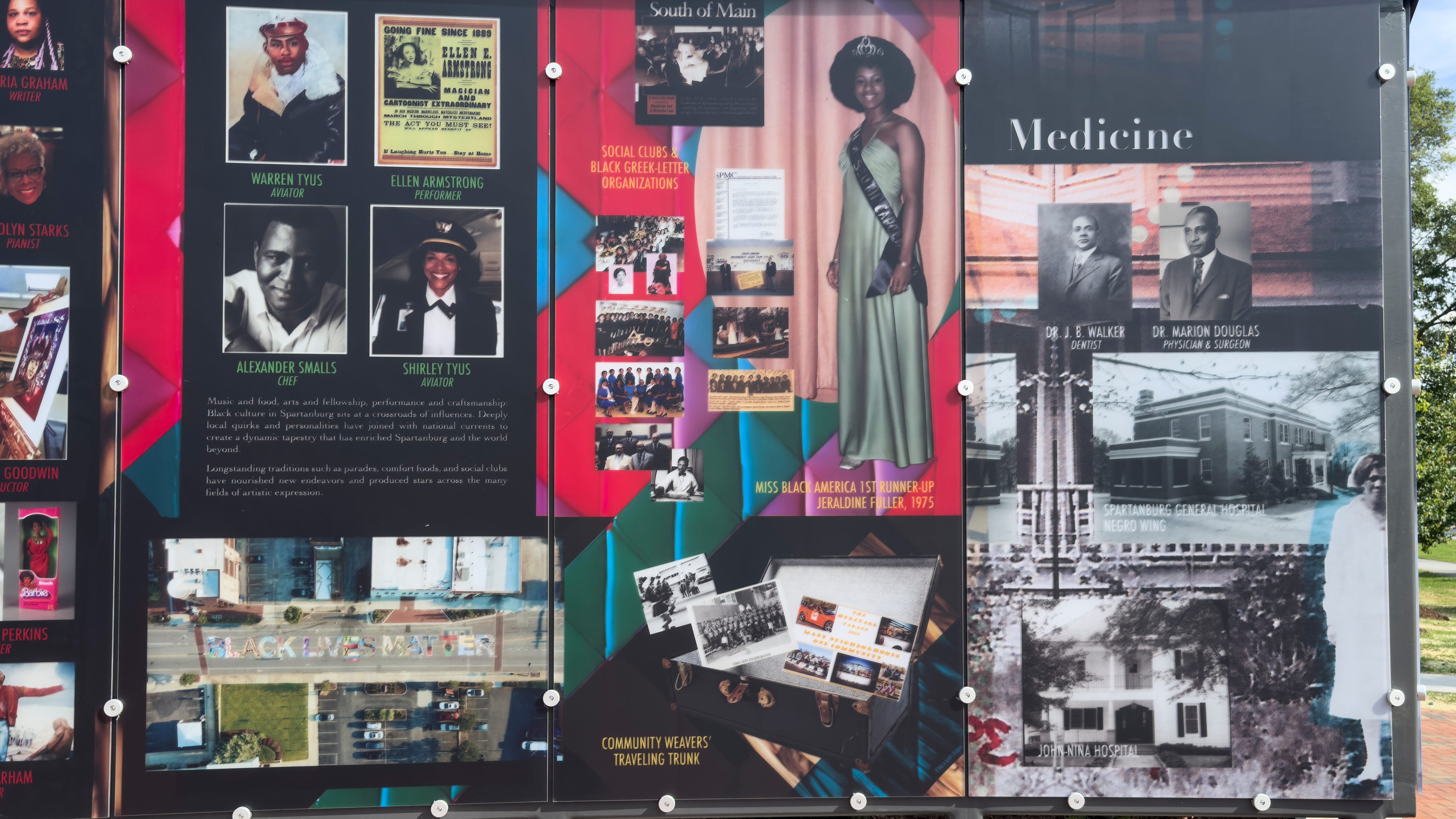
A crowd of more than 200 gathered on Saturday for the long-awaited unveiling of an installation at the corner of Hudson Barksdale Boulevard and South Converse Street, celebrating the history and cultural contributions of Spartanburg’s Southside community.
A once-thriving community, the predominantly Black Southside was remade – largely destroyed, according to those who remember it – by the “urban renewal” programs of the late 1960s and early 1970s.
Urban renewal aimed to address blight and improve housing in the nation’s cities, but it also resulted in the displacement of residents and the demolition of businesses.
In Spartanburg, the “vibrant heart of the Southside was wounded,” said state Rep. Rosalyn Henderson-Myers.
She spearheaded the development of the Southside Cultural Monument—a work of art that reveals the community’s rich history through a collection of photographs, text, and graphic design, focusing on people, places, and themes such as education, faith, civic leadership, and the arts.
Names and faces of key figures appear throughout the monument, which spans 149 feet from left to right.
There are musicians and artists, including Arthur Prysock, Clara Smith, Pink Anderson, and Winston Wingo, alongside athletes such as Lee Haney and Stephen Davis.
The installation features business and civic leaders, including Kay Woodward, Tyrone Gilmore, and former South Carolina Supreme Court Chief Justice Don Beatty.
Artist Jessica Scott-Felder said her most significant challenge was balancing a compelling design with the wealth of information and stories to be presented. The monument was designed in a series of panels that can be updated or edited as the community—and its perspectives on its past—evolve.
Jessica Scott-Felder said she envisioned the monument as “a community-wide hug, an enveloping embrace.”
She was one of several speakers to make remarks at the unveiling.
Former Mayor James Talley described the project as “a labor of love.”
Talley chaired the City of Spartanburg’s African American Heritage and Cultural Committee, which guided the content of the monument.
Henderson-Myers said she hoped the stories and perspectives presented in the monument would inspire young people. “May they see their potential reflected,” she said.
The unveiling drew an audience of all ages.
Some in the crowd were old enough to have attended Carver High School, the city’s Black high school before it was integrated. Former state Rep. Brenda Lee Pryce led the Carver alumni on hand in singing the school’s anthem.
Pryce has been instrumental in sharing stories of Black history in Spartanburg. She co-authored the books “South of Main” and “North of Main,” published by Hub City Press.
Jim Neighbors, a Wofford English professor who leads the college’s African American Studies program, worked with Pryce on “North of Main” and served on the African American Heritage and Cultural Committee.
He said the book and the monument represent “the most gratifying work of my career.”
The turnout for the unveiling was “amazing,” he said. “This is the true definition of community.”
Henderson-Myers helped secure state funding of $1.3 million as well as private donations to make the monument possible. She began working on the idea following a 2018 trip to Columbus, Ohio, where she was inspired by a monument honoring the city’s Black history and culture.
Seeing it finally unveiled to the community was “a dream come true,” she said.
For Willie Mae Thacker, who grew up in the Southside neighborhood before the changes wrought by urban renewal, the unveiling was an opportunity to reflect. She recalled the many businesses that thrived in the neighborhood as well as the dynamic social scene of schools and residential streets.
The cultural monument won’t return all that, she said, “but it brings back memories – and that’s important.”


