

After Jack Johnson’s reign ended, the odds were stacked against Black fighters who were vying to become the world heavyweight boxing champ. That ended due to a fighter with Detroit roots—Joe Louis.
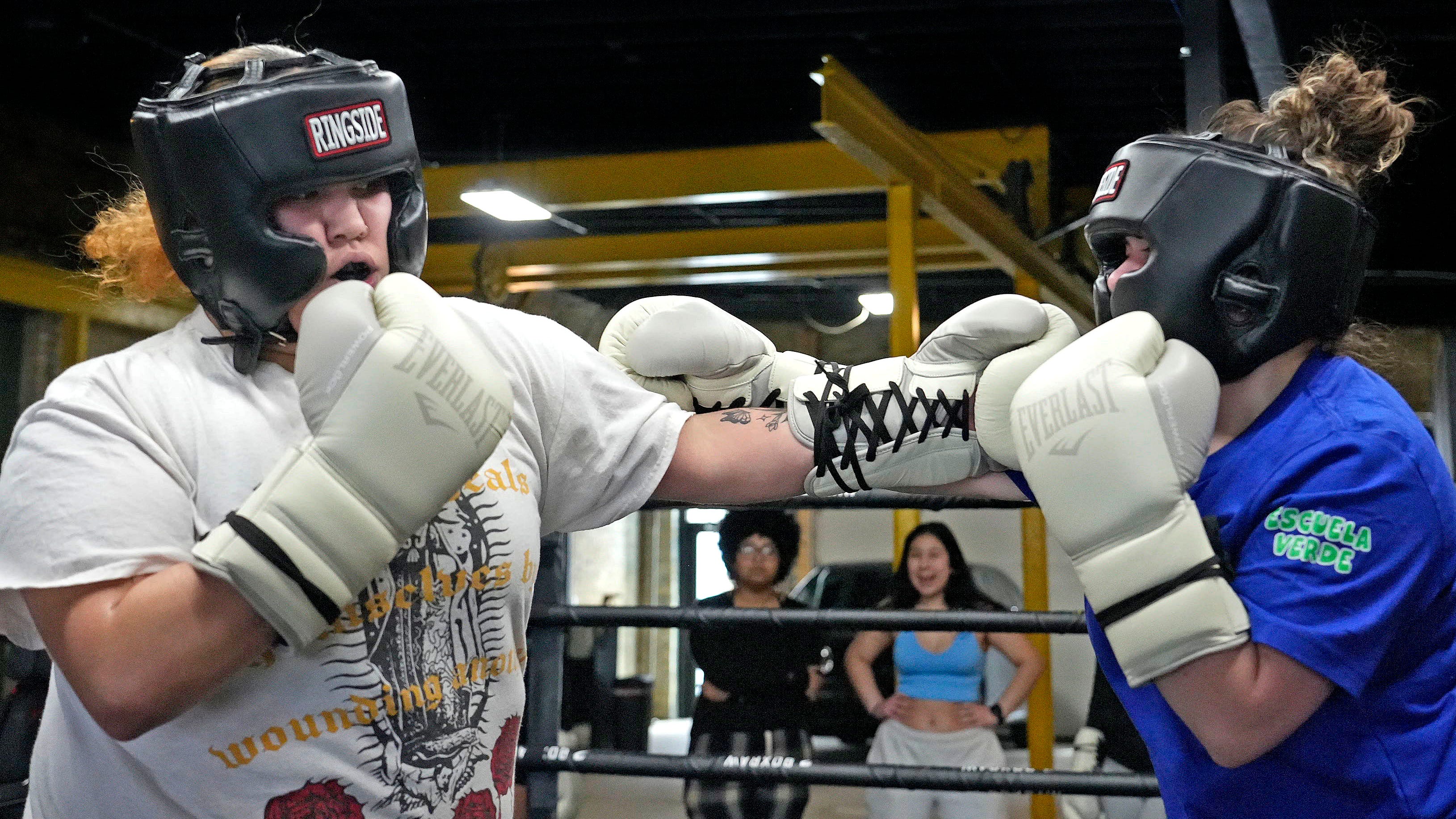

Female boxers find a home at a new Milwaukee women’s only boxing gym
SheWolf MKE, a women’s only boxing gym, provides a space for teen girls and women to learn the technical skills of boxing while becoming fit.
- Jack Johnson, the first Black heavyweight champion, defeated James J. Jeffries in 1910, sparking race riots across the U.S.
- Johnson’s victory challenged white supremacy and had a lasting impact on boxing, delaying the next Black heavyweight title fight for decades.
- Joe Louis, the next Black heavyweight champion, was carefully marketed to white America, contrasting with Johnson’s controversial image.
- Despite their different personalities and public perceptions, both Johnson and Louis faced similar challenges and inspired people through their boxing careers.
The date was July 4, 1910, the location was Reno, Nevada, and the event scheduled to take place was billed as the “Fight of the Century.”
Roughly 20,000 people packed into a newly built, massive amphitheater to see Jack Johnson, the first Black world heavyweight champion of the world, defend his title against former champion James J. Jeffries. In addition, tens of thousands more gathered at locations across the country to receive telegraph-generated reports as the battle played out.
Popular gathering spots away from Reno on that Monday holiday included downtown Detroit, where an estimated 5,000 people “jammed together in the form of a huge letter ‘V’” to hear reports that were streaming from the offices of the former Detroit Evening Times, as the publication reported on June 5, 1910.
However, the action that took place inside the boxing ring that day hardly matched the buzz felt outside of it, as Jeffries, who had been encouraged to come out of retirement by the legendary novelist Jack London and many others to return the heavyweight crown to the “white race,” was easily defeated by Johnson. With Jeffries bleeding badly from cuts over an eye and in his mouth, and with the other eye nearly swollen shut, the fighting in the ring ended in the 15th round, during which Jeffries was knocked down three times by Johnson.
But then the real Fourth of July fireworks began afterward in the form of race riots “in all parts of the country,” where “scores of negroes were injured seriously, and eight negroes were killed outright,” according to the New York Times’ July 5, 1910, front page.
“The picture that many people have today of riots are of the urban uprisings of the late 1960s, but the race riots following that fight on Independence Day 1910 were actually white attacks inflicted by mobs of folk because Johnson’s victory was a betrayal of white social assumptions,” Theresa Runstedtler, author of “Jack Johnson, Rebel Sojourner: Boxing in the Shadow of the Global Color Line” (UC Press, 2012) explained. “At that time, boxing was one of the premier, if not the premier spectator sport with fights held in massive arenas. And the world heavyweight championship was viewed as the epitome of white manhood. So for Jack Johnson and later Joe Louis to step into that role it was symbolically a hard pill to swallow for many.”
In addition to the violence and heightened racial tensions that resulted immediately after the Johnson-Jeffries fight, the outcome also had a lingering impact on who would be able to fight for the heavyweight crown in the future. After Johnson’s reign as the world heavyweight champion ended following his loss to Jess Willard in Havana, Cuba on April 5, 1915, a Black fighter was not granted another opportunity to fight for the world heavyweight crown until June 22, 1937 when Louis knocked out James J. Braddock before more than 40,000 fans at Comiskey Park, the original home of the Chicago White Sox.
Detroit’s Brewster Recreation Center is credited as the place where Louis received his formal start in boxing, and the Detroit Golden Gloves tournament—sponsored by the Free Press during the 1930s—provided a platform where Louis continued to hone his skills as an amateur. But Runstedtler says it took some shrewd maneuvering outside of the ring once Louis turned pro to place him in a position to fight for the heavyweight crown, which set the stage for the iconic status that Louis still holds today in Detroit and across America.
“Joe Louis was marketed very strategically by his Black braintrust,” said Runstedtler, an Ontario native and full professor in the Departments of History and Critical Race, Gender & Cultural Studies at American University, who authored the scholarly article “In Sports the Best Man Wins: How Joe Louis Whupped Jim Crow.”
On the afternoon of July 1, in explaining how Louis was “marketed to White America” as a professional boxer, Runstedtler referenced the famous “rules,” also known as “Joe Louis’ Seven Commandments” that were supposedly given to Louis by his co-managers Julian Black and John Roxborough to navigate Louis’ public image. The “Joe Louis Seven Commandments” stated that Louis would: “Never have his photo taken with a white woman. Never go to a nightclub alone. Never have a “soft” fight. Never fix a fight. Never gloat over a fallen opponent. Always stay deadpan for the cameras. Live and fight clean.”
The actions taken by Louis’s managers to make the commandments known to the media and public helped to portray Louis as the antithesis of Johnson, whose lifestyle often garnered more attention than his boxing ability. And judging from the outcome, Louis’ managers carried out a winning plan.
“For Joe Louis to be embraced as an American icon, as an African American, and to be recognized as a symbol of American grit with working class appeal, that was unprecedented,” stated Runstedtler, who says the zenith of Louis’ popularity came after Louis’ first-round destruction of German Max Schmeling in their second fight on June 22, 1938 at New York’s Yankee Stadium, which was called a blow to Nazism and a victory for democracy.
But Runstedtler also points out that a deeper dive into history reveals similarities shared by Louis and Johnson, who was posthumously pardoned by President Donald Trump in 2018, 105 years after Johnson was convicted of violating the Mann Act for transporting a white woman, who later became his wife, across state lines. More than just a Black man who was bold enough to display his interracial relationships during the early 20th century, Runstedtler describes Johnson as a “global celebrity” who sparked heated debates about racism and imperialism on a global stage. And in the process, Runstedtler says Johnson became a hero to oppressed people across the globe, even as far away as Australia where Johnson was looked up to by Aboriginal Austrailians in Sydney, where Johnson won the world heavyweight title from Canadian Tommy Burns on December 26, 1908. Runstedtler says that a study of stories written about Louis in the Black Press during his boxing heyday reveals that he, too, was admired in different ways than Louis’ normal mainstream portrayal.
“Joe Louis represented different things to different people and this was true even for the Black community, depending on a person’s age,” Runstedtler stated. “Many in the younger generation liked the idea that he was often beating the crap out of white men. And that he was stylish and embodied an air of class, Black independence and Black self-determination. The older generation admired many of those qualities as well, but for some it was more important that Joe Louis represented respectability.
“Personality wise, Jack Johnson and Joe Louis were definitely different, but in some ways they had more in common than their differences because of the shared challenges that they took on in and out of the ring. And because of that their stories still inspire us today.”
Scott Talley is a native Detroiter, a proud product of Detroit Public Schools and a lifelong lover of Detroit culture in its diverse forms. In his second tour with the Free Press, which he grew up reading as a child, he is excited and humbled to cover the city’s neighborhoods and the many interesting people who define its various communities. Contact him at stalley@freepress.com or follow him on Twitter @STalleyfreep. Read more of Scott’s stories at www.freep.com/mosaic/detroit-is/. Please help us grow great community-focused journalism by becoming a subscriber.


