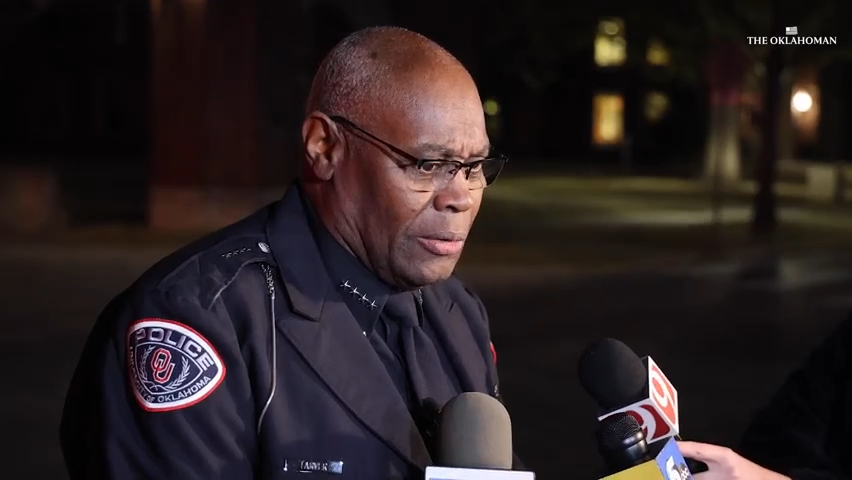

OU Police Chief gives update on report of active shooter on campus
“No threats were found,” Chief Nate Tarver said.
Nathan J. Fish, Oklahoman
Even 20 years after Clara Luper’s famous sit-in, no Black people had been employed by the city of Moore.
Until Nate Tarver.
Things were very different in 1979, Tarver remembered. He’d recently graduated from the University of Oklahoma with a bachelor’s degree in journalism and, by his own admission, never really had any intention of being a police officer. But he was paying a utility bill in Moore when he saw that the city was hiring and decided to apply.
“I think I was naive, like a lot of 21- and 22-year-olds are at the time, as to what the political climate was, what the social climate was, so I had no clue that there were no Blacks that worked in the city of Moore,” Tarver said.
Tarver, now retiring as chief of police for OU, has been recognized as a trailblazer in the Black community and in law enforcement. That praise is a far cry from the derogatory statements and racist comments he was hearing when he first joined Moore.
His retirement from law enforcement was effective Friday, Sept. 19 ― 46 years to the day he was hired as the first Black police officer for the city of Moore.
Moore residents were so unaccustomed to seeing a Black man, Tarver said, that they would sometimes call the police department when they would see him on patrol in the squad car, claiming he must have stolen it. People who had called police for help with emergencies sometimes wouldn’t even let Tarver into their homes.
The racism even extended to the some members of the department itself, Tarver recalled. He said several officers were unwilling to join him on patrol duty after he joined the department.
“There’s a lot of misconceptions because if you don’t have interaction with people from other places or other communities, you don’t know anything about it,” Tarver said. “A lot of those people obviously went with what had been handed down to them from whomever about what Black people were like. Luckily for me, some of those people I worked with and some of the people I got to know were curious enough to say, ‘Hey, these are some of the things I’ve heard; are these things true?’ And I would go, ‘No, that’s not true.’”
The climate was tough, but Tarver, a deeply religious man, felt God had compelled him to stay in the force. And, he also remembered, not every police officer was racist, with another open-minded officer declining to join a masonic organization if Tarver would not be allowed in.
Slowly but surely, over a decade working for Moore, things changed. By the late 1980s, Tarver had become well-liked by the townsfolk for his good-natured attitude, and by the time Tarver left the Moore Police Department to work for Oklahoma City, Moore had hired more Black police officers.
“I had made a mark there, and a lot of people knew me. From the young people through the school system to the businesses, I’d made myself known,” Tarver said. “When I went to Oklahoma City and I met other officers who had gone to work at Moore, they’d say, ‘Oh, you’re Nate Tarver. Everybody talks about you! Everybody is still talking about you!’ I guess it was worthwhile.”
Turning point for law enforcement, community support amid OKC bombing
His decision to leave Moore for Oklahoma City in 1989 was largely an economic one. A decade into employment with Moore, then-sergeant Tarver had not seen a raise for several years, and officers in Oklahoma City persuaded him to apply with their department. Around that time, Oklahoma City had passed a public safety-related sales tax that would help hire hundreds more officers and firefighters.
Knowing that the hiring process is often slow, Tarver didn’t expect it to go quickly. But recruiters, already familiar with him due to enthusiastic references from other officers in the area, called him back and had him taking police academy courses within weeks.
The next 26 years saw Tarver work numerous assignments, including patrol, robbery detective work, gang enforcement and drive-by shooting investigations. He also returned to help Moore several times as part of emergency response efforts after devastating tornadoes in 1999 and 2013.
But it was Oklahoma City’s response to the 1995 bombing of the Alfred P. Murrah Federal Building that particularly sticks out in his mind.
At the time, Tarver was the police department’s public information officer, tasked with speaking about the law enforcement response to the bombing with various news outlets around the world. But the platform also allowed him to show others the “Oklahoma Standard” at work.
“It was a horrific event, but one of the things it did was show the goodness of people and community,” Tarver said.
First responders were well-supported by the community, Tarver said, particularly with food donations, clothing or anything else they might need.
Witnessing the devastation of a bombing that left 168 people dead, however, felt like stepping into a warzone, Tarver said. Signs of post-traumatic stress disorder among the responders became readily apparent, and haunting memories of the bombing 30 years ago still persist for many of his colleagues.
Before that, police officers kept mental or emotional strife to themselves, Tarver said, but the department was at a turning point, and soon after began offering grief counseling and similar support services.
Tarver’s move to OU
In July 2015, Tarver, then a captain, decided to leave the Oklahoma City police department for his alma mater, OU. He was hired as the deputy chief for the OU Health Sciences Center, located in northeast Oklahoma City, and would be promoted to chief over the campus after two years.
As he researched the campus, Tarver began to realize that Black residents who lived in areas nearby, some of whom were without health insurance, didn’t feel like the university had been a good neighbor. They would tell him about unfair treatment they’d received, with Tarver believing it was very recent, only to discover the offending incidents had actually occurred several years beforehand but had never been addressed.
He was also told that minority employees at OUHSC felt like they weren’t getting the respect they deserved from the university. He sought to change this dynamic by meeting with the groups and asking the OU police to go about things differently, asking them to be more interactive with the campus employees and residential neighbors alike.
“Someone listened to them, someone talked to them, someone took them seriously and heard what they had to say and said, ‘Yeah, you’re right, that shouldn’t have happened, but this is not going to happen going forward,'” Tarver said.
“I talked with my officers and said, ‘When you drive through these neighborhoods, I need you to stop, talk to people, greet people, wave at the kids, hand out these little badges, play ball with them, whatever the case may be.’ And it’s a different environment now.”
In 2020, Tarver was selected to be chief of police for the entire OU system, including the primary campus in Norman and the medical school in Tulsa. He took over the role in the wake of the COVID-19 pandemic-related shutdowns and widespread protests after the murder of George Floyd by Minneapolis police.
“It hasn’t always been easy,” Tarver said, noting that university police staff always face issues with funding, equipment or being a lower priority than athletics. But the safety of students has always been of the utmost importance, for the students and their families.
“I did get those phone calls from those parents, wanting to know, ‘If I’m sending you my kid, I’m gonna need to know if they’re going to be safe on your campus.’ And those are important phone calls and questions to ask, if you’re going to be spending good money in sending your precious child out of state, or across the country, or even down the street, whether they’re going to be safe.”
Making a difference a career highlight
Tarver has had a front row seat to many of the most important moments in the state’s history over the past five decades. But he says his fondest memories are when he’d found out that current police officers and business owners were among the children he’d taught in anti-drug classes in the mid-90s.
“For me, if you can influence or save or help one person, I think that you’re a success, but I’ve had numerous of those types of situations that have come up,” Tarver said. “I always wanted to help young Black men, so that was great for me. That’s the highlight of my career.”
Leaving the police chief role, Tarver said he was looking forward to a four-week road trip with his wife and some friends, visiting the Grand Teton and Yellowstone parks. It’s the first time, he said, that he’ll be able to go on a trip and not have to worry about what’s happening if his phone rings.
But Tarver has said he’s always cared about people and making sure they were treated respectfully. Now, even in 2025, residents in Moore, Oklahoma City and Norman remember him for his kind demeanor. That, he said, is an important part of the legacy he wants to leave behind.
“When I came into this business, people weren’t very nice to me,” Tarver said. “I’ve been called every name under the sun and been spit at. And it’s bad enough when a grown person would call you the N-word, but when you have a 3- or 4-year-old that you walk by and they call you the N-word, that stings really bad, because you realize that the kid has been taught that. They’ve been taught that hate. I know what it feels like to be treated poorly and unkindly, and I never want anyone else to feel that way.”