The City of Atlanta’s Reparations Study Commission is hoping to implement public feedback from Black residents who are advocating for redress.
The commission welcomed the residents to its first public meeting earlier this month, allowing them to ask questions or comment on what reparations could look like in Atlanta.
“Complete reparations is the process by which a nation of people are provided with the means to restore their condition to repair the damage,” said Reginald Muhammad, director of the National Reparations Institute. “At the end of the day, we’re talking about how do we make a people whole?”
Some local educators also attended the meeting, raising questions about how to address education in the context of redress.
“How will this committee prioritize reparations that directly address the educational inequities from early childhood through college, and ensure that Black students in Atlanta receive the investments that our ancestors were denied?” said Dehjah Vaughn, a sixth-grade teacher at KIPP Woodson Park Academy who teaches in a predominantly Black community.
The feedback from the public will add to the commission’s research for a study examining the history and impact of legal discrimination against Atlanta’s Black residents during enslavement and the Jim Crow era.
The study commission was established in late 2023 following a unanimous resolution sponsored by Councilmember Michael Julian Bond.
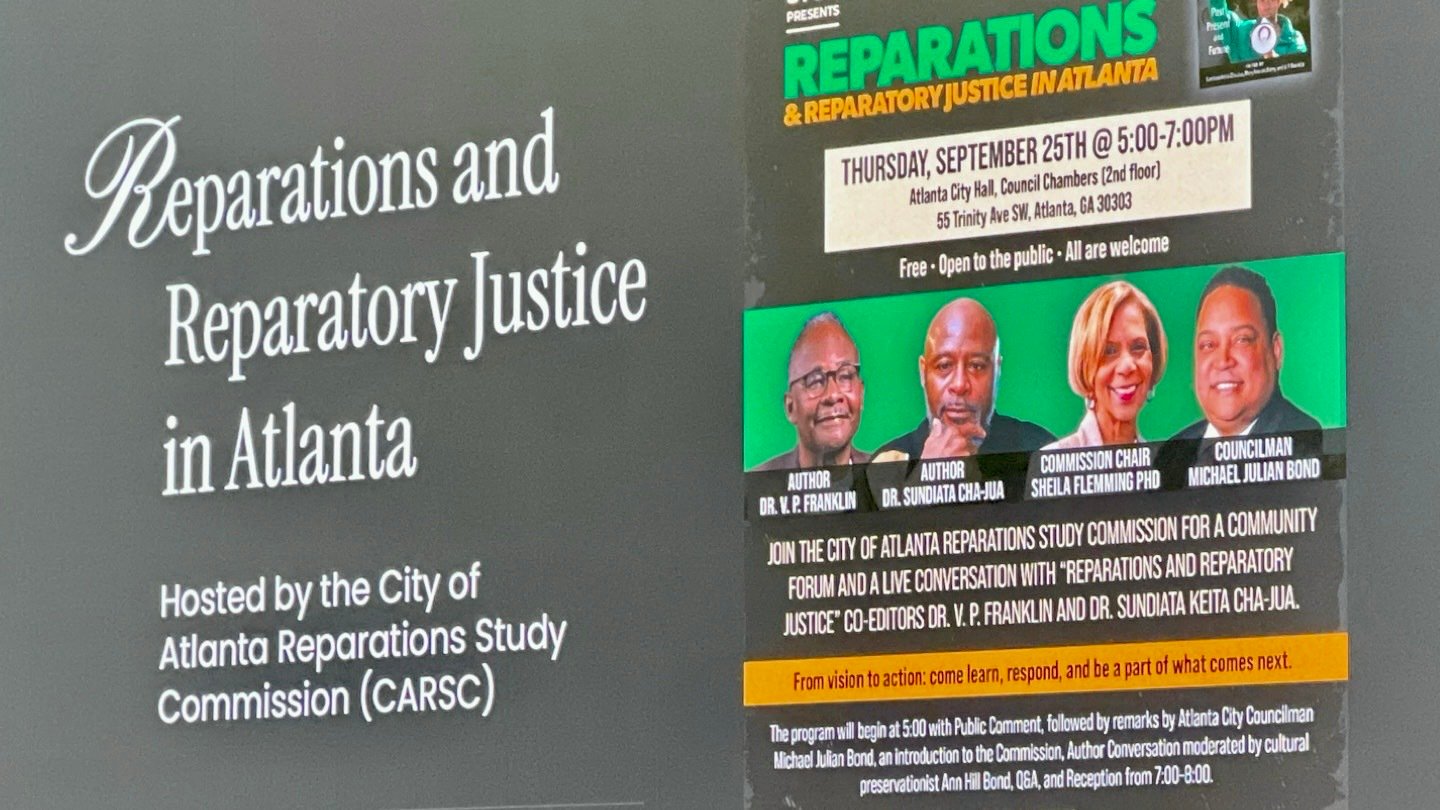
Atlanta’s Reparations Study Commission hosted its first meeting in September, taking in feedback from residents to add to their research on legal discrimination against Black people in Atlanta. (DorMiya Vance/WABE)
“We want to make sure that the community is engaged… on these issues because it is only with the collective recognition of the experience of all of those who have suffered… that we can hope to move forward as a city,” Bond said during the public meeting.
The meeting also featured a short Q&A with authors V. P. Franklin and Sundiata Cha-Jua. Franklin and Cha-Jua are co-editors of Reparations and Reparatory Justice.
“One of the important things to keep in mind as you go about this work is that reparations are not philanthropy. Reparations are not philanthropy,” Franklin said. “No, reparations are what are owed, and what has to be compensated for damage, for harm, for injury that has been done in the past.”
“We know that there is a disparity in life in this country that’s rooted in our oppression and exploitation. So, one of the first things is that we talk about that gap in each city. Be clear on what that difference is in Atlanta and in the metro area,” Cha-Jua added.