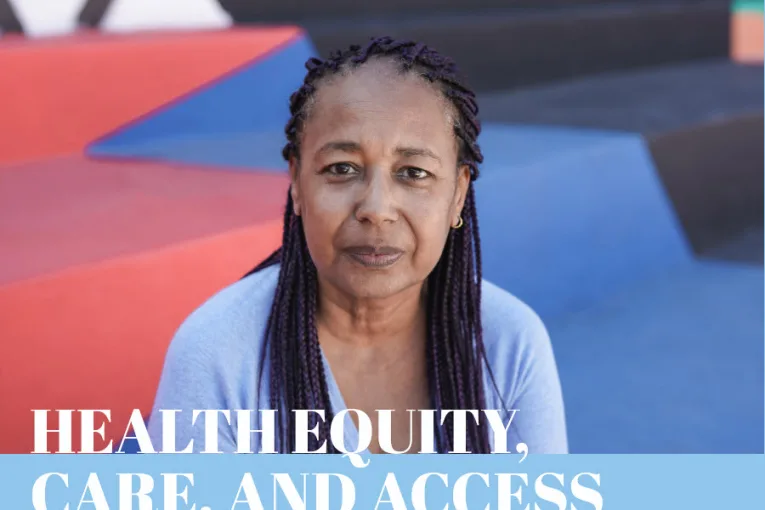
Image from Black Reproductive Justice Policy Agenda report
In an interview with The Vanguard, Dr. Regina Davis Moss, president and CEO of In Our Own Voice: National Black Women’s Reproductive Justice Agenda, warned that potential funding lapses in the Supplemental Nutrition Assistance Program (SNAP) and the Special Supplemental Nutrition Program for Women, Infants, and Children (WIC) could have devastating consequences for millions of families—particularly Black women and children.
“It is not a luxury. It is not something that can just be turned on or off. It’s a lifeline,” Moss said. “It literally does mean the difference between taking a literal bottle out of a baby’s mouth and parents having to really be stressed out about putting food on the table.”
Moss emphasized that both programs are directly tied to better health outcomes and economic stability. “Having a constant source of nutrition from conception through infancy, through early childhood—and with SNAP also offering nutritious foods for elderly and dependent individuals—is critical. It is directly linked to better health outcomes, safer pregnancies, and people being able to connect to other programs and resources in the community,” she said.
As political gridlock threatens funding, Moss said the impact is immediate and severe. “While they’re playing political chess, or the brinkmanship with these programs that families depend on, one day, 50%, 60% in certain cities, they’re turning off machines so that even if we are restoring it, it’s unnecessary stress and this is less food on the table for millions of Americans who are already struggling,” she said.
SNAP provides food assistance to more than 40 million low-income Americans, while WIC supports nearly 6.5 million women, infants, and children. Moss said that when these benefits are disrupted, families are forced to make impossible choices between nutritious food and cheaper, less healthy options.
“When people plan their whole meals around knowing that they’re going to have this assistance, and now they have to pivot—that’s when you start seeing people shopping and really buying those unhealthy foods,” Moss said. “People don’t want their children to be hungry.”
According to Moss, the current economic climate is compounding the crisis.
“The staples are the ones that are so expensive—the eggs, the milk, vegetables, baby food—and these are the things that SNAP has supported,” she said. “Couple this with the high grocery cost and it’s a recipe for disaster.”
Moss credited food banks and delivery services like DoorDash for stepping in, but noted that community efforts cannot replace systemic support.
“A lot of people have stepped up, and mind you, they were already stepping up because let’s not forget this workplace push-out,” she said, referring to job losses disproportionately affecting Black women. “Black communities are feeling that in front of that. And so yes, we need those programs because there are an awful lot of people hurting right now.”
She explained that reductions in SNAP funding threaten WIC eligibility as well, since “about 80% of WIC participants are eligible through their participation in SNAP or Medicaid.” Moss added, “So reductions in SNAP will jeopardize WIC access. That’s about 3 million people, including pregnant and postpartum women.”
Despite more white recipients overall, Black families bear a disproportionate burden from benefit cuts.
“We are disproportionately in poverty,” Moss said. “Black women already face disproportionate health burdens. We will bear the brunt and are already bearing the brunt.” She called those inequities “a mirror” of broader structural injustice. “When you want to see what inequity looks like, this is what it looks like—the cumulative impact of that,” she said.
Moss linked nutrition insecurity directly to maternal and child health outcomes, noting that consistent access to healthy food is crucial long before childbirth. “Nutrition is so critical preconception,” she said. “It’s important to be already fortified with nutrient foods. A lot of times our healthcare systems try to help with that by providing prenatal vitamins and really trying to make recommendations around healthy diets. But that is one of the things the WIC program does to help support that.”
She added that consistent nutrition during pregnancy and early childhood is essential to reduce infant mortality.
“The WIC program is there through age five. We see the most critical time to intervene with regard to nutrition in the first year of life because of the infant mortality rates in which we have already stated that Black babies are disproportionately at risk,” she said.
Moss tied these issues to the broader framework of reproductive justice, as outlined in In Our Own Voice’s 2025 Black Reproductive Justice Policy Agenda.
“This is one of the things we are talking about when we talk about reproductive justice—the right to have a child or not have a child, but the other key tenet of it is the right to raise a child in a safe and sustainable and healthy environment,” she said. “While you can have a choice, it doesn’t mean anything to a pregnant woman if she can’t afford to feed her child.”
Moss also cited recent polling from In Our Own Voice showing heightened economic anxiety among Black women.
“We just did some polling in 10 states six months into this new administration. We wanted to know what Black adults 18 years and older think in this moment,” she said. “We are seeing, in particular, women of reproductive age worrying daily about these things like being able to pay their bills, wanting to have a child, planning to have children, and intending to do so. And these are the types of things they’re worried about—‘Am I going to be able to take care of my family?’”
For Moss, the solution lies in a comprehensive commitment to reproductive justice and health equity. “We want a nation where every family has what they need—not just to survive but to thrive,” she said.
Follow the Vanguard on Social Media – X, Instagram and Facebook. Subscribe the Vanguard News letters. To make a tax-deductible donation, please visit davisvanguard.org/donate or give directly through ActBlue. Your support will ensure that the vital work of the Vanguard continues.
Categories:
Breaking News Food Issues Food Justice State of California
Tags:
Black children Black families Black women Food banks Food Insecurity Low-income Americans Regina Davis Moss Reproductive Justice SNAP WIC

:max_bytes(150000):strip_icc():focal(722x365:724x367)/kate-beckinsale-Campari-At-amfAR-2024-061125-3a42ee41a95045dfac0fdacc36dbd50f.jpg?w=480&resize=480,360&ssl=1 "Kate Beckinsale Sues Canary Black Producers for Allegedly Exposing Her to ‘Dangerous and Unsafe Conditions’ on Set")