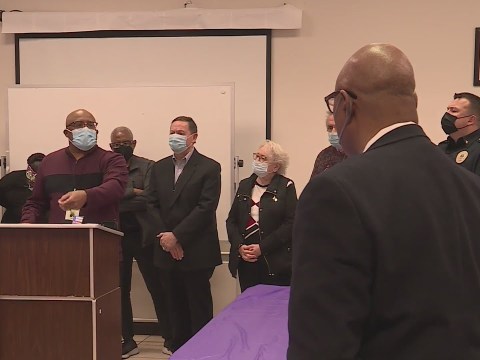
Kinston, home to one of the state’s largest Black communities, was one of the areas targeted by North Carolina lawmakers in a Trump-backed redistricting effort aimed at picking up another seat for Republicans in Congress.
ssharpe@newsobserver.com
KINSTON
Voters showing up to the polls on Election Day in Kinston had much more than maps on their mind.
They were worried about growth in the small city and the dueling visions for progress proposed in a mayoral race decided by razor-thin margins. They fretted over the condition of local veterans, many of whom are struggling with homelessness. And they spoke of consequential lapses in federal funding for food benefits.
But although it may not have been on the ballot Nov. 4, Kinston — home to a Black community that is one of the state’s largest as a share of population — was one of the areas targeted by North Carolina lawmakers in a Trump-backed redistricting effort aimed at picking up another seat for Republicans in Congress.
“It came quick and fast and a lot of people didn’t know,” Stefon Robinson, a Kinston voter, said. “Now that it has happened … a lot of people are learning the truth, and they’re turning against Trump. So you never know what might happen.”
Last month, Republican state lawmakers removed the city of roughly 20,000 from the 1st Congressional District, an area that previously included all of northeastern North Carolina and the state’s historic “Black Belt.”

That district, one of the most racially diverse in the state, has elected Black members of Congress for over 30 years — including current Democratic Rep. Don Davis. Now, however, the influence of Black voters has been significantly undercut, with lawmakers redrawing the district to include white-majority counties along the coast and cutting out some Black-majority areas like Kinston.
All of Lenoir County, where Kinston is located, has been moved to the 3rd district, alongside Greene, Wilson and Wayne — all of which have sizable Black populations.

Republican Rep. Greg Murphy currently represents the 3rd district and has vowed to continue running there, despite significant changes to its composition. Davis has not confirmed which district he will run in, but has frequently voiced his opposition to the new map.
“It is not only one of the darkest moments in our state’s history, but the way it was done — offering limited public participation by those affected and ignoring the voices of those who did participate — is morally wrong on all fronts,” he said on social media.
Voters in Kinston spoke highly of Davis, including Hilda Deriese Graham, a longtime resident who said she first met the congressman years ago when she was working at the local radio station.

“He does a great job,” she said, noting that she’d spoken on the phone with Davis about the issues facing her city. “I told him ‘I’m a veteran, we need things in Kinston just like the people in Goldsboro and Greenville.’ He answered the call, he’s a great man, I enjoy him.”
Antonio Pearl Hardy, the city’s mayor pro tem, echoed the praise for Davis.
“I don’t think it’s fair,” he said of the state’s latest redistricting effort. “But you know, all’s fair in love and war — and politics.”
Hardy, speaking to The News & Observer outside a polling place, said he hoped Davis would still run for reelection — even if it meant doing so in a new district that didn’t include Kinston.
“We’re hoping that even though the redistricting happened, that people get out and vote and still support him — and hopefully he can keep his seat,” he said.
While some voters on Election Day spoke forcefully against the new map, with one man saying the country was “just about to turn into a dictatorship,” many others weren’t aware of the state’s latest round of redistricting.
“Kinston is a small town,” Robinson said. “A lot of people don’t even know about the redistricting — they don’t know it even affects them.”
Even in a state notorious for its frequent map redraws, last month’s process was unusually rapid and opaque.
Lawmakers released the map proposal on a Thursday. By the following Wednesday, it was law.
Unlike in previous years, the state held no town halls in the affected districts and did no outreach to voters.
Instead, they heard roughly two hours total of public comment during committee hearings in Raleigh, where each speaker was limited to one minute.
They also set up an online portal for public comments, which received over 12,000 responses — the majority of which opposed the map.
Also unusual about this year’s redistricting process was the blunt candor from lawmakers about their intentions.
“The motivation behind this redraw is simple and singular: draw a new map that will bring an additional Republican seat to the North Carolina congressional delegation,” Sen. Ralph Hise, a Mitchell County Republican, said in a committee hearing last month.
Republican legislators also admitted that they were redrawing the map at the direction of President Donald Trump, who has called on red states to enact more favorable maps for the GOP ahead of the midterms. Democrats are now doing the same for their own party in some blue states.
Because the state and U.S. Supreme Court have essentially legalized partisan gerrymandering in recent years, lawmakers are now able to brazenly draw districts in their own party’s favor.
Don Hardy, Kinston’s mayor, said hours before his narrow defeat in the election that his city deserved a better process.
“I think that we need to take a look at how we draw maps in the future and provide input and have an in-depth conversation as to how we want to move forward,” he said. “… How do we make it fair for all?”

Kyle Ingram
The News & Observer
Kyle Ingram is a politics reporter for the News & Observer. He reports on the legislature, voting rights and more in North Carolina politics. He is a graduate of the Hussman School of Journalism and Media at UNC-Chapel Hill.