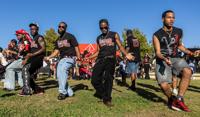
Members of Kappa Alpha Psi Fraternity stroll during the Homecoming Tailgate on Nov. 15 at The Green at College Park. Multiple fraternities and sororities set up tents during the event.
With matching black jeans, sweaters and crisp white collars, the brothers of Alpha Phi Alpha storm the stage.
The heavy pulse of hip-hop rattles through Texas Hall, pulling the crowd into the moment as heels hit the floor in perfect unison, each stomp echoing across the room.
A quick clap. A sliding pivot. The sequence builds; it’s not just a routine, but a ritual.
“It’s a way of us continuing the legacy of people that want it better,” said Romeo Joseph, Phi Beta Sigma member and cinematic arts senior. “The biggest thing about being in the Divine Nine was that we do a lot for our community, and strolling is just us showcasing how far we’ve come.”
Eight of the Divine Nine fraternities and sororities stepped into the Homecoming spirit Friday night at the annual National Pan-Hellenic Council Homecoming Step Show, built around the theme “Ease on Down the Culture: Embracing Fashion, Music and Historical Movements.”
Hand clapping and foot stomping have been present in African American folk dances since the 19th century, according to Britannica. The practice known today as stepping grew from song and dance rituals developed within Black fraternities and sororities.
It’s a tradition rooted in resistance, unity and pride long before the lights of Texas Hall shone Friday night.
For many students, the history isn’t distant. Trinity McCullen, Sigma Gamma Rho member and public health senior, said her sorority was founded at a predominantly white institution during a time when the Ku Klux Klan was active.

“They made that happen while that was going on,” McCullen said. “So it’s just the history that comes behind it.”
For others, the connection is artistic.
Brycen Gibson, university studies junior and Kappa Alpha Psi member, said stepping is deeply rooted in hip-hop and dance — elements that have long shaped the Black community.
“Everybody expresses their emotions through dance,” Gibson said. “This is an art form in which people can choose their own style, be original.”
Their routine played on the contrast between old school and new school, mixing song selections from the generations before with current trends.
Other organizations shaped their sets around specific movements in Black history.
Alpha Kappa Alpha highlighted the legacy of Negro Leagues Baseball, performing to “Back to the South” by Zillionaire Doe. Exercise science senior Liberty Hayes, Alpha Kappa Alpha step captain, said this choice was to center Black woman athletes whose contributions often go overlooked.
“We wanted to represent the women that also made history in sports,” Hayes said.
Student Activities coordinator Chrysta Porter said the show represented something larger than performance.
“Being able to have a space where we can celebrate ourselves and then having other people come and celebrate us too,” Porter said. “It’s just to showcase who we are and where we come from and the things that make us us.”
Alpha Phi Alpha wove its fraternity’s legacy into its choreography. Interior design sophomore Jakinda Opondo said that with the fraternity being here today, it felt like showing off the legacy was really doing something.
“I’m really doing something for a reason, and I gotta do this, not only just for me, but for those who are inspired after me,” Opondo said.
The Divine Nine excelled at exciting the audience, but only one fraternity and sorority were crowned winners by the judges.
Kappa Alpha Psi and Alpha Kappa Alpha won first place. Construction management sophomore Hannah Edwards performed in the step show and said she prepared a lot mentally and reassured herself, even in stressful times.
“We’ve been practicing since August,” Edwards said. “People don’t really realize how stressful it is putting together a show, but it’s a lot of hard work that goes into it, a lot of time that you have to put into it.”
The significance of stepping extends far deeper than applause and trophies.
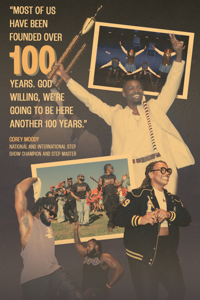
Dallas resident Corey Moody, a national and international step show champion and step master, 42, said stepping not only builds community within individual organizations but also fosters unity across the Divine Nine.
“We all have the same principles and morals, for the most part, and goals,” Moody said. “We had to come together as a community then, and we still do it now.”
“Most of us have been founded over 100 years. God willing, we’re going to be here another 100 years.”
News editor James Ward contributed to this story.
@tay._.sansom @court.franklin
news-editor.shorthorn@uta.edu