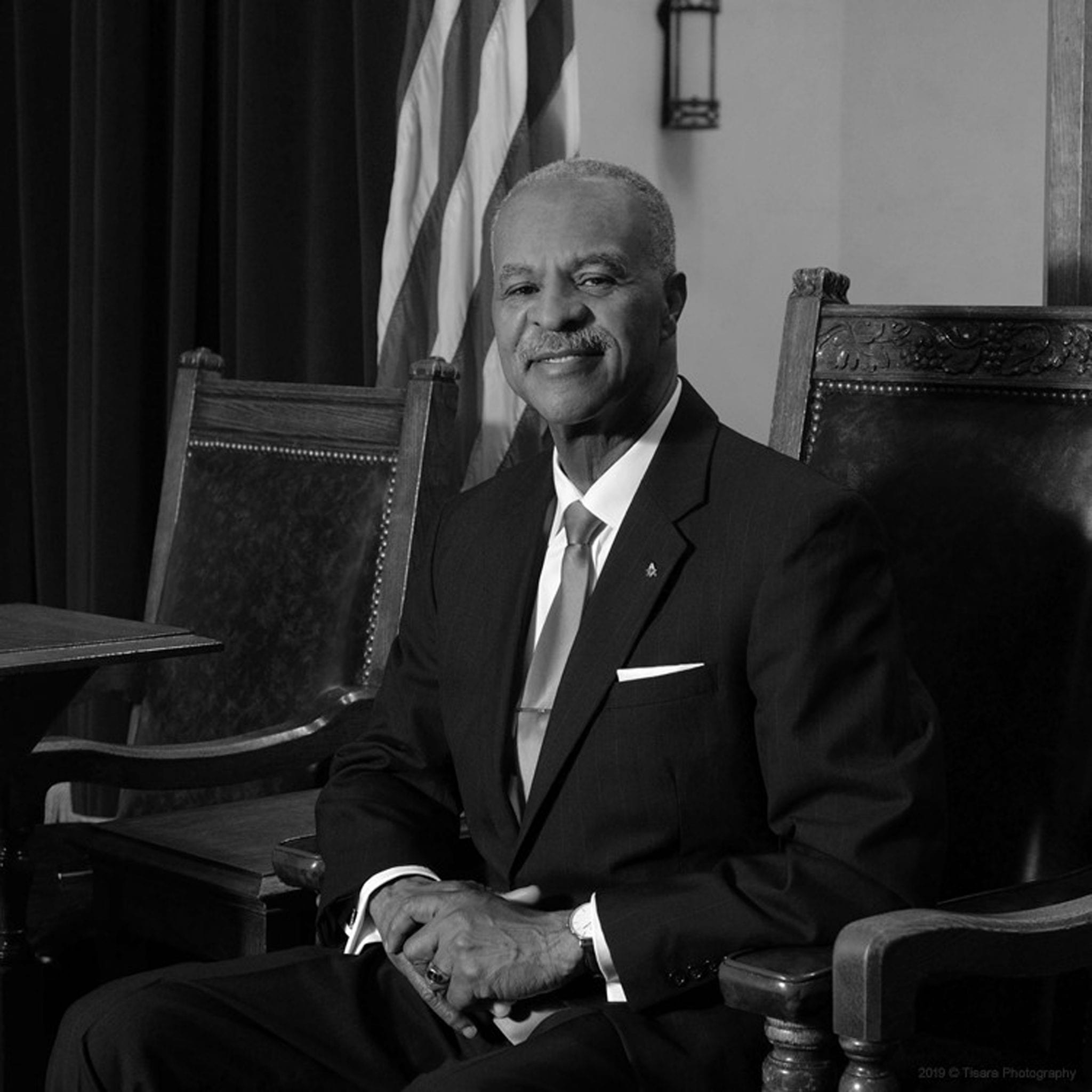
ALEXANDRIA, VA — Alexandria has lost one of its most passionate historians, advocates, and community stewards. McArthur Myers, whose life’s work helped ensure that the stories of African Americans in Alexandria would never be forgotten, passed away this morning. He was 73.
A Living Legend of Alexandria and a steadfast force for social justice, community memory, and historical preservation, Myers dedicated his life to uplifting the city he loved. Guided by the belief that “the time is always right to do what is right,” he lived those words every day through service, mentorship, and an unwavering commitment to telling the whole story of Alexandria.
A Childhood Shaped by Courage and Firsts
Born in South Carolina, Myers came to Alexandria at 6 months old in 1952 and was raised during segregation. Myers experienced firsthand the challenges faced by Black children integrating previously all-white institutions. He and his sister, Lucille, were among the first African American students to attend Prince Street Elementary School. He later helped integrate both the Alexandria Boys Club and its Boy Scout Troop.
A graduate of T.C. Williams High School, Myers studied Administration of Justice at American University before embarking on a more than 40-year career with the District of Columbia Department of Mental Health.
Inspired by Strong Women and a Lifelong Call to Serve
Myers often credited two women for instilling in him a drive for justice and service: his mother, Carrie Myers, a Civil Rights–era “Block Captain,” and former Alexandria City Manager Vola Lawson, whom he called his second mother.
“She helped me to become the man I am,” he said of Lawson. Through her, he learned to navigate human rights struggles, community organizing, and the responsibility to speak up for others. His personal motto — “You got to step up and step in” — reflected both his approach to life and his invitation for others to join him in the work.

A Leader in Prince Hall Freemasonry
“I always wanted to be a Mason,” Myers told Jeanne Theismann in a video interview in 2020, “When I was growing up there were Masons all around. You knew ’em by their car, because they had the emblem.” In 2012, Myers joined Universal Lodge #1, the oldest Prince Hall Lodge in Virginia, where he quickly emerged as a dedicated historian and advocate. His petition to the Virginia Department of Historic Resources resulted in a state historical marker honoring the lodge in 2018.
He served as the 174th Worshipful Master and later became Grand Historian of the Prince Hall Grand Lodge of Virginia. In 2016, he became the first African American member of the George Washington Masonic National Memorial Association — a milestone he regarded as deeply meaningful. “My sister and I used to walk down to the Masonic Temple to look into it because it was such a huge place, ” he told Theismann, “What kid didn’t want to know what that was about?” Two years later, he organized the first Prince Hall meeting ever held at the Memorial.

Champion of Alexandria’s African American Story
Myers was a driving force behind the placement of nine historical markers acknowledging significant African American sites throughout the city, including a granite bench dedicated to Martin Luther King, Jr at the Masonic Memorial in 2023, Roberts Memorial UMC, Beulah Baptist Church, Third Baptist Church, and Universal Lodge #1.
He was integral in bringing the Freedom House Museum into the Alexandria Museum System and played a major role in developing the African American Heritage Trail, now mapped along the Waterfront through historic communities such as Fishtown, The Berg, Canal, and The Hump.
“Walking through Alexandria, you hear all the stories–you hear George Washington, the Revolutionary War, the slavery story, John Gadsby, Gadsby’s Tavern, and then you wouldn’t hear the African American story, and I knew something wasn’t right, ” Myers said in the video interview. “And I looked around and said, the story is here, but we don’t have it visible. And that’s when I started. Tell the good, the bad, and the ugly. And you’ll find more beauty than ugly. This is our city. Tell the story.”
In 2019, the Alexandria Archaeological Commission honored him with the Ben Brenman Archeology in Alexandria Award for Outstanding Community History.
A Tireless Voice for Confronting Racial Terror in Alexandria
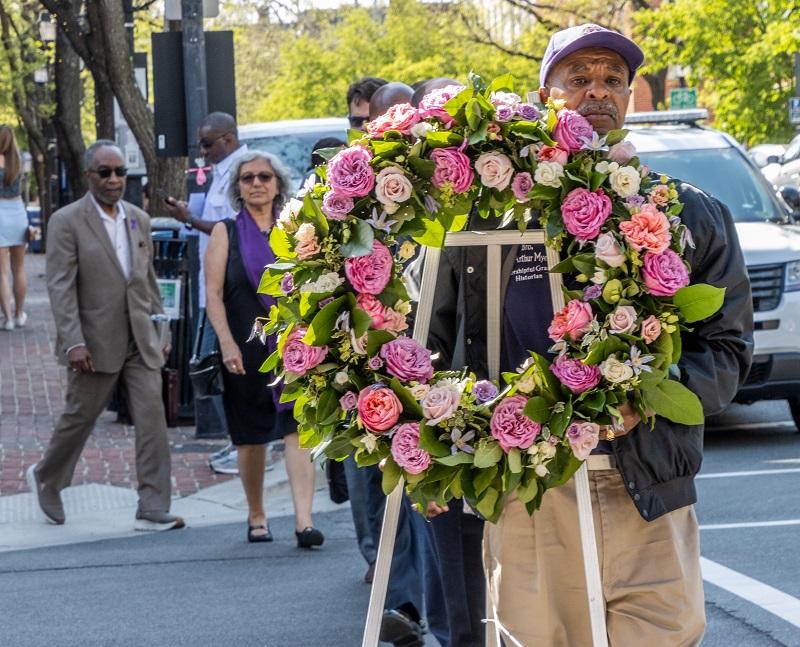
Among Myers’ most deeply held commitments was ensuring that Alexandria never forgot the tragic death of Joseph McCoy, a 19-year-old Black Alexandrian who was lynched by a mob on April 23, 1897. Myers worked closely with the Equal Justice Initiative’s Community Remembrance Project, helping lead the city’s annual memorial gatherings that honor McCoy’s life and acknowledge the injustice he suffered.
He believed that telling McCoy’s story — and the truth about Alexandria’s era of racial terror — was essential to healing, accountability, and community understanding. Myers helped educate residents about the lynching site, supported soil collection ceremonies, and spoke often about the need to face this chapter of history directly, not quietly.
Through his efforts, McCoy’s name became known to new generations, ensuring he would not be erased from the city’s narrative.
Mentor, Advocate, and Bridge-Builder
Myers devoted more than 14 years to mentoring 15 young men, offering guidance grounded in compassion, patience, and lived experience. He served with numerous organizations, including the Alexandria Society for the Preservation of Black History, the Alexandria Black History Museum Board, the Alexandria Historic Resource Commission, and the Equal Justice Initiative’s Community Remembrance Project.
His life’s work created a roadmap for honoring the past while building a better future.
Final Days and Enduring Spirit
In recent weeks, Myers experienced significant health struggles. After time in the ICU at INOVA over the weekend, he was moved to the Alexandria Rehabilitation Center, where he continued to fight with the same determination that defined his life.
Friends say he remained hopeful and forward-looking until the end. “I am in the business of living,” he often said — a mantra he lived by even through brutal medical battles.
It is too soon for details on memorial services, though those who worked closely with him, including longtime collaborator Audrey Davis, will share information as it becomes available. [Editor’s Note: Zebra will update the story when details are provided.]
A Legacy Rooted in Love of Alexandria
Even as his health declined, Myers remained committed to the work he still hoped to accomplish. “Alexandria offers an opportunity to be the best and to enhance the quality of life for all, young and old,” he said.
He urged others to “stand on the shoulders of others,” always recognizing those who came before. His guiding belief — “One city, many stories” — now stands as his legacy, a reminder that Alexandria’s history is richer because he lived here.
Post Views: 1,070