In a letter dated Feb. 12, 1973, Millie Russell wrote to Seattle Councilmember Sam Smith about the multiyear effort to rename the Henry L. Yesler Memorial Library located in the heart of the Central District.
The historically Black neighborhood needed “culturally meaningful names, generated by, and of importance to our predominantly Black library service area,” she wrote. As the founder of the Black Friends of the Yesler Library and leader of Alpha Kappa Alpha Sorority, Delta Upsilon Omega Chapter in Seattle, Russell penned the letter on behalf of the community and enumerated the reasons for the name change.
“Henry Yesler means very little to us,” she bluntly pointed out in the first bullet point. She went on to highlight the historical importance of reading in the Black community and other recent name changes of the era to reflect the Central District’s Black roots. “We have so many unsung heroes…profiles in courage,” Russell wrote. “We hope the Seattle City Council will approve our efforts. If they do not, then they, not we, are out of step and tune.”
Following a community vote, on Dec. 5, 1975, the Seattle Public Library location on Yesler Avenue was officially renamed the Douglass-Truth Branch Library in honor of Frederick Douglass and Sojourner Truth, two influential formerly enslaved Black abolitionists.
On Dec. 13 from noon to 5 p.m., the Douglass-Truth Branch will celebrate the 50th anniversary of the location’s name change, reaffirming its commitment to serve the Central District. The library invites the public to tour the location, watch a performance by the Garfield Jazz Quartet and explore its African American Collection, one of the largest collections of its kind on the West Coast.
“The celebration of the name change just brings it all back around for folks that are new in this community,” said Stephanie Johnson-Toliver, president of the Black Heritage Society of Washington State, which is co-sponsoring the event. “It’s a big deal because there’s a huge footprint here in the CD of Black legacy, history and heritage. So many people living in these little pocket neighborhoods and within the boundary of the Central District don’t know.”
Brian Den Hartog-Lindsey, curator of the library’s African American Collection, called the 50th anniversary event a “reset,” and a means of reintroducing the library’s extensive historical resources to the public. “What we’re trying to accomplish here is getting more people to actually use the collection because a lot of folks don’t know we have it.”
In 1914, the Henry L. Yesler Memorial Library opened on Yesler Way, named after one of Seattle’s richest white businessmen of the early 19th century. In the decades after its opening, the Central District’s Black population grew significantly due to discriminatory housing policies preventing Black families from living elsewhere in the city. By the 1960s, the neighborhood was over 70% Black and, right around that time, the Yesler branch had poor circulation and was at risk of closure.
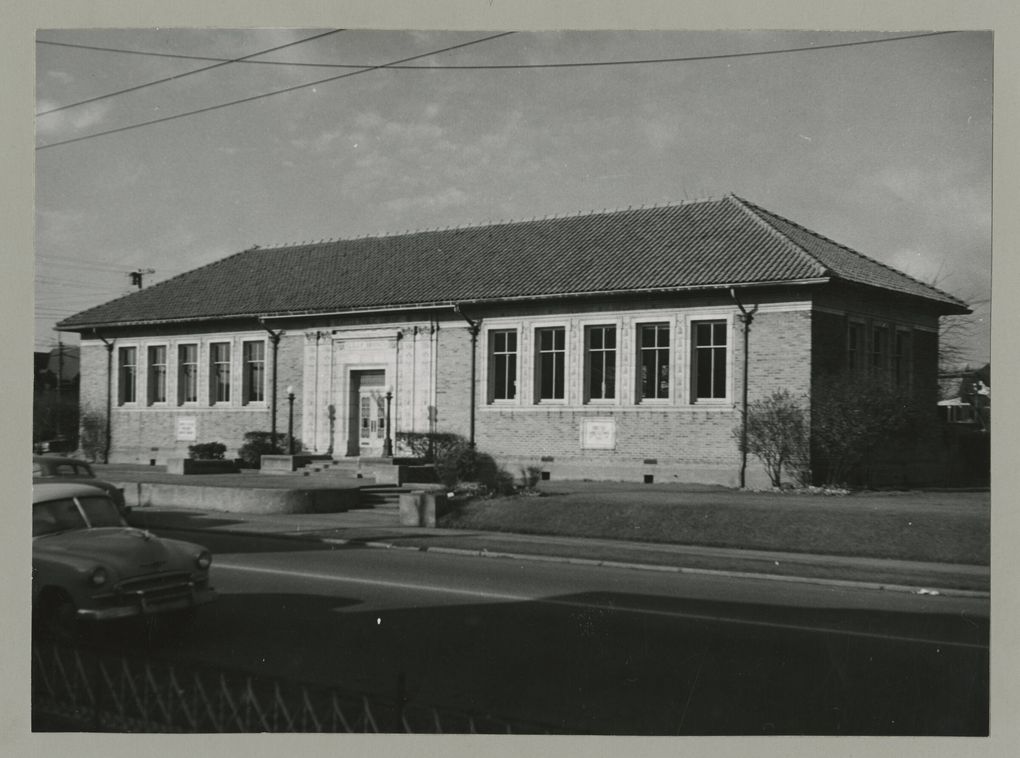
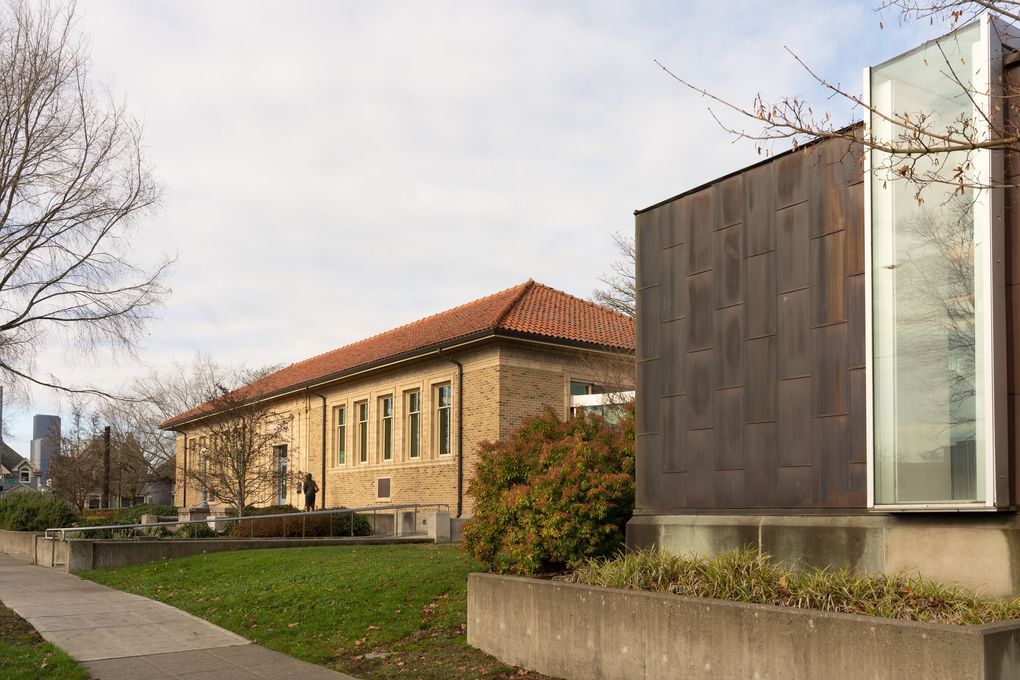
Exterior of the Douglass-Truth Branch in 1955, when it was still the Henry L. Yesler Memorial Library, left, and the library in 2025, right.
Exterior of the Douglass-Truth Branch in 1955, when it was still the Henry L. Yesler Memorial Library, left, and…
Seeing the need to keep a crucial meeting space and resource for the neighborhood’s Black residents, Russell, her fellow AKA-DUO chapter sorors Roberta Byrd Barr, Shirley Wilcox and Ruth Marie Brown, as well as librarians James Welsh and Audrey Wright, organized to keep the library on Yesler. In 1965, AKA-DUO raised funds for the location and donated a number of Black literature titles to the library in an effort to make their catalog better reflect community interests. That donation became the Negro Life and History Collection and is now known as the library’s 10,000-item African American Collection featuring works of local and national importance.
Organizing around that cause gave community leaders the momentum to push for the name of the library to also better reflect the Central District’s population. After years of talking with the public, in 1974, Black Friends of the Yesler Library and AKA-DUO sorors finally distributed a ballot — sage green, resembling a bookmark — with the names of 10 prominent Black American leaders for the community to vote on.
Listed in alphabetical order, the choices were: writer James Baldwin, naturalist and mathematician Benjamin Banneker, poet Gwendolyn Brooks, historian and activist W.E.B. DuBois, playwright Lorraine Hansberry, activist James Weldon Johnson, abolitionist Frederick Douglass, writer Richard Wright, and abolitionists Sojourner Truth and Harriet Tubman. The contest became a dead heat between Douglass and Truth, resulting in a tie. Rather than choose only one, organizers hyphenated their last names to form the Douglass-Truth library.
In a Nov. 30, 1975, letter announcing the winning name to Seattle Mayor Wesley Uhlman, Russell — now representing the newly reborn Friends of Douglass-Truth Branch Library — said the change “would instill a deep oneness and response in our library.” Five days later, on Dec. 5, 1975, Mayor Uhlman issued a proclamation cementing the library’s name change, codifying a several-year campaign into history.
Over the last half-century, the Douglass-Truth library has been a continuous witness to change. On Oct. 15, 2006, the library reopened following a 17-month closure and $6.8 million upgrade and expansion, adding 8,400 square feet of space. The demographics of the neighborhood have greatly shifted due to rapid gentrification of the area. As of 2021, the Central District’s Black population now sits at less than 18%. However, the legacy of Black activism behind the Douglass-Truth name change continues to inspire today.
“For me, as an immigrant and as a minority in this country, (Douglass-Truth) is huge because I wouldn’t be here without the work that these two wonderful activists have paved for me to walk on,” said Douglass-Truth branch manager Sang Le, of the library’s namesakes and upcoming anniversary. “It’s truly an honor.”
AKA-DUO has continued to support the branch through fundraising efforts for the African American Collection and hosting their annual teas at the location. “This anniversary is recognition of a shared legacy of representation, preservation, civic power and community dignity,” said Saunjah Brantley, president of AKA-DUO. “The change signified solidifying representation for the heart of the community that beats in the walls of this library and through every book of the collection.”
Greeting patrons as they walk through the building’s glass doors are Eddie Ray Walker’s 1975 pointillistic portraits of the library’s namesakes. Originally hung in the library before the expansion, Walker rendered Douglass and Truth with dots of purple, mustard yellow, acid green and sky blue. He overlapped their traditional portraits with depictions of both Douglass and Truth seemingly dancing, lost in some reverie. Walker’s two paintings uniquely capture both the spirit of the era that led to the library’s name change and the seriousness of the task.
“It was such a pivotal moment for empowering the community. It’s like you can still feel the resonant pride of the hard work that went into it,” said Sean Lanksbury, managing librarian for special collections at The Seattle Public Library. “We’re celebrating the renaming, but what this really is is the culmination of … an effort to keep this location alive and vibrant for the community that actually lived here.”
Correction: A previous version of this story misidentified Yesler Way, calling it Yesler Avenue.