.jpg?w=675&resize=675,360&ssl=1 "Overtown museum will spark rebirth of Miami’s Black community")
.jpg "Overtown")
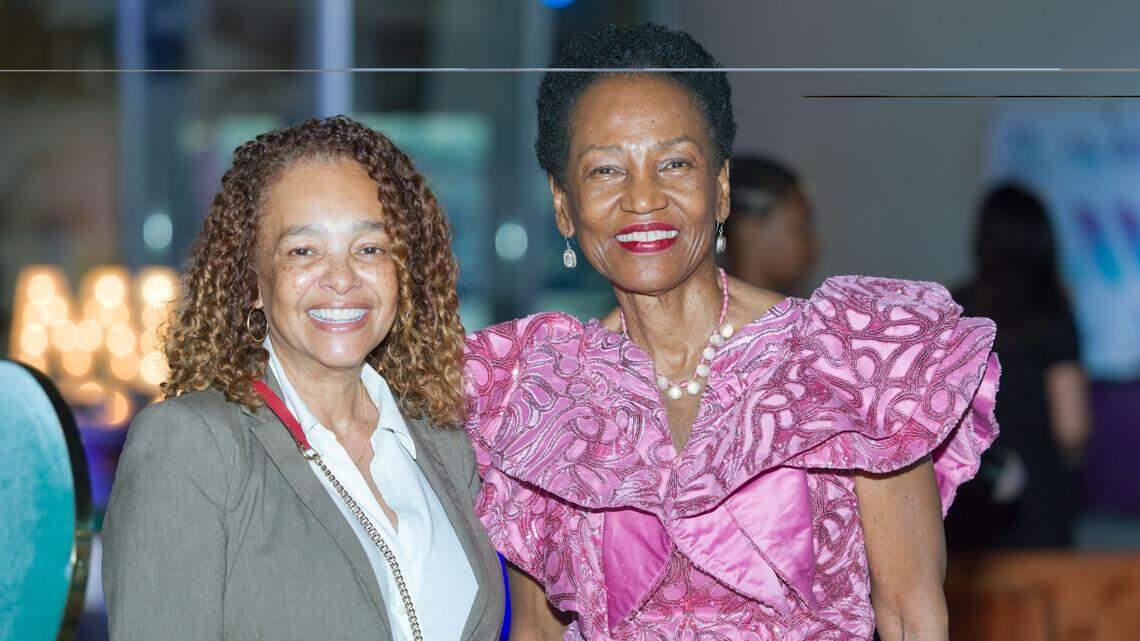
Miami City Commission Chairwoman Christine King, left, and Marilyn Holifield, co-founder of the Miami Museum of Contemporary Art of the African Diaspora, celebrate the 10th anniversary of the museum and plans for the museum to open in Overtown, Dec. 2, 2025, Historic Lyric Theater in Miami.
The winter holiday season brings to my mind cherished childhood memories living in Miami’s Overtown. At Christmastime, we strolled up and down Northwest Second and Third avenues where businesses were aglow with lights. Members of the Longshoremen Local #1416 and police officers from the Colored Precinct posed as Santa Claus at the stores. They listened to our requests for presents and handed out candy canes. It was a feeling of joy, excitement and anticipation.
Later, for nearly 60 years, the lights were out and the gaiety muted in this once-vibrant community. This was the time when Overtown’s eastern boundary, Northwest Seventh Avenue, did not welcome us. Booker T. Washington Jr./Sr. High was built with its back turned so we could not see Seventh Avenue. The construction of I-95 divided the community, forcing residents to relocate and businesses to close. Decades later, a women’s jail was built directly across the street from the school.
This is the neighborhood, then called “Good Bread Alley,” where internationally acclaimed artist Purvis Young lived. He attended Booker T. Washington Jr./Sr. High School the same time I did.
Over time, community groups and individuals fought and refused to give up. We worked with the City of Miami, the Southeast Overtown/Park West Community Redevelopment Agency, an arm of Miami city government, Miami-Dade County and others to revive the community we once knew and continue to love.
The restoration and reopening of the historic Lyric Theater, 819 NW Second Ave., and other historic sites, along with Art Basel, helped spark Overtown’s rebirth. When Art Basel Miami Beach started in 2002, it was artists Gene Tinnie and Marvin Weeks who attended the meetings. They understood the significance of Art Basel and insisted that Black artists be included. Miami’s first Black Art Basel exhibit was held at the Lyric Theater.
In 2010, architect Neil Hall created the Art Africa Miami Art Fair in Overtown, adding “soul” to Art Basel. Four years later, the Greater Miami Convention & Visitors Bureau organized The Art of Black Miami (AOBM) to celebrate local Black artists.
The evolution of Art Basel’s soul blossomed with the 2025 season and the announcement of a $25 million project, approved by the Miami City Commission last year, to convert the former women’s jail across from Booker T. Washington into a museum showcasing Overtown’s rich history and the African diaspora across the globe. The project will be the next phase of the Miami Museum of Contemporary Art of the African Diaspora (MoCAAD), a virtual museum that celebrated its 10th anniversary in December at a gala at the Lyric Theater.
.jpg "Soul Basel 25 MoCAAD_AJ465 (1).jpg")
How the Overtown museum came about
Some years ago, Marilyn Holifield, co-founder of the museum and a partner in Holland & Knight, approached me about creating a museum featuring Overtown’s history, combined with art and technology. I welcomed her into Overtown.
“From ashes of despair, the Miami MoCAAD museum of the future will bring creativity, innovation and hope, “ Holifield said about the planned museum.
Holifield has not done this by herself. Art enthusiasts Hans Ottinot, a prominent Broward attorney, and Nelson Adams, a Miami obstetrician associated with Jackson Memorial, are central to the museum’s dream team. Holifield is a Tallahassee native whose heritage is rooted in Mississippi, Barbados and Suriname. Ottinot was born in Port-au-Prince and grew up in Liberty City. Adams is a Miami native.
In collaboration with the Overtown CRA, they began with three interactive murals that honor Overtown’s rich history and culture. The murals are featured on the museum’s website and in Overtown.
The museum team searched throughout Overtown for permanent exhibition space. Their effort to find a home in Overtown seemed futile until Miami-Dade County Commissioner Keon Hardemon, who grew up in Liberty City, conceived a brilliant idea. He had seen how I-95 divided our community, homes, places of worship and businesses.
Hardemon, working with Miami City Commission Chairwoman Christine King and CRA Executive Director James McQueen, imagined a future that put Overtown at the center of art and innovation. There was one lone abandoned municipal building — the women’s jail — the one across the street from Booker T. Washington Senior High and in the vicinity of three elementary schools: Frederick Douglass, Paul Lawrence Dunbar and Phillis Wheatley.
What the museum dream team did not see was the pain in our hearts about this jail. Decades earlier, when the jail was being proposed, our community fought against it. Individuals as well as the Overtown Advisory Board and the Booker T. Washington Alumni Association opposed the jail, which nonetheless was still built.
It took determination and persistence of the museum dream team to ignite the imagination of Hardemon to see the abandoned detention center as an opportunity to plant more seeds that will grow into trees for Overtown’s future.
Hardemon rescued Miami MoCAAD’s dream with his brilliant plan to collaborate with King and McQueen to repurpose the county-owned women’s detention center into the home for Miami MoCAAD, financed with the $25 million in CRA bond funding.
There will be tremendous opportunities for students to create exhibits, develop programming and operate a museum. The museum, focused on the arts, history and technology, will draw tourists and scholars from around the world.
The women’s detention center that we once fought against we are now embracing to bring joy, excitement and anticipation to Overtown. A museum in our town, Overtown, is a dream I could not imagine.
It will be “the miracle on Seventh Avenue.”

Dorothy Jenkins Fields, Ph.D., is a historian and founder of The Black Archives Historic Lyric Theater. Send feedback to djf@bellsouth.net

Joan Chrissos
Miami Herald
Joan Chrissos is a longtime editor at the Herald who occasionally writes stories off the news and food, travel and features stories. She has a master’s from Northwestern University’s Medill School of Journalism.