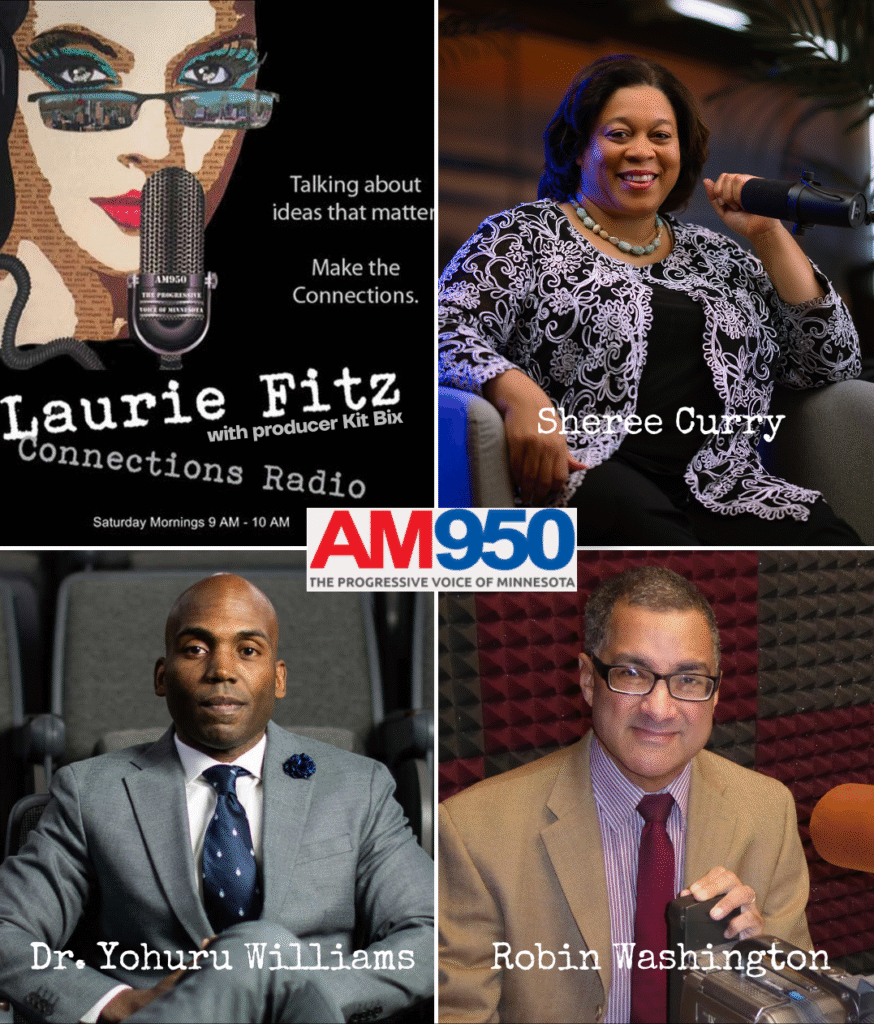
Dr. Yohuru Williams, Distinguished University Chair, professor of history and founding director of the Racial Justice Initiative at the University of St. Thomas, appeared on AM950’s Connections Radio show with host Laurie Fitz to discuss the relationship between Black and Jewish communities. Joined by Sheree Curry, co-president of the National Association of Black Journalists in Minnesota, Williams reflected on the rich and complex history explored in the PBS series “Black and Jewish America” with Henry Louis Gates Jr., highlighting both longstanding solidarity and moments of tension between the two communities.
From the conversation:
Williams: … I think we are in a moment when the Trump administration, in particular, is giving people permission to do that. That permissiveness matters. So we have devolved in a lot of ways.
I was just speaking to someone about this the other day. This year marks the 100th anniversary of Black History Month. If we go back to 1976, when the U.S. was celebrating its bicentennial, you have President Gerald Ford telling the American people to lean in and study Black history. It is a powerful pronouncement.
In a moment when the nation was suffering from a crisis of confidence after Vietnam, he was saying, one of the things we can celebrate is how far we have come with regard to race relations.
Now here we are on the eve of the nation’s 250th anniversary, and in many ways we have moved backward. The litmus test is not only how Black Americans are treated. It is also the divisive impulse we see toward immigrants, and the antisemitism that has accompanied anti-immigration sentiment throughout American history.
Curry: And we have these areas where people look at President Barack Obama and say, well, we have not really gone back. Look at how much we have achieved. But there are still people who see anti-Black sentiment and hostility toward so many other groups, immigrants and others. So yes, that is interesting.
Williams: I love that you said that, Sheree, because … one of the things that exposed a deep, hidden white supremacist foundation, and exposed the structure, was the election of Barack Obama. That moment led to the rise of the Tea Party, the transformation of the Republican Party as we knew it, and the emergence of MAGA, which is deeply racist and deeply antisemitic.
Fitz: Well, when we look at how both Black Americans and Jews share the distinction of being primary targets of white nationalist ideology, how is the hate playing out differently today? What do you see?
Williams: It is a great question because our communities are often pitted against each other, and we see that in our contemporary moment.
Rather than leaning into our shared history and the sensitivities that should come from two groups whose histories include pogroms, lynchings, and race riots, we are often led to believe we have less in common.
What worries me is the way Israel is conflated with antisemitism in the United States. People react to what they perceive as a pro-Israel stance without nuance, without recognizing that Jewish communities are not monolithic. Not all Jews are Zionists, and Gaza has been deeply divisive, including within Jewish communities.
Many Jewish people have spoken out against what they see as a settler colonial impulse, similar to the displacement of Indigenous people in this country.
At the same time, there is latent antisemitism that people want to talk about. Sometimes it is not only among Black Americans, but also among immigrants who arrive with prior experiences involving both Black Americans and Jews that shape perceptions.
And within the Black community itself, there is a fractured history. I was impressed that Skip explored the notion that some Black Americans perceive Jews as the haves. That can create the impression that Jewish support has been charitable rather than rooted in shared experiences of oppression.
But we have to talk about the history of Jewish people, and particularly Jewish history in the United States, as a history steeped in oppression as well.