Black storytelling took center stage this weekend as Fulton County marked the 19th Annual Black History Film Festival — a two-day celebration of culture, community, and cinema.
Hosted by District 5 Commissioner Marvin S. Arrington Jr., the festival opened Friday with a reception and scholarship awards, then continued Saturday with hours of film programming at the Fulton County South Service Center on Stonewall Tell Road.
The Saturday lineup featured a wide range of films, including “The Spirit We Move With,” “Justice and Reconciliation,” “Strut the Yard: The Documentary,” “The Great Organizer: Ella Baker,” and “Prophet: The Story of Nat Turner.”
In addition to screenings in South Fulton, libraries across the county hosted showings of films such as “If Beale Street Could Talk,” “Selma,” “Crooklyn,” “Hidden Figures,” and “The Gabby Douglas Story,” expanding the festival’s footprint countywide.
“We need to preserve our stories”
For Dr. Kristy Arnold, a fourth-generation Atlantan attending the festival for the first time, the event felt both necessary and deeply personal.
“I think it is very necessary,” Arnold told CBS News Atlanta. “We need to preserve our stories and therefore tell our stories.”
Arnold said that too often Black history and film are interpreted through an outside lens.
“Oftentimes, a narrative about anything related to Black history or Black filmography in general is told through the lens of someone that’s not the direct cultural recipient of or the storyteller of,” she said. “When it comes from us, it has much more heart, much more accuracy in the story, because it’s coming from direct descendants.”
A Decatur native and Lakeside High School alum, Arnold said storytelling has long been part of Atlanta’s cultural fabric — even before formal festivals like this one.
“Unofficially, there were always different stories being told,” she said. “We, as the children and grandchildren, were sitting at their feet and learning from them. Now it’s really exciting to see various filmmakers actually put it on screen — take it out of the living room, take it out of Big Mama’s table — and bring it to life.”
CBS News Atlanta 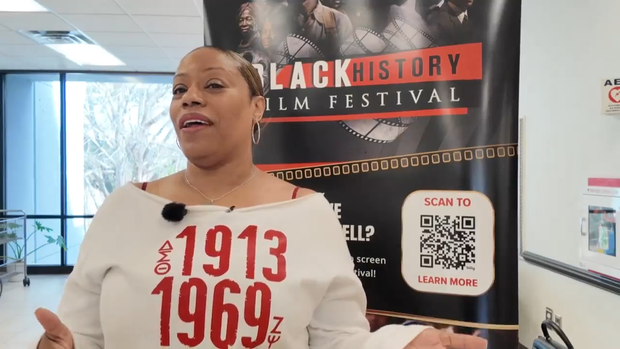
Scholarships and a full-circle moment
Commissioner Arrington founded the Black History Film Festival in 2008 at the Woodruff Arts Center. Now in its 19th year, he says the mission remains the same: create space for Black filmmakers and invest in the next generation.
“We’re just happy to be a vessel for these stories that are being told,” Arrington said. “These filmmakers have great stories — all that deserve to be told, but not only deserve to be told, but to be seen.”
This year, the county awarded six scholarships — three for essay winners and three for short film winners from Fulton County high schools.
Arrington called the event a “full circle moment,” noting that David Manuel, now Fulton County’s Arts Director, was involved in the festival’s early days and remains connected to its growth.
CBS News Atlanta 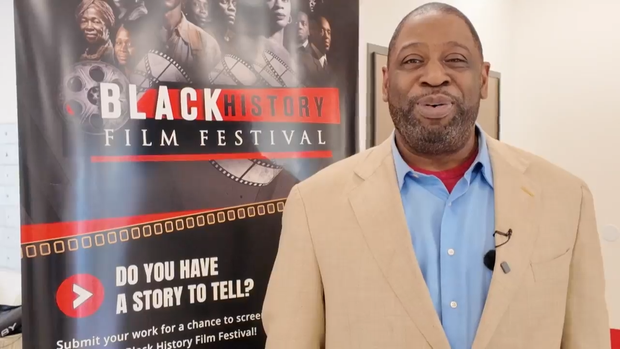
The arts as an economic driver
Beyond cultural impact, Arrington says the festival also carries economic weight.
“I believe that the arts are an economic driver,” he said.
Citing Georgia’s booming film industry, Arrington noted that approximately $6 billion was spent on film projects in the state in 2024.
“Fulton County is the largest and most populous county,” he said. “We need to make sure that we’re getting our fair share of that money.”
He also founded Fulton Films, an initiative aimed at promoting and attracting film productions to the county.
While some critics question public funding for arts initiatives, Arrington framed the investment as both cultural and practical.
“The arts help provide a certain quality of life that makes Atlanta and Fulton County more attractive for people to move here, to do business here,” he said. “So it is absolutely — the arts are absolutely an economic driver.”
A signature event in Fulton County
Over nearly two decades, the Black History Film Festival has grown into what organizers call a signature annual event — spotlighting independent filmmakers, honoring historical figures and bringing residents together through the power of cinema.
For Arnold, that collective experience matters just as much as the films themselves.
“I’m here because why not support the storytellers and the filmmakers who are actually telling our stories — therefore my story,” she said.
With Black History Month behind us, organizers say the festival stands as a reminder that preserving history isn’t just about looking back — it’s about creating platforms for the next generation to tell their own stories forward.