

At the Robert Churchwell Museum Magnet Elementary School, four of the late Robert Churchwell’s children, Robert Churchwell Jr., André Churchwell, Marisa Churchwell Smith and Keith Churchwell, stood in front of a marker honoring their father’s enduring legacy in Nashville.
“It’s a grand day,” Churchwell Smith said during the event Friday. “I know my dad is smiling down on us, and my mother as well.”
Across the city, 290 historic markers recognize the trailblazers of Music City, honoring musicians, artists, teachers, writers and more, and now, one is dedicated to the legacy of Robert Churchwell, the first Black journalist to work as a full-time reporter for a Southern newspaper — the original Nashville Banner. That’s how he earned his title as “The Jackie Robinson of Journalism.”
“There was no physical monument for him until now,” André Churchwell said. “But progeny with his name and humor, who seek to preserve the memory of his grace, who recite his intensely unique personal journey. His legacy is that mercy, love and service must be taught, shared and perpetuated. For him, this was the meaning and purpose of a complete life.”.
Churchwell grew up in Nashville. He graduated from Pearl High School, served in the U.S. Army during World War II and went to Fisk University for his undergraduate degree. After graduating from Fisk in 1949, he wrote as a columnist for the African American weekly publication The Commentator.
In 1950, the Nashville Banner hired Churchwell as a reporter. The publisher at the time, James Stahlman, was overtly racist and took a public stand against integration in Nashville.
“He didn’t care for African Americans much at all,” Robert Churchwell Jr. said in the first episode of the Banner’s podcast “Banner & Company,” which chronicled the history of the old Nashville Banner.
Back then, the paper reflected Stahlman’s racism. Editors pushed problematic, one-dimensional stories about Black Nashvillians, solely portraying them as criminals. But Churchwell changed that. His stories highlighted the prosperity and resilience of Nashville’s Black communities, celebrating their successes.
Every morning, Churchwell walked around Black Nashville, meeting residents and finding his stories in the field. He covered everything — from high school graduations to babies being born.
For five years, Churchwell reported without a desk. He also wasn’t able to attend staff meetings and only visited the office to turn in his story for that evening’s issue. He couldn’t attend staff parties and made significantly less money than his white coworkers.
“He believed that what he was doing was worthwhile, something that would take upon greater than he ever thought,” Churchwell Jr. told “Banner & Company.”
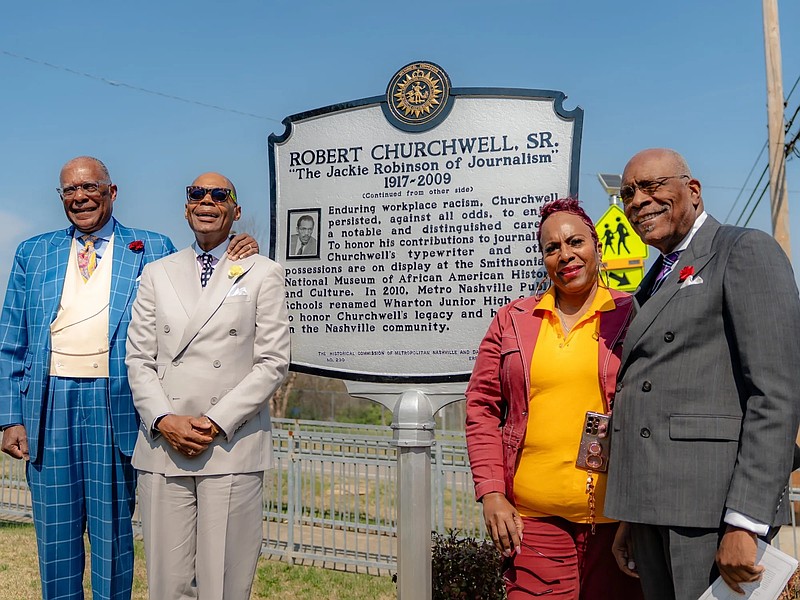
“It takes faith to go up against opposition,” he continued. “He took care of what he needed to take care of.”
Churchwell persisted in his revolutionary work, receiving accolades far and wide for his journalism, including the Society for Professional Journalists’ Helen Thomas Award for Lifetime Achievement, which he received posthumously. Some of his possessions, including his typewriter, are on display at the Smithsonian’s National Museum of African American History and Culture.
Throughout his life, and supported by his wife, Mary Elizabeth Buckingham Churchwell, he forged a path of leadership, character and perseverance for his children and many others to follow.
“He was one who, every single day, put his head down and got out of the house and worked for his family, worked for his community,” Keith Churchwell told the Banner. “He worked for himself, and that in itself was one of the great reasons I think he has such a great and wonderful legacy.”
This article first appeared on Nashville Banner and is republished here under a Creative Commons Attribution-NoDerivatives 4.0 International License.


