/https://tf-cmsv2-smithsonianmag-media.s3.amazonaws.com/filer_public/8c/04/8c0478a5-02e7-46e0-beb8-0fa04e7244e9/tougaloo-nine.png?w=675&resize=675,360&ssl=1 "Nine Black College Students Were Arrested in 1961 for Reading at a Segregated Public Library. Their Contributions to the Civil Rights Movement Have Long Been Overlooked")
Known as the Tougaloo Nine, the demonstrators staged a sit-in that helped the NAACP push for the desegregation of public spaces in Mississippi’s capital
:focal(750x500:751x501)/https://tf-cmsv2-smithsonianmag-media.s3.amazonaws.com/filer_public/8c/04/8c0478a5-02e7-46e0-beb8-0fa04e7244e9/tougaloo-nine.png)
The Tougaloo Nine, from left to right: Joseph Jackson Jr., Geraldine Edwards, James Bradford, Evelyn Pierce, Albert Lassiter, Ethel Sawyer, Meredith Anding Jr., Janice Jackson and Alfred Cook
Courtesy of Tougaloo College Archives
When nine Black college students walked into a segregated public library in Mississippi on March 27, 1961, they knew what to expect next: Staff would call the police, and they would probably be arrested if they refused to leave. According to local laws, being Black in a space designated only for the white public constituted a breach of peace. By stepping through the doors of the Jackson Municipal Library, they would be risking physical harm and verbal abuse. They might even face an angry crowd.
But the students, from the historically Black Tougaloo College, had trained for this moment. This was a sit-in, a nonviolent direct-action protest, and they were prepared. They’d been guided by the likes of Medgar Evers, the NAACP’s first Mississippi field officer, who was known for his public investigation into the murder of Emmett Till and his fight against Jim Crow laws in the state; Ernst Borinski, a Jewish lawyer who’d fled Nazi Germany, then accepted a position teaching sociology at Tougaloo after World War II; and Tougaloo chaplain John Mangram.
The civic-minded students wanted to effect change in Mississippi. Entering that library would boldly oppose the state’s unyielding system of segregation and highlight the disparities they experienced as Black residents.
James Bradford, better known as Sammy, reads a book as police discuss how to proceed at the Jackson Municipal Library. NAACP Photo Collection, Library of Congress / Courtesy of the University Press of Mississippi/https://tf-cmsv2-smithsonianmag-media.s3.amazonaws.com/filer_public/09/6b/096bd2df-c207-46bb-a10d-12690ab16641/21_-_sam_bradford_reding_copy.jpg)
The Tougaloo Nine’s demonstration would etch their names in Mississippi history: Meredith Anding Jr., James Bradford (better known as Sammy), Alfred Cook, Geraldine Edwards, Janice Jackson, Joseph Jackson Jr., Albert Lassiter, Evelyn Pierce and Ethel Sawyer. Nationally, though, their story is “often overlooked” in the broader civil rights narrative, says historian Daphne Chamberlain, chief program officer at the Emmett Till Interpretive Center in Mississippi and a Tougaloo College alumna.
At the library, most of the students found the books they were looking for and sat down to read. As expected, a librarian called the police. Despite the presence of law enforcement, the Tougaloo Nine didn’t move. Eventually, the officers told them they were under arrest.
“Why can’t I go in and read a book? It comes back to that, the simplicity of it all,” says Tony Bounds, an archivist and institutional historian at Tougaloo College. The response to this question at the time was, “Well, you have a Black library across town,” he adds. But the Tougaloo Nine had done their homework. They’d specifically requested texts that weren’t available at the Black library.
The exterior of Tougaloo’s Woodworth Chapel, where most of the Tougaloo Nine first met Medgar Evers M.J. O’Brien / Courtesy of the University Press of Mississippi/https://tf-cmsv2-smithsonianmag-media.s3.amazonaws.com/filer_public/1c/5a/1c5af5b2-2594-4809-9631-1089b0d78c7a/3_-_woodworthchapel_copy.jpg)
Following their arrest, the students were held in jail for more than 30 hours. Behind bars that night, Jackson Jr. reflected “on Emmett Till, the history of lynching connected with Mississippi,” as he told OC Weekly in 2015. “The later it got that night, I was in fear of my life.”
Black community members, particularly students at Jackson State College (now Jackson State University), a nearby historically Black public school, rallied around the Tougaloo Nine and began protesting in support of them. Although authorities had arrested the Tougaloo students without resorting to violence, the Jackson State students’ demonstrations sparked a brutal crackdown. As the young people marched, police officers armed with billy clubs, tear gas and dogs forcefully dispersed their gathering.
When the Tougaloo Nine appeared in court on March 29, police beat a crowd of Black onlookers, including Evers, who had gathered outside the courthouse. They also attacked the group with dogs.
Scenes from Mississippi History: The Tougaloo Nine
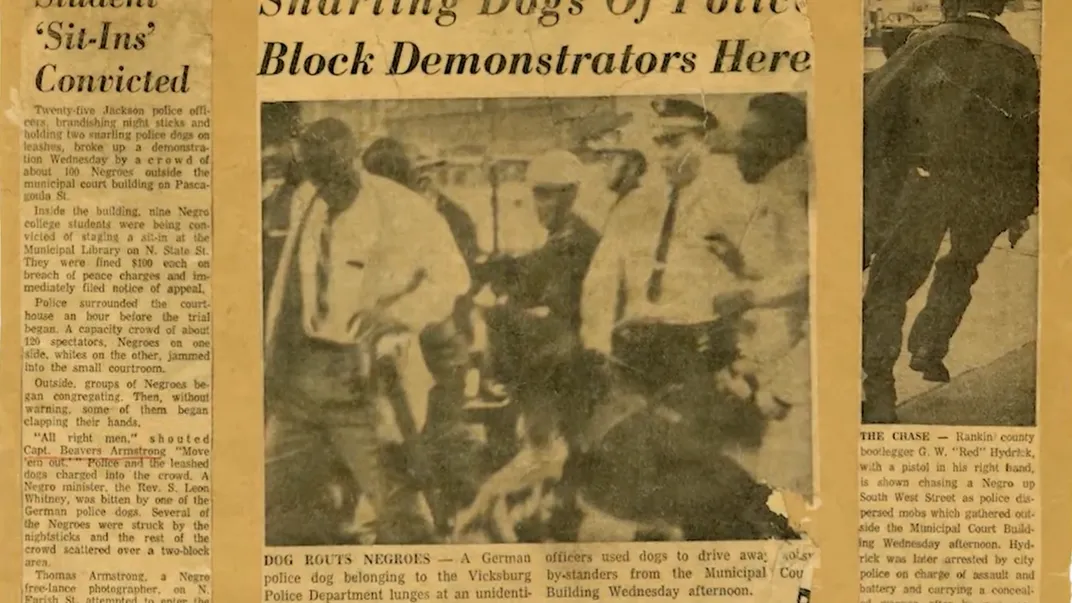
Law enforcement officers had recruited canines for policing long before 1961, but their use in Jackson represented what the author and researcher M.J. O’Brien, in his book The Tougaloo Nine: The Jackson Library Sit-In at the Crossroads of Civil War and Civil Rights, describes as “the first attacks by police dogs on nonviolent crowds during the civil rights era, two years before the more sensational attacks in Birmingham grabbed national headlines.”
The students pleaded not guilty to the breach of peace charge, but a judge found them guilty anyway. As first-time offenders, they were each fined $100 and sentenced to 30 days in jail, although the court ruled that this time would be suspended if they pledged to avoid participating in other protests. They all agreed.
In a letter to NAACP leader Roy Wilkins, Evers wrote, “These young people exhibited the greatest amount of courage in the face of mounting tension and were reported in our local newspapers as being ‘orderly, intelligent and cooperative.’”
Need to know: The legacy of Medgar Evers
- The civil rights leader was born in Decatur, Mississippi, in 1925. After serving in the Army during World War II, he returned home and ramped up his activism.
- Evers advocated for desegregation, organized protests and promoted voter registration drives. He also investigated the lynchings of Black people, most notably the 1955 murder of Emmett Till, a 14-year-old from Chicago who was visiting family in Mississippi.
The Black community’s embrace helped keep the students afloat in the aftermath of their sit-in. While they were in jail, this assistance “was demonstrated most tangibly in the cookies, cakes, hot food and snacks that individual families, mostly Black women, brought to the jail to help support this newly forming resistance movement,” O’Brien writes.
The college’s leadership also supported the Tougaloo Nine. “After they’re released from jail, they go back to class,” Bounds says. “They’re not expelled.” All eventually went on to earn bachelor’s degrees, most from Tougaloo but some from other institutions. Their sit-in and the protests that followed had reverberated in Jackson. College students were helping the NAACP lead the fight against segregation and anti-Black discrimination in Mississippi’s capital.
“It’s a game-changing moment, certainly within Mississippi, which at one point in time had the highest lynching rate in the 20th century,” Bounds says.
For the students, simply reading in the Jackson library “was an act of defiance,” Bounds says. “It was an open act. Jackson had never seen anything like it.”
Civil rights activist and NAACP field secretary Medgar Evers poses for a portrait around 1960 in Jackson, Mississippi. Michael Ochs Archive / Getty Images/https://tf-cmsv2-smithsonianmag-media.s3.amazonaws.com/filer_public/7e/b1/7eb17557-0b27-42f0-a7b1-6642df110e3d/gettyimages-84040031.jpg)
The Tougaloo Nine have only recently had their collective story told in detail, most notably in O’Brien’s book, which was released in the fall of 2025.
“It’s a project that is long overdue, but he had been working on it for several years,” says Chamberlain, who was one of the book’s early reviewers. Through interviews and deep research, O’Brien wove together the events of March 27, 1961, and beyond. He was able to talk to all but one of the nine students, as Pierce died before O’Brien started working on the book.
The author places the Tougaloo Nine’s actions in the context of state and local history. “Such a direct assault on segregation had never been tried before in Mississippi’s capital city,” O’Brien writes. He provides insights on the day of the sit-in, down to the weather.
Ernst Borinski (right) teaching at Tougaloo College in 1960, with Ethel Sawyer (third from right) in his class Tougaloo College Eaglet / Courtesy of the University Press of Mississippi/https://tf-cmsv2-smithsonianmag-media.s3.amazonaws.com/filer_public/74/cc/74ccf0f4-90ab-42a0-8ffa-aa6a806aa05b/ff8fef50-7d0c-420a-a1f7-a7d295a3c7ed-1.jpg)
That morning was cold with rain on the way.
“Lassiter remembered specifically deciding to wear a trench coat to keep off the chill and the rain, yes, but also ‘to provide an extra layer of protection’ against whatever beatings might come,” O’Brien writes. According to O’Brien, Edwards later recalled, “I was very concerned that I dress well and that I dressed warm. That I was comfortable. That I was well protected.”
As the students approached the building, the significance of their protest dawned on them. Janice Jackson remembered walking into the municipal library as a “surreal” experience. “It was like I was there doing what I was supposed to do, but I felt like I was lifted out of my body or something,” she added, per O’Brien’s book.
The Tougaloo Nine were determined, though, and they continued in their mission.
Evers had helped the students plan the read-in. He was “an energetic man who was committed to bringing about integration in public facilities,” Jackson Jr. told OC Weekly. The protest was executed exactly as planned: The Tougaloo Nine aimed to get arrested only for breach of peace. As soon as they were placed under arrest, they got up and followed officers’ instructions to avoid charges of resisting detainment.
Images of the Tougaloo Nine are prominently displayed at the Mississippi Civil Rights Museum, which opened in Jackson in December 2017. M.J. O’Brien / Courtesy of the University Press of Mississippi/https://tf-cmsv2-smithsonianmag-media.s3.amazonaws.com/filer_public/86/b8/86b87950-3d1c-4ac2-9fc2-d09906e3f46a/43_-_t-9atcrmuseumdisplay_copy.jpg)
The students’ time at Tougaloo primed them all to become leaders in their own ways. After graduating, four of the nine went on to become educators. Lassiter served three decades in the Air Force. Anding pursued careers in both the military and education, enlisting in the Air Force before teaching at universities.
A tenth student who was part of the demonstration but has long been excluded from the story is Jerry Keahey. A graduating senior at the time, he was the photographer behind a frequently distributed group picture of the nine ahead of their read-in. “That’s a really important role because he was able to document by way of camera what was going on at the time,” Chamberlain says. Keahey also helped the students travel to the library that day. Driving in two separate cars, Mangram and Keahey dropped the students off near their destination.
Tougaloo is a small private school with a big history. Known as “the oasis,” it was founded in 1869 by the American Missionary Association, a Christian abolitionist organization. For the past 15 years, its enrollment has hovered around 600 to 900 students; that number would have been even smaller in the 1960s.
The college is located “off the beaten path,” Bounds says, yet it has welcomed such distinguished visitors as Langston Hughes, Martin Luther King Jr. and Stokely Carmichael.
The entrance gate of Tougaloo College as it appeared in 1961 Tougaloo College Eaglet, 1961 / Courtesy of the University Press of Mississippi/https://tf-cmsv2-smithsonianmag-media.s3.amazonaws.com/filer_public/01/f7/01f7dbb1-7b04-4199-bf32-2ee002eda6f1/2_-_tougaloo_college_gates_copy.jpg)
“You cannot detach Mississippi’s civil rights movement from Tougaloo,” Bounds notes. “Those are two synonymous terms.”
The school fostered an environment in which the Tougaloo Nine could grow into activists. Previous protests also laid the foundation for these students. One of the earliest library sit-ins took place in Alexandria, Virginia, in 1939, when a group of Black men visited a public facility that was open only to white community members. As the men picked up books and began reading, library staff called the police, who arrested them and escorted them out of the building.
In 1960, the year before the Tougaloo Nine’s protest, four Black men participated in one of the most well-known sit-ins of the era—at the Woolworth’s lunch counter in Greensboro, North Carolina. This protest inspired an array of similar demonstrations across the American South.
“You had sit-ins, you had read-ins, you had church-ins,” Bounds says. “On the coast, you had wade-ins, because the beaches were segregated.”
The Greensboro Four staged a sit-in at a Woolworth’s lunch counter in 1960. Public domain via Wikimedia Commons/https://tf-cmsv2-smithsonianmag-media.s3.amazonaws.com/filer_public/ad/1e/ad1eae81-a72d-462a-849f-1bf59550a598/greensboro_four.jpg)
In an email, Kevin Strait, a curator at the Smithsonian’s National Museum of African American History and Culture, says, “By targeting public spaces like lunch counters and libraries, participants directly confronted the daily practice of racial exclusion and helped spark the public awareness and pressure that made desegregation possible.” The Tougaloo Nine’s action was “a powerful statement about access—and who gets to learn, gather and belong in our shared public spaces,” he adds.
Making the public library the focus of the their demonstration put a spotlight on the uneven distribution of educational resources to segregated public schools. Often, Black students received “secondhand books that are years old,” Chamberlain says. Despite 1954’s Brown v. Board of Education decision, which deemed segregation in American public schools unconstitutional, “states like Mississippi were rolling out desegregation as slow as they possibly could,” she notes.
The books that the Tougaloo Nine picked up in the Jackson library, while obscure and selected for strategic reasons, symbolized freedom. Bradford chose Introduction to Parasitology, while Cook picked Bergey’s Manual of Systematic Bacteriology—a text that “would become central to his later profession but now was a convenient foil,” according to O’Brien.
Following the abolition of slavery in the United States in 1865, “one of the definitions of freedom became access to education,” Chamberlain says. “As an enslaved person, you could not be learned, you could not know how to read. It was to keep people powerless and of course ignorant to the world around them, and to also keep them subservient in this status that they were born into.”
It took another three years for the goals of the Tougaloo Nine’s sit-in to be enshrined in federal law. The students—and the broader civil rights movement—lost a leader along the way.
Roy Wilkins (left), executive secretary of the NAACP, and Medgar Evers (center), NAACP field secretary, are arrested while picketing outside a Woolworth’s department store in Jackson, Mississippi, in 1963.
Bettmann via Getty Images/https://tf-cmsv2-smithsonianmag-media.s3.amazonaws.com/filer_public/4e/54/4e547d1b-77d7-4193-b29a-ba0d9231b4f2/gettyimages-514682530.jpg)
In June 1963, 37-year-old Evers was murdered, shot in the back in his own driveway. Byron De La Beckwith, a known white supremacist, was convicted of the killing three decades later, in 1994. Evers had been working tirelessly right until the end: Two weeks before his death, he shepherded another Jackson sit-in that became national news. Several Tougaloo students sat at a whites-only Woolworth’s lunch counter, where they were harassed and attacked by a hostile crowd.
The struggle for desegregation continued, and in July 1964, President Lyndon B. Johnson signed the Civil Rights Act, which outlawed segregation of public facilities and race-based discrimination in the U.S.
Later, in the 1980s, some members of the Tougaloo Nine received notices that the City of Jackson had absolved them of their breach of peace violations. But they still faced difficult realities: “Some complained that the misdemeanor continued to show up on their formal criminal record for years to come,” O’Brien writes.
Surviving members of the Tougaloo Nine were honored at Trustman Park in Pearl, Mississippi, in 2022. Kaotate via Wikimedia Commons under CC BY-SA 4.0/https://tf-cmsv2-smithsonianmag-media.s3.amazonaws.com/filer_public/e1/ea/e1ea5872-22c6-4bad-b861-b73cf317823e/3840px-tougaloo_nine_throwing_out_the_first_pitch_at_trustmark_park.jpg)
Today, four of the Tougaloo Nine are still living: Jackson Jr., Edwards, Sawyer and Lassiter. Edwards wrote about her life in the 2011 book Back to Mississippi. Members also gathered periodically for anniversary celebrations of their sit-in.
In 2017, the state dedicated a historical marker outside the Jackson Municipal Library to the students and their groundbreaking action. The group’s surviving members and their families were also honored at a local baseball game in 2022.
Back in 1961, the Jackson library’s sea of books represented everything that the Tougaloo Nine were trying to achieve. Chamberlain says, “Just by being able to pick up a book and having access to that knowledge, it opened a world of opportunity for those nine young people.”


/https://tf-cmsv2-smithsonianmag-media.s3.amazonaws.com/filer_public/8c/04/8c0478a5-02e7-46e0-beb8-0fa04e7244e9/tougaloo-nine.png?w=480&resize=480,240&ssl=1 "Nine Black College Students Were Arrested in 1961 for Reading at a Segregated Public Library. Their Contributions to the Civil Rights Movement Have Long Been Overlooked")