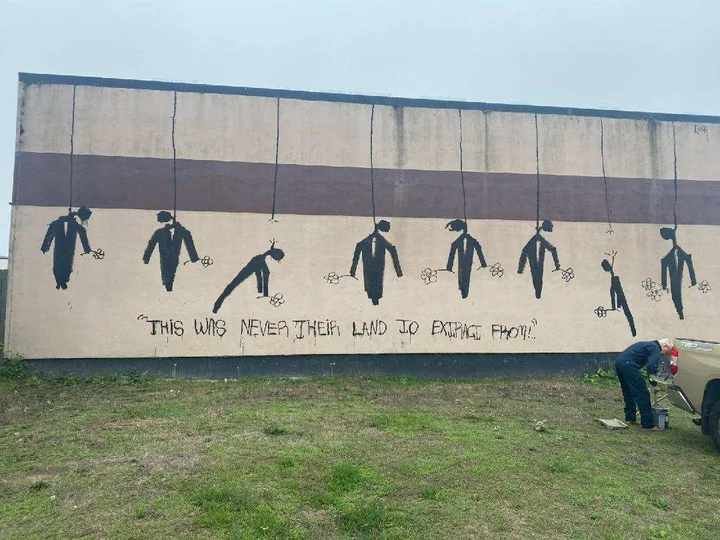
###
PREVIOUSLY:
###
Press release for Humboldt Showing Up for Racial Justice and the Ink People:
Humboldt
Showing Up for Racial Justice (SURJ), the Ink People Center for Arts
and Culture, Black community leaders, and elected officials condemn a
series of stenciled images discovered on September 18 and 19 in
Eureka and Arcata depicting a hanged person, some accompanied by the
words “Don’t be the next.” These images — discovered by Black
community members on September 19, after a week of escalating
racialized violence and speech across the nation, including the
alleged lynching of a Black student in Mississippi — evoke the
history of lynching in the United States and are widely understood as
messages meant to intimidate and instill fear in Black communities.Why
this matters
A
known symbol of racial intimidation. Noose/lynching
imagery in public spaces is historically tied to racial terror and
modern hate intimidation. Cultural and civil-rights institutions have
repeatedly documented its use as a threat (Smithsonian Magazine).
The
current climate. The
U.S. Department of Justice reports that anti-Black incidents
constitute a majority of race-based hate-crime incidents nationally
(2023), and agencies recorded 11,679 incidents in 2024 (Department of
Justice).
California
context. California’s
Attorney General reports anti-Black bias remains the most prevalent
race-based motivation in the state’s hate-crime data (California
Department of Justice).
Applicable
law. California
Penal
Code §11411 prohibits
displaying terrorizing symbols (including nooses) at homes,
workplaces, schools, or public places with the purpose — or
reckless disregard — of terrorizing others.
In
this period of growing unrest, these images have caused concern in
the local community, striking fear and grief among those whose
ancestors and families have experienced the long history of racial
violence and terrorism in this country. Nearly 5,000 lynchings
occurred in the U.S. from 1882 to 1968, though the actual number is
likely higher due to underreporting. Lynching was also a tool of
white supremacy used against Latinos and Indigenous peoples in
California. While lynchings aren’t as frequent today, lynchings and
references to lynchings continue to be tools of white supremacy and
racial terrorism inflicted on Black communities.Local
Black community members have expressed the terror and distress they
have felt since seeing these images in our communities’ business
and arts districts — including on the building of at least one
Black-owned business. One local Black community member, who wished to
remain anonymous for their own safety, shared:
“It’s
the reality — the harm was done, the fear was stoked in people.
Sometimes carelessness causes real palpable harm. And I understand
why people don’t necessarily believe what’s being said. It’s hard to
imagine anyone claiming to stand for the message that is supposedly
being intended would be so careless as to use imagery synonymous with
the murder of Black folks while we are actively being lynched all
over the country in the last week. Who in their right mind would even
do that? How much privilege do you have to carry to not understand
how that image will inevitably be interpreted?”
The
pairing of lynching imagery with “Don’t be the next” is
reasonably perceived by Black residents as a direct threat. In a
national environment where documented hate-crime levels remain high,
incidents like these heighten fear, retraumatize communities, and
chill participation in public life. As community members and leaders
here in Humboldt County — where extreme episodes of racial terror
and violence have taken place — we collectively condemn the use of
racist imagery, regardless of the intent of the message behind it.
Using an image of a hanged person at any time causes harm and
instills fear in local Black community members, and the use of it in
the current political climate is ignorant and indifferent to the very
real harms that Black people in particular continue to experience
with racist violence. These recent acts demonstrate that, at best, we
have a lot of learning and work ahead of us to fight ignorance and
racial violence.
Against
this backdrop, public displays invoking lynching — paired with the
phrase “Don’t be the next” — do not read as “mere
graffiti.” They echo historic mechanisms of racial terror, and for
many Black residents and other communities of color, they function as
threats aimed at silencing, isolating, and driving people out of
public space.This
is a moment of community action and learningThe
coalition calls for continued investment in:
- Education
& prevention on the history and present realities of
racialized violence.
Visible
solidarity. Public agencies, schools, businesses, and civic
groups should affirm that Black residents belong and are safe here —
and back those words with action.
Reporting
& support. If you see similar graffiti or have
information, report it immediately.
Take
action: We
have a collective community responsibility to one another to resist
racial ignorance and violence and take action in support of the
safety and belonging of our Black, Indigenous, and People of Color
friends, families, neighbors, and colleagues. We invite you to take
tangible action today. Some ways you can do this are:
Meet
your neighbors and look out for each other.
Learn
more about the history of lynching in this country and
state (link).
Join
and support the Eureka chapter of the NAACP (link).
Learn
more and take action on issues of racial and economic justice with
Humboldt SURJ (Showing Up for Racial Justice) (link)