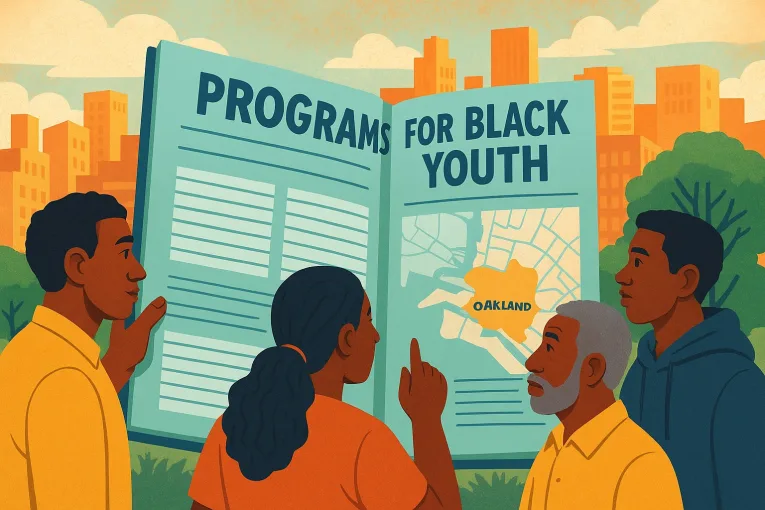
OAKLAND — A powerful new tool has emerged from Oakland’s vibrant and resilient Black community. The Brotherhood of Elders Network has officially released the first volume of the Black Youth Development Book (BYD Book), a comprehensive directory that connects families and caregivers to over 200 educational, cultural, and wellness programs specifically designed for Black youth. The directory showcases the work of more than 60 Black-led organizations in Oakland, offering everything from arts and literacy to STEM training, mentorship, health services, and paid work experience.
The BYD Book was born out of necessity. Kevin Hill, the driving force behind the project and co-chair of the Brotherhood of Elders Network’s education committee, saw firsthand the difficulty parents faced when trying to find accessible and culturally resonant opportunities for their children. As a parent himself, Hill recognized the importance of not just collecting this information, but sharing it with the broader community. “Instead of doing some research and keeping it to myself… I wanted to share with the community at large what I learned about all the opportunities that are available for our young people to self-actualize,” Hill explained.
The BYD Book originated as a digital resource in 2022, following Hill’s landscape analysis of Oakland’s youth-serving ecosystem. His research was driven by a desire to understand who was doing what, and how those efforts could be elevated and made visible to families in need. That report evolved into a publicly accessible directory, culminating in the publication of a physical book just a few months ago. The timing couldn’t be better, as narratives about Oakland often focus on crime or dysfunction, overshadowing the deep networks of care that have long sustained its communities.
“The reality is that Oakland is a strong, proud, and beautiful community where we look after each other,” Hill said. “Connecting Black youth with programs that are created for them by our community is one of the important ways that we continue weaving a strong future that centers our collective health and well-being.”
“Connecting Black youth with programs that are created for them by our community is one of the important ways that we continue weaving a strong future that centers our collective health and well-being.” – Kevin Hill
Each program featured in the book was vetted with a focus on cultural affirmation and accessibility. Many of the programs are free, while others offer stipends or paid positions. The organizations highlighted serve children and young adults from preschool age through their early 20s. There are programs that support literacy and storytelling, like Cinnamongirl, which helps young girls write, edit, and publish their work, while also offering book clubs and international travel opportunities. Other programs, like The Social Engineering Project, provide STEM and engineering education through culturally relevant instruction, summer camps in partnership with Stanford University, and mentorship in data science and math.
Oakland Voices trains youth in journalism, giving them the tools to tell the stories of their own neighborhoods. Roots Community Health offers wraparound services to youth facing homelessness, sexual exploitation, or involvement in the juvenile legal system. The West Oakland Youth Center provides academic tutoring, financial literacy training, music production, and even architecture training through a partnership with UC Berkeley.
According to Hill, many parents are only aware of a few of these programs—usually those recommended by schools or social circles. “There’s a lack of awareness,” he explained, “because organizations don’t have advertising budgets. Most focus on raising money and delivering services—not outreach. And if you were somehow hearing about 60 or 70 different orgs at once, it’d be overwhelming.”
Hill emphasized that a key goal of the book is to bridge the gap between organizations and families. “We have what we need in our community,” he said. “Maybe aside from all the funding—but in terms of people, knowledge, culture—we’ve got it.”
The Brotherhood of Elders Network itself plays a unique role in this ecosystem. The intergenerational group of Black men, with members ranging in age from their 20s to their 80s, centers African cultural traditions and mentorship. They bring together ancestral wisdom with modern leadership and mentorship models. Their cascading mentorship model allows for knowledge-sharing across generations and ensures that young people receive support rooted in cultural continuity.
One of Hill’s proudest revelations has been the community’s enthusiasm for collaboration. “Everyone was down to participate,” he said. “We’re building a community of practice—sharing resources, applying for funds together, and facilitating warm handoffs between programs so that young people feel like there’s a ‘no wrong door’ policy.”
The BYD Book is not just a directory but a call to action. Hill hopes it will serve as a catalyst for deeper collaboration, broader visibility, and more sustained investment in Black-led initiatives. The organizations range in size and scope, but they are united by a shared commitment to equity, cultural pride, and youth empowerment.
Among the lesser-known but critical programs are those like MISSSEY, which supports young women and nonbinary youth who have experienced sexual exploitation. Hill considers these unique programs to be among the most important. “Without them, there would be very few places for those youth to turn, especially for culturally affirming care.”
Other standout programs include The LGBTQ Center, a Black-led institution offering safe spaces and support services for queer and trans youth in East and West Oakland. “The most unique programs are often the most valuable,” Hill said, reflecting on the impact of having safe and welcoming spaces for all Black youth, regardless of gender identity or background.
Hill also pointed to programs like the East Oakland Youth Development Center, which collaborates with the Brotherhood of Elders Network to offer paid career exploration opportunities. These programs don’t just help young people build skills—they help them earn while they learn, reinforcing a cycle of empowerment and self-determination.
Despite the number of programs—now approaching 70 organizations and over 200 offerings—Hill says the demand is still high, and the need for visibility and access is even greater. “Every time I tell people how many there are, they’re surprised,” Hill said. “It speaks to both our resilience and the dysfunction of the nonprofit industrial complex, where so many folks operate in silos.”
Still, he is optimistic. “What I was incredibly pleasantly surprised by is how down everyone was to collaborate,” he said. “By centering our youth and our families, really what we’re doing is centering our entire community—because we’re only as strong as our next generation of leaders.”
The BYD Book is available online at bydbook.org, and copies are being distributed throughout Oakland to schools, community centers, and organizations. Hill hopes the book is just the beginning. He envisions future volumes, deeper partnerships, and increased funding to scale this work.
“We can’t keep miseducating our youth and expect the community to change,” he said. “So we’re doing something about it—together.”
Categories:
Breaking News Everyday Injustice
Tags:
Brotherhood of Elders Network BYD Book Cinnamongirl Kevin Hill Oakland Voices Roots Community Health The Social Engineering Project