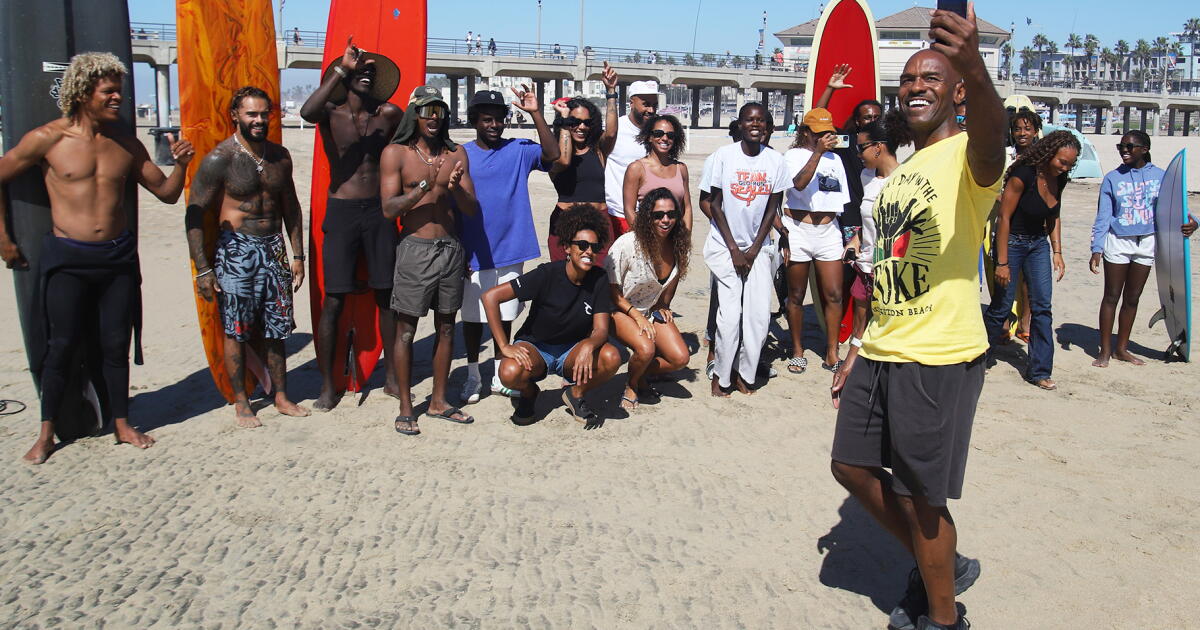
Outdoor spaces, such as national parks and recreation areas, have historically been unwelcoming to people of color in America. Many elder Black community members can still collectively recall segregation, oppression, and even violence in the outdoors, which contributed to an overall feeling of exclusion. That sentiment is reflected in the low visitation rates of Black people within national parks—less than 1 percent of annual visitors, according to one National Park Service report—and reinforced by actions that seek to erase Black history. Just this month, the Trump administration attempted to remove several plaques from the former home of George Washington, in Philadelphia, honoring those who were held in bondage by the nation’s first president.
Despite this documented history of exclusion, dozens of Black-led organizations are working to expand the idea of who belongs in the outdoors. From Our Parks Too to Black Outside, grassroots groups are closing the nature gap—the gulf between Black Americans and their access to nature—and creating space for their communities to enjoy nature. One such organization is the Georgia-based HBCUs Outside, a nonprofit that specifically focuses on fostering opportunities for students at Historically Black Colleges and Universities (HBCUs) to become leaders in outdoor recreation.
This past fall, Marcia Roseme, a program manager for HBCUs Outside, worked with the Sierra Club Georgia to put together a training workshop at the Atlanta University Center (AUC) for local students. They were training students to become guides and leaders in the Sierra Club Outings program, a network of outdoor experiences, ranging from day hikes to backpacking trips. “They learned about coordinating outings, and they received their first aid and CPR training,” said Roseme. “Towards the end of the workshop, [Sierra Club staff] expressed that they wanted to partner further … and do an outing.”
Earlier this month, that goal came to fruition atop one of Atlanta’s highest peaks—Stone Mountain. More than three dozen students from Morehouse College, Spelman College, and Clark Atlanta University climbed up the storied mountain on a chilly morning to commemorate Black History Month. As they jostled up the gray slab, the thrill of feeling the sun on their skin, the breeze at their backs, and the crunch of leaves beneath their feet was palpable. That sense of merriment and wonder felt especially powerful on Stone Mountain, which for much of Georgia’s history has been a symbol of the state’s racist past.
Stone Mountain, which sits about 20 miles east of Atlanta, isn’t technically a mountain at all; it’s the world’s largest piece of exposed granite. The above-ground portion of the rock (two-thirds of the rock is subterranean) stands more than 1,600 feet tall. On a clear day, standing on its summit provides views of Atlanta and beyond.
Stone Mountain, Georgia, Civil War carving. | Photo by Atlantagreg/iStockPhoto
The geologic superlatives are obstructed behind what most people recognize Stone Mountain for today: etched in the north side of the mountain is the largest Confederate carving in the world. It displays Confederate military leaders Robert E. Lee, Jefferson Davis, and Stonewall Jackson going into battle. Caroline Helen Plane, a member of the United Daughters of the Confederacy (UDC) and a Ku Klux Klan sympathizer, led the effort to create the nearly 200-foot-long depiction in 1915 on what was then privately-owned land.
In 1958, Georgia legislators designated the area a public park and formed the Stone Mountain Memorial Association, a governing body that enforces a mandate to obscure the Civil War’s legacy of slavery and instead cast it as a war fought over states’ rights. That mission is reflected in street names, such as Robert E. Lee Blvd, and in the representation of the Confederate flag—itself a symbol of slavery.
Fatima Aboeid, a Clark Atlanta University student, was among the students contemplating history on the day’s hike. She’s from Greensboro, North Carolina, and like many students from out of state, she wasn’t familiar with the ongoing contention surrounding Stone Mountain Park and its message. “I didn’t know that people were fighting to keep Confederate flags up,” Aboeid said in between breaths while climbing the base of Stone Mountain.
Activist groups such as Stone Mountain Action Coalition (SMAC) have pressured the state legislature and Stone Mountain’s governing body to remove the park’s Confederate-messaging. The Sierra Club’s Outdoors for All campaign has also joined these efforts to promote a sense of belonging in parks and on public lands for all recreationists. So far, they’ve seemed to gain some friends in high places.
In February 2025, democratic legislators reintroduced Georgia House Bill 243, which would allow leaders to repurpose Stone Mountain as a park focused on natural history rather than Confederate whitewashing. However, the bill has yet to be voted on, and with a few weeks left before the end of the current legislative session, its chances of becoming law are slim.
Back on our hike, as the noon sun peaked, the students continued their ascent. Dressed in sweatshirts and joggers, they mostly walked in pairs, making small talk as they navigated between towering loblolly pines. It was the first time many of them had hiked this trail. Lydia Scott, a junior at Spelman College, was familiar with the history of the peak, which made her hesitant to visit Stone Mountain, but hiking with the group of HBCU students helped her embrace a new perspective: that having fun in a place created to steal Black joy is possible.
“The fact that we’re able to really reclaim it … was really powerful,” Scott said. “We’re having fun out here, and we’re climbing to the top, and we’re having a great time.”
As she and her classmates reached the top of Stone Mountain, Sherman Neal II, the deputy director of the Sierra Club’s Military Outdoors campaign and a decorated Marine Corps veteran, shared another part of the area’s white supremacist history: on Thanksgiving night in 1915, more than a dozen Klansmen burned a cross at the top of Stone Mountain. The cross burning successfully reignited interest in the Ku Klux Klan, which began in 1865 after the Civil War to terrorize newly freed Black Americans, but was largely eradicated a decade later during the Reconstruction Era.
“That might be the history, but that doesn’t necessarily have to be the future,” said Zora Neal Walton, a Spelman College senior and vice president of the SpelTrek hiking club, as we all enjoyed the vista atop the peak. “By acknowledging the history and realizing that that doesn’t define what we’re doing today, you can still hike and have a great experience and celebrate Black History Month.”
As the large group began their descent, the hikers dispersed quickly, choosing varied paces down the switchbacks. Frontrunners loped to the bottom, fearlessly bopping between large sections of rock. The more cautious hikers took tinier steps, considering their footing to avoid a tumble, an all too common occurrence while heading down the mountain.
With guidance from HBCUs Outside and the Sierra Club, the student hikers carved their own empowering journey, even when their inclusion isn’t automatically affirmed. “Climbing to the top,” Scott said, “solidified that there is space for us everywhere.”