In 2019, this found itself on a page in a book that I wrote:
Enter the New. From South America, the Dominican Republic, Puerto Rico, Cuba. When MLB’s African American population was at its apex, the Latin and Latin-associated population in the game averaged in the 10-11% range from 1967-1983, according (again) to SABR. By 2009, that number had ballooned to 28.5%. A percentage that still remains close to the same as the 2019 season began. For the “new Negroes” that baseball has chosen to replace the original ones, there’s a “happy to be here” nucleus it seems MLB is not only taking advantage of but enforcing. Again, the Chico Escuela theory. It’s more ideology than fact, but the optics . . . damn. It looks like, and often comes off as, MLB goes out of its way to seek talent everywhere outside of America and places in America where Blacks aren’t before they seek places and spaces where Black American talent can easily be found.
In a CNNMoney.com piece written in 2007 on the “Green Behind the Decline of Blacks in Baseball,” then MLB executive vice president Jimmie Lee Solomon openly admitted, “Clubs do leverage their dollars much better if they develop a kid in a country not subject to the draft. Those decisions are purely business decisions, very pragmatic business decisions.”
The problem is, how that only seems to affect the American ballplayer of non-white, non-European, non-rural-living, non-U.S.-privileged, non-melanin-challenged, non-seat-at-the-Trump-White-House-table descent.
The title of the chapter: #baseballso-white. And (unfortunately) while it hasn’t aged poorly, it has become a non-topic even as the problem hides blatantly in front of us. Yes, I’m speaking about the World Baseball Classic. Of course, I’m talking about the U.S. team they sent as representatives.
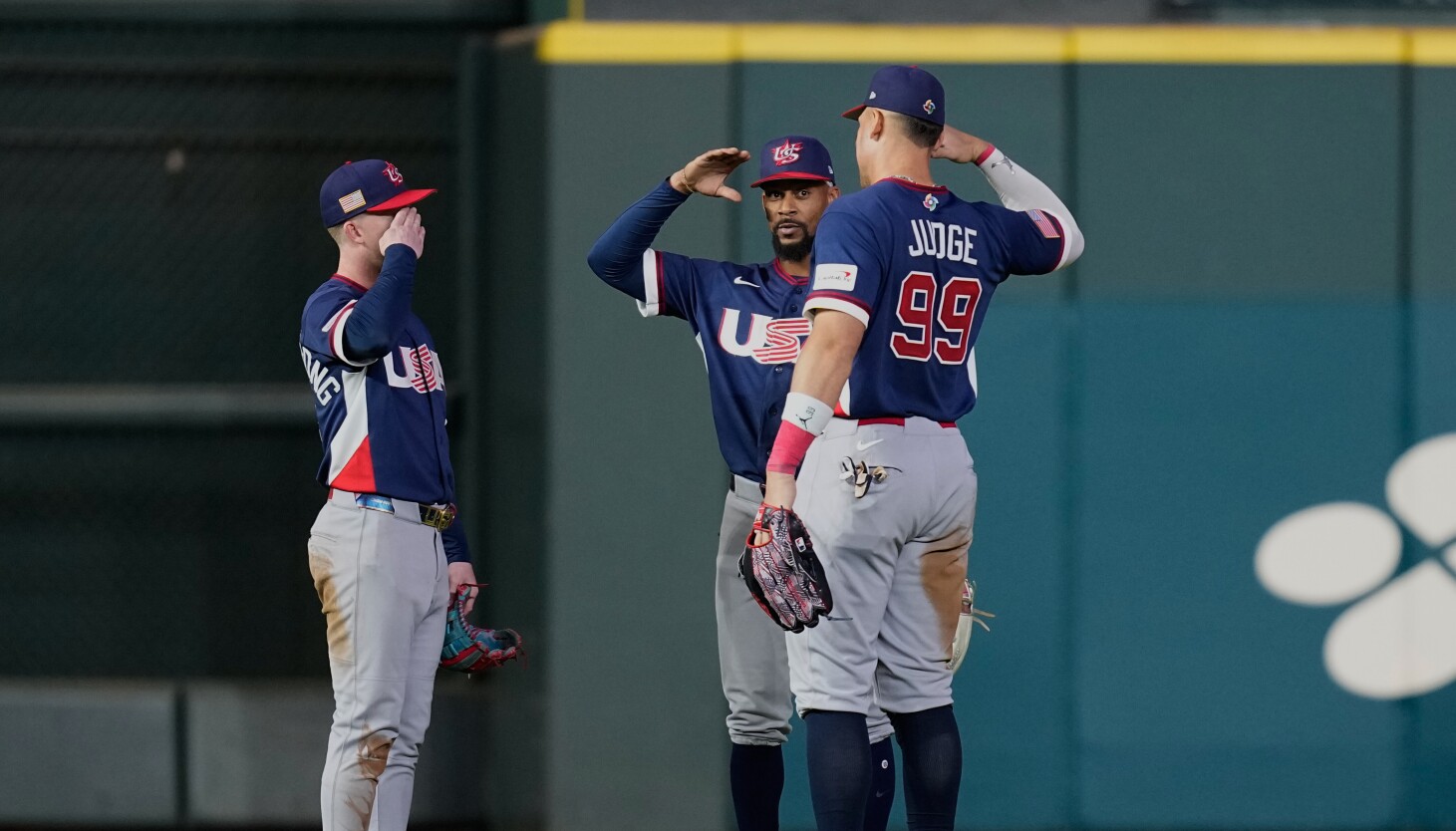
On a roster of 39 players, managers and coaches, there exists three who just happen to not be white. Two players and the first-base coach (George Lombard Sr.). No Mookie Betts (birth of child), no Hunter Greene (right elbow surgery), no James Wood (likely due to his second-half falloff last season), all legit candidates and legit reasons why they aren’t a part of America’s reflection in the WBC.
But underneath that legitimacy, the fact those are the only three Black American players outside of Aaron Judge and Byron Buxton who had inarguable room for consideration of being chosen for the U.S. squad is a story bigger than the one you’re currently reading.
Canada has more black players on its WBC roster than the U.S. team. The Netherlands, a country claiming to have an 81% Caucasian population, has more players of color on their WBC roster and coaching staff than the United States. If I could say less, I would.
(Do yourselves a favor. Go to MLB.com and pull up the World Baseball Classic 2026 rosters of Canada, the Netherlands and the United States just to verify how much I’m not tweakin’.)
It’s an international baseball championship tournament put together by the United States (via MLB and MLBPA, in conjunction with the World Baseball Softball Confederation based in Switzerland) in 2005 to put on display this place’s dominance. Baseball just happened to be the symbolism behind the mask.
Two-time Team USA skipper Mark De-Rosa (whose loss of awareness and understanding, called a “rough moment/staggering gaffe” in media circles, came close — thanks to Italy, a team that could’ve actually fielded their own dual-citizen USA roster because of the split citizenship of the team — to managing the country to its worst outcome in any WBC), Team USA general manager Michael Hill and Team USA executive director/CEO Paul Seiler put together a GOAT squad that no USA baseball team has probably ever seen.
A team that not only to them reflects the best America has to offer in the pastime this country pridefully tried to call one of its greatest contributions to sports and mankind before the whole Abner Doubleday invention of baseball got Christopher Columbus’d, but one that (just so happens by happenstance and coincidence?) is a reflection of exactly how these 48 contiguous, currently un-unified states (ratified colonies?) are supposed to look. Of the way things used to be.
The belief is that eventually this place we live in called the land of the free will show itself for what it really is. Funny is how we wait for the eventual to arrive when the always never alters.
The sonority of the ball leaving a bat has no color. Or the ball leaving the hand, the same. Still whiteness, ubiquitous. I know, that’s not the world’s problem — or white America’s problem and from their perspective — it’s ours. I’ll let Chance take the wheel from here:
Being real that’s business as usual here
Look alive you could die at a funeral here
It’s a lot of complaints but we just can’t file ’em
Open case shut case still won’t solve ’em
The judge said, “What? I don’t see no problem”
The world said, “Yup, that’s the negro problem”
The Negro Problem
The Negro Problem
The Negro Problem
’Cause it’s your problem (the Negro Problem)
Even though we are the same, we don’t feel your pain (negro problem)
’Cause it’s your problem (the Negro Problem)
Even though it’s in your face, we don’t share your pain ’cause it’s yours.