On a cool Wednesday afternoon, an intimate group huddled around a television screen to watch a rapid response training led by members of the Athens Immigrant Rights Coalition (AIRC).
Adelheid Schmidt, one of the coordinators of the Rapid Response Team (RRT), leads the group through a series of powerpoint slides outlining the different roles volunteers can take to respond to the presence of U.S. Immigration and Customs Enforcement (ICE) in Athens. Volunteers are expected to monitor reports from community members regarding ICE sightings and police activities that could potentially affect immigrants around the community.
“The primary purpose of AIRC existing for RRT is [to show] that we’re a community, we’re neighbors,” Schmidt said. “We’re here for each other, and we’re not going to let bigots bring us down.”
Schmidt joined AIRC in 2016, right after the first-term election of President Donald Trump in November. She was friends with one of the founders of the organization through other local grassroots movements such as Athens for Everyone and Occupy Athens.
AIRC was formed in 2011 in response to a crackdown by the Georgia State Legislature on undocumented immigrants, particularly in light of House Bill 87, which made life “extremely difficult” for immigrants, according to the organization’s website. HB 87 required businesses in the state to verify employees’ legal status.
Since their formation, AIRC has continued to support immigrant families against discriminatory policies by hosting rallies, workshops and festivals; providing emergency financial and emotional support to those impacted by deportations or detentions; and forming these Rapid Response teams to alert and protect families targeted by ICE.
“I think it’s really important to [say] that the immigrant community, the AIRC members, we’re all here for each other,” Schmidt said. “We’re working together to safeguard the Fifth Amendment, the Fourth, 14th [and] several amendments that are being violated.”


A protest in solidarity of immigrants and the Athens Latino community on Thursday, Feb. 6, 2025, in Athens, Georgia. Approximately 200 people were in attendance. (Photo/Lily Kate Akins; @lilykatea_photos)
Since Trump’s inauguration for his second-term presidency, AIRC has noticed an increase in reports of ICE sightings around Athens. According to Schmidt, the AIRC responded to over 80 reports last year, though she clarified that they were mostly false reports or they didn’t respond in time.
However, ICE arrests around Georgia have increased. In fact, Georgia trails behind only California, Florida and Texas in the number of people arrested by ICE between Jan. 2025 and Oct. 2025, according to data obtained from the federal government through a lawsuit by the Deportation Data Project. All three of those states have significantly larger immigrant populations than Georgia.
Additionally, plans to establish large-scale detention centers in Social Circle and Oakwood — two cities only 30-45 miles from Athens — along with police departments in North Georgia signing partnerships with ICE, have put some on edge.
“I think there’s a lot of fear right now, because we don’t know what to expect,” Lori Garrett-Hatfield, an elementary school language teacher for non-native speakers and chair of the AIRC-EDU committee, said. “People here are scared. They know where Social Circle is. They know where Oakwood is. It’s very close.”
But Garrett-Hatfield does note that Athens is “lucky” in terms of federal immigration enforcement. While acts like Georgia’s House Bill 1105, the “Georgia Criminal Alien Track and Report Act of 2024,” have required more cooperation between local law enforcement and federal immigration agencies, Garrett-Hatfield says that Athens law enforcement has made efforts to build a stronger relationship with immigrant families.
Oftentimes, immigrants don’t feel comfortable reporting crimes to the police even if they are in danger — like in cases of domestic violence or robbery — out of fear, according to Garrett-Hatfield.
“The police have done a better job trying to make inroads into the community because when I first started teaching immigrants here in Athens in 2003, the immigrants and undocumented people that I served didn’t feel comfortable going to the police,” Garrett-Hatfield said. “And I feel like now there is a better relationship between the immigrant community and the police. There’s still distrust, for obvious reasons … but I feel like they’ve tried to have a better relationship.”
Like Schmidt, Garrett-Hatfield joined AIRC in 2016 following Trump’s election to his first term, and has remained involved through the rest of Trump’s first term, Biden’s term and the beginning of Trump’s second term.
“There was a group of us that really were feeling powerless as educators. We had a feeling what was coming with his election, just because of the political rhetoric that was in place when he was elected in 2016 and so we just kind of started from there,” Garrett-Hatfield said.

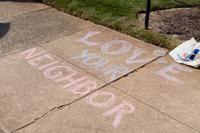
Chalk art from the gathering of Athens area faith organizations in downtown Athens, Georgia, to protest against mass deportations on Sunday, Sept. 21, 2025. The protest started across the street from the school district and ended at the downtown post office. (Photo/Lily Kate Akins; @lilykatea_photos)
AIRC-EDU, which Garrett-Hatfield chairs, is a branch of the organization dedicated to providing immigrant students and families in the Clarke County School District with resources, information and support needed to feel safe. The group does a number of different duties for immigrant communities, including informing families of their rights, providing resources and support to families affected by federal immigration agencies and providing bilingual mentorship opportunities to support students struggling with their mental health.
The organization also provides cultural support resources for teachers. Garrett-Hatfield emphasized that the support is not just for Latino students in Athens, but for a wide range of immigrant communities.
“We have several different cultures represented in Athens, not just the Latinx culture. We have students from all over the globe, Asia, Africa, other parts of Latin America that don’t include Mexico, for example,” Garrett-Hatfield said. “The teachers here may not understand what those cultural differences look like and so we also provide resources for that.”
Record numbers of unauthorized immigrants poured into the U.S. under the Biden administration, numbers that Garrett-Hatfield took note of.
“What we were seeing was children who were born here, but their parents were not,” Garrett-Hatfield said. “A lot of the kids that I see in an elementary setting, for example, they’re American citizens. They were born here. Their parents have been here for quite a while. But we started to see an increase in new arrivals under Biden.”
AIRC members did not observe a “mass arrest situation” like those in Minneapolis earlier this year or near Savannah in September 2025, but have noticed an increase in individual cases of arrests and detentions. For example, an undocumented immigrant may go into a court date or a meeting with ICE, and be arrested there.

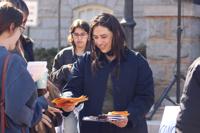
A protester hands out informational pamphlets during a demonstration opposing the death of Alex Pretti at Athens-Clarke County City Hall in Athens, Georgia, on Sunday, Feb. 8, 2026. The turmoil in Minneapolis has lead to nationwide demonstrations and walkouts against President Trump’s immigration policies and recent actions taken by ICE. (Photo/Alex Abbate)
“We did have a parent who got into a fender bender that was not her fault, but because she didn’t have documentation, she ended up getting arrested,” Garrett-Hatfield said.
Schmidt agreed with this observation.
“They’re not doing a ton of raids here,” Schmidt said. “They’re being quiet and sneaky, and they’re targeting people who are in the system for seeking asylum or here on a visa.”
But members of AIRC remain resolute. Even as increased immigration enforcement and violence in the streets have driven civil unrest across the country, communities have come together to protect their neighbors.
Athens has been no different. Several protests and a candlelight vigil have been organized by Athens-affiliated groups across the county. Affiliates of the AIRC, like Dignidad Inmigrante en Athens, U-Lead Athens and the Interfaith Sanctuary Coalition, as well as organizations outside the coalition, like the Athens Anti-Discrimination Movement and the Athens Area Democratic Socialists, have all come together to protect their communities.
Guppy Stott, a Ph.D student studying bioinformatics at the University of Georgia and one of the other co-coordinators of the Rapid Response Team, wants those facing the threat of detention and deportation to know they are not alone.
“We, as a community, care about you,” Stott said. “Be safe and seek out those resources that are there to help.”
Garrett-Hatfield echoes that sentiment, saying that the amount of people in Athens who want to help, whether through buying extra food or donating money, has been encouraging.
“It is really easy for us to lose hope, because I think that we have seen the worst in people,” Garrett-Hatfield said. “It is really heartening, for those of us who work within the immigrant community, to see all of these neighbors that I’ve been a part of for 25 years come out and support people that are new just because they don’t like what’s happening.”