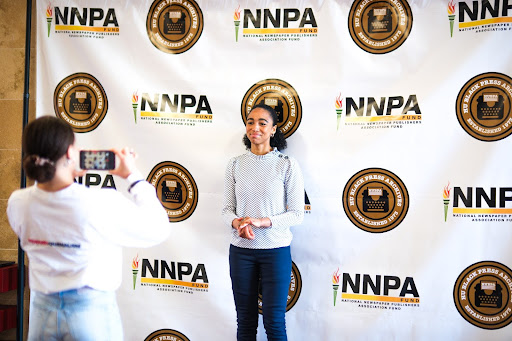
Black publishers and journalists around the country convened in the Blackburn auditorium to celebrate the 199th anniversary of the Black Press. The event held on Wednesday Mar. 18, was hosted by the Moorland-Spingarn Center, which houses the Black Press Archive, and the National News Paper Association (NNPA), honored the legacy of the Black press, the state of the Black Press and its future in the face of artificial intelligence (AI).
The conception of Black Press in the United States is marked by the first publishing of the Freedom’s Journal in New York City in Mar. 16, 1827 by John Brown Russwurm and Samuel Eli Cornish.
In address to their first patrons, the first editors wrote, “We write to plead our own cause. Too long have others spoken to us.” The Freedom’s journal, like other inaugural Black newspapers, covered issues to the Northern Black community like lynchings, anti-slavery campaigns and social events like births, weddings and memorials.
Many Black owned and operated newspapers to this day still feel their presence is essential to Black American life, asserting that mainstream news does not properly cover the issues most pertinent to local Black communities.
Benjamin Chavis Junior, the president of the NNPA, a trade association of Black newspapers around the country, delivered a speech on the state of the Black Press.
“Members of the NNPA, we’ve had a lot of struggle, but we’re today proving that our history, that we know and learn from, follows us,” said Chavis Jr. “I resolve to not let forces external to our reality divide and conquer us,” he added. According to the NNPA website, over 22 million people relied on the member newspapers for news, information and commentary in 2024.
He spotlighted William O. Walker, editor and publisher of the Cleveland Call and Post in 1965, who had the idea of establishing a Black press archives and gallery of distinguished newspaper publishers.
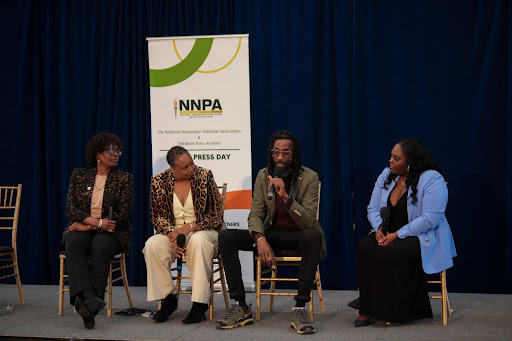
The D.C. chapter of the National Association of Black Journalists (NABJ) president and HuffPost deputy editor, Phil Lewis, led a discussion on artificial intelligence journalism and media called the AI Fireside Chat.
The panel included Alex Green Jones of AG Media Agency, Ra-Jah Kelley, the Chief Officer of Technology and Grants at the Washington Informer, Paris Brown publisher for The Baltimore Times and Dean of Cathy Hughes School of Communications, Ingrid Sturgis, PhD.
Paris Brown was candid in her use of artificial intelligence so that the community can tell and submit their own stories, but warned of overreliance on the tool.
“As I look at AI, I would not compromise the reputation of the publication by putting up misinformation,” Brown said.
Sturgis agreed with this acceptance of AI, but imposed that the reader should know how and when AI is used.
“Transparency. You have to let your reader or users know exactly how they’re using it. Tell them where it’s being used and how you intend to use it,” Sturgis said.
The role of the Black Press has not changed and in this address Sturgis emphasized what it means to be a part of the black press in a social media age with technological advancement like AI.
“We tell the truth, but there’s so much misinformation out there that they don’t know who to trust. Our job is to let them know that we’re the ones to trust,” Sturgis said.
As one of the event sponsors, the Black Press Archive unveiled its use of AI within their Black Newspaper Digitization Project, which will allow physical editions from some of the nation’s oldest Black newspapers to be available to the public online.
Alexis Woolford works as an archive librarian who manages the Black Press Associations inventory, and looks forward to the day each year.
“Seeing the legacy of these newspapers is really cool, along with the enshrinement. I love when they do that every year,” Woolford said.
Each year, the NNPA enshrines a publisher into their gallery of distinguished Black publishers, housed inside Founder’s library. This year, it was Bernal E. Smith, publisher of the Tri-State Defender in Memphis, Tennessee. As publisher, Smith returned the historic press back into local ownership.
“Burnell understood that being a publisher was a sacred trust,” said Towanda Peete-Smith, Smith’s widow, who helped to unveil his gallery plaque. “He walked in footsteps of those who came before him,” she added.
Dashon Farad, GoPro Radio reporter, broadcaster and writer described the Black Press as more than news but a necessary act of protest.
“The Black Press is essential because we don’t write about history after it takes place, we write about history as it takes place,” Farad said.

Farad explained how for the past several centuries, the black experience has often been told by non-black people.
“So it’s our responsibility as black people to tell our own stories properly,” Farad said.
Copy Edited by Kennedi Bryant