

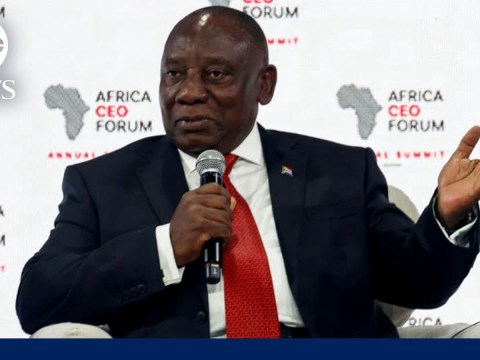
Cyril Ramaphosa says there has been no sustained pressure from the United States, dismissing claims of influence following South Africa’s removal from the G7 summit in France.
He adds that the move should not be seen as a snub, noting the country has not attended every G7 summit in the past. #eNCA



Ramaliar is very ill. He went for brain surgery but the doctors could not find any brain.
You snubbed 😂😂😂😂😂😂😂😂😂😂😂😂😂😂😂😂😂😂😂
Bro ,read the news ,your buddies Cuba next and then😮😂who knows😂😂😂😂😂😂
"Take the shame, Cyril, take the shame – you were not invited and you know exactly why!"
G7 won't invite criminals…….easy as that….
Hahahaha. WTF? KAKPRAAT…NONSTOP.
The only to get RAMAPOSA TOO LISTEN AND BRING HIM DOWN ,IS CLOSE ALL HIS MCDONALD'S ,THAT WILL WAKE HIM UP
😂😂😂😂😂😂😂😂😂😂😂😢😢😢😢😢😢😅😅😅😅😅
Blame apartheid Cyril that’s all you can do
😂😂😂😂😂😂😂😅😅😅😅😅😅😅😅😅😅😅😅😅😅😅😅😅😅poompan
Macron invited you during the G20 and he just uninvited you. You were snubbed. You can fool some not all the people. Just admit and take it like a man cupcakes.
What a weak little man
Rams l think there's a problem on the side ,why can't you step aside
He is now MGABED into the economic dustbin watch 5 years comin. 33 trillion rand GRANT PER EACH LOVA.. hahahahha..
Omg
Buy right
Pick n pay
Maybe he can go privately. Apparently i heard there is money in the couch
Boxer
Usave
Spar
KARMA😂
embarrassing
BLIND BLIND BLIND South African and worldwide islamofacist blood libel support is the proverbial elephant in the room
Here’s a summary of key statements and rhetoric by Yahya Sinwar and Ismail Haniyeh related to October 7, threats of repeat attacks, and the broader Hamas narrative — based on verified sources. (Note: direct verbatim speeches aren’t fully available publicly, so what follows are documented quotes and widely reported remarks.)
Yahya Sinwar — Hamas Leader in Gaza
Threat of Repeating or Escalating October 7-style Attacks
Sinwar publicly warned that “October 7 was just a rehearsal” for future operations — indicating that the group viewed the attack not as a one-off event but as part of ongoing confrontation.
Pre-October 7 Rhetoric
In speeches before October 7, Sinwar spoke of coming against Israel as a “roaring flood” with “endless rockets” and fighters, likening the effort to a mass surge that would overwhelm Israel — language that foreshadowed the intensity of the October 7 assault.
Operational Directives
Documents attributed to Sinwar show he instructed fighters to deliberately create and broadcast brutal images of violence to “strike terror into their hearts.” Those notes detailed violent acts such as shootings, stabbing, or burning neighborhoods to generate terror imagery.
IDEOLOGICAL FRAMING
Experts have noted that Sinwar’s rhetoric and internal messaging portrayed Palestinian casualties as “necessary sacrifices” in the struggle and emphasized continuing armed confrontation rather than seeking peace.
Ismail Haniyeh — Former Hamas Political Chief
Speech on October 7, 2023
In his address on the first day of Operation Al-Aqsa Flood (the name Hamas gave to the October 7 attacks), Haniyeh made several key points:
He framed the assault as proof of the “powerlessness of the enemy” and declared that the battle was destined to continue until objectives were met.
He said Hamas and its allies wanted to expel Israel from what they consider Palestinian land, including Jerusalem and the Al-Aqsa Mosque, telling the enemy “get out of our land, get out of our sight”.
Haniyeh called on Palestinians and the broader Muslim world to join the struggle and continue resisting.
Threats and Objectives
In that speech, Haniyeh rejected threats and pressure from Israel and the international community, saying such intimidation would not deter their goals.
His rhetoric explicitly linked the October 7 assault to a larger, ongoing resistance struggle aimed at achieving liberation, not just a single military action.
Context on October 7 Attacks
For background, on October 7 2023, Hamas, supported by allied militant groups, launched a coordinated land, sea, and air assault from Gaza into Israel, resulting in widespread killings, abductions of civilians and soldiers, and significant violence. This attack was unprecedented in scale and triggered intense military conflict between Israel and Hamas.
What These Statements Imply
Leaders like Sinwar and Haniyeh have framed October 7 as part of a broader existential struggle rather than an isolated incident.
Sinwar’s rhetoric, especially phrases like “just a rehearsal”, has been cited by analysts as a threat of continued or escalated attacks beyond October 7.
Haniyeh’s speech tied the operation to ongoing resistance, calling for continued engagement from supporters.
Under international law, genocide intent is a very high bar that must show intent to destroy a protected group, not just intent to defeat a state or an army.
Here’s how analysts connect the dots:
Arguments claiming these statements show genocidal intent
Used by Israel, the U.S., UK, EU analysts, and many legal scholars:
October 7 targeted civilians as civilians
– including mass killings, kidnappings, sexual violence, burning of entire families.
– This is seen as evidence of intent to destroy part of a group.
Sinwar’s “rehearsal” statement
– Interpreted as announcing a goal of repeating mass killings of Israeli Jews.
Haniyeh’s praise of Oct 7 as “historic”
– Treated as endorsement of civilian-targeted violence.
Article 7 of the 1988 Charter
– The hadith about killing Jews is cited as a religious mandate for genocide.
Eliminationist ideology
– The charter’s insistence on erasing Israel aligns with the destruction of an ethnic/national group.
Operational orders to create terror imagery
– Used to argue deliberate targeting and dehumanization.
Legal scholars describing Hamas’s conduct sometimes call the combination of charter + speeches + actions clear evidence of genocidal rhetoric.
https://youtube.com/watch?v=MLWOvIMI42w&lc=UgzIHG-gKDZUVrwQt-J4AaABAg&si=kniwq0p0O4epj59M
You're a pariah, Ramaphosa. Face up to it.
all the time this man speaks i hear,feel and i see wisdom
These comments are so redundant. I loathe any conversation concerning bad mouthing your own country.
Looting anc terrorists not welcome !
Kenya is attending instead of SA. Emmanuel did invite us past year. Why has the Ben 10 changed his mind all of a sudden? Did the US threaten to boycott G7 France Summit if SA was invited? So does this mean Ramaphosa is not that important but Trump is?