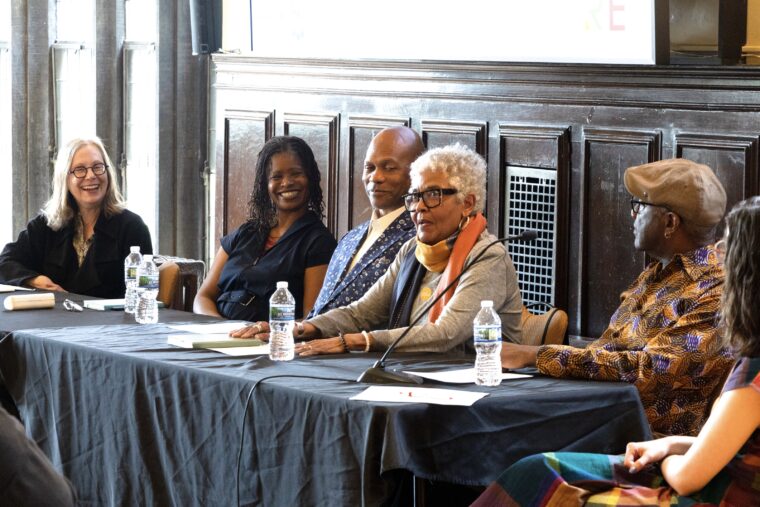
Panelists discuss the intersection of performance, power, and race (Tamiah Woodfork | Staff Photographer)
The Performing Arts Department and the Department of Anthropology’s Experiential Ethnography Studio (ESS) moderated a panel conversation about the role of performance in personal empowerment and political change, especially in the Black community, April 9.
The panel featured E. Patrick Johnson and D. Soyini Madison from Northwestern, Judith Hamera from Princeton, Renée Alexander Craft from the University of North Carolina, and Ron Himes, founder of The Black Rep, a theater company for African American performance. The panel was moderated by AJ Jones, director of the EES.
The conversation began with the panelists addressing what performance meant to them individually.
For Craft, the power of her performance education lies in how she uses it to uplift students.
“[At] this moment in our country, I’m witnessing both undergraduate and graduate students … feel as though they’re not enough, their voice isn’t enough, their artistry isn’t enough,” Craft said. “I love [having] the ability to say, yes, it is.”
Johnson spoke on how his discovery of the power of oral communication while writing his dissertation, “Appropriating Blackness: Performance and the Politics of Authenticity,” based partially on his grandmother’s life as a Black domestic servant working in the segregated South which inspired his passion for the performing arts.
“It never occurred to me that I could take something that was a part of my family, this woman who[m] I loved and respected and honored, how I could translate … that through performance,” he said. “For me, performance, professionally and personally, is about performance as a … method, and the method that is about translation.”
Himes, who graduated from WashU in 1978 with a bachelor’s degree in business administration, leveraged performance as a means of political action through his company, The Black Rep. Himes has produced and directed more than 200 plays at his company.
Himes also emphasized the impact of his work in performance on his hometown community. Specifically, he reflected on the impact he had on a group of boys he grew up playing basketball with.
“If I go to my old neighborhood, I can still see some of them on the same corner, but they know what I’ve been doing, and they’re lifted by that, and they support that, and they’re proud of that,” he said. “I think that that’s part of what continues to drive me.”
The event was organized by Jones, with EES member and Professor of Performing Arts, Elaine Peña.
Jones was enthusiastic about being able to moderate the discussion as part of WashU’s ESS program, as part of WashU’s ESS program, which connects researchers with resources for ethnographic practice.
“We’re really invested in helping students [and] our faculty members, engage in more creative and sensory and embodied means of being in the world …. So how do we actually make that part of our research practice?” Jones said. “For me personally, that has come through performance ethnography, [and] some of these people are huge inspirational figures to me.”
Sophomore Oni Boulware, who attended the event for her Black Theater Workshop taught by Himes, said the event gave her a fresh perspective on performance.
“I had never looked at theater as something so nuanced, something that could be used to inspire change, even in political spaces,” she said.
Although the discussion was between experts in the performing arts, Himes emphasized the importance of the performing arts to anyone who has seen a live performance.
“You could come into a theater later today, and the lights have already gone down, and you don’t know who you’re sitting next to, but … you share [that] experience in the dark,” he said. “It’s a shared communal feeling in the dark, across race.”