Jamarah Amani, Executive Director of the Southern Birth Justice Network, in front of the organization’s new bus for its Mobile Midwife Clinic.
askowronski@miamiherald.com
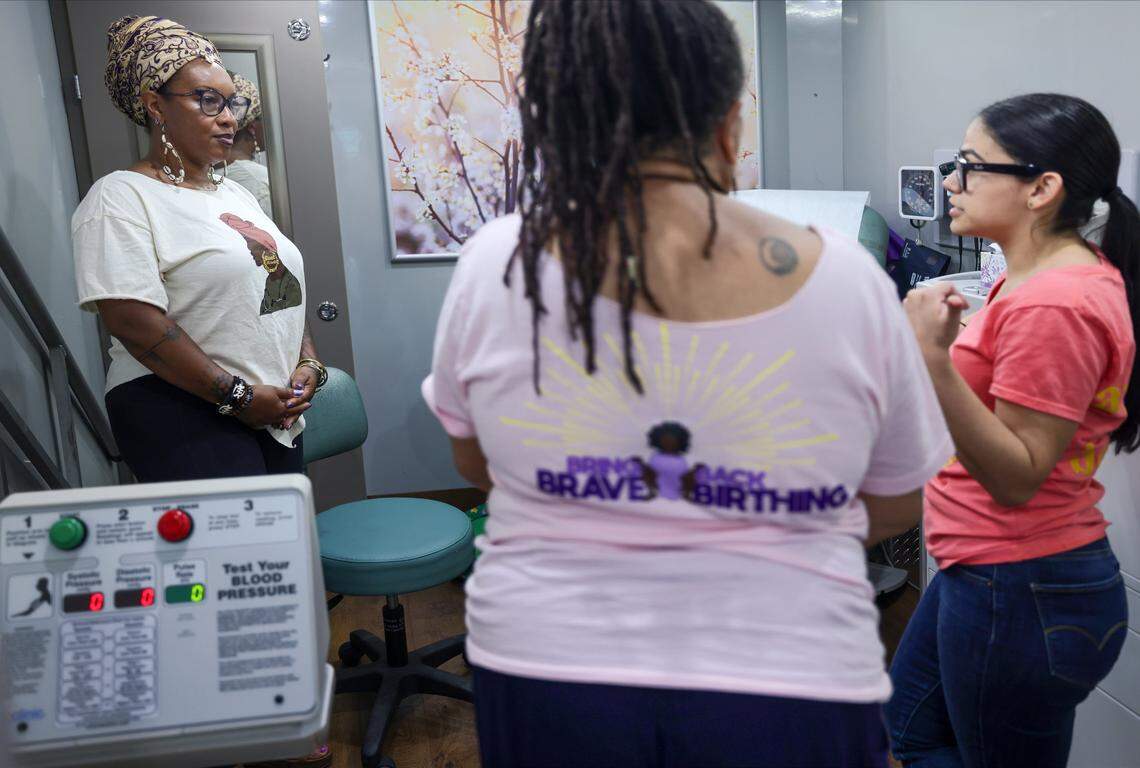
Huddled in a patient room inside a mobile midwife clinic outside the Overtown Youth Center, a pregnant Venezuelan woman who brought her small child speaks with a student midwife to assess her prenatal care. She gets her blood pressure checked and a series of other screenings to ensure the safety of her next child.
She is one of four scheduled patients at the Southern Birth Justice Network’s newest Mobile Midwife Clinic on this warm but breezy April afternoon. It’s the kind of care co-founder and executive director Jamarah Amani envisioned she would one day provide.
At 19, Amani, then a college student at the University of Pennsylvania, went to her first prenatal visit with a detailed list of questions for her obstetrician. As she went through her list, the obstetrician suggested she talk to the midwife down the hall.
“[The midwife] spent two hours with me as a walk-in,” Amani said. “She got on the floor in yoga poses to show me how to manage my back pain.” The midwife listened to Amani, from her concerns about being a single mom to what kind of birth she wanted. And when the time came, the midwife was with her when Amani went into labor.
“That was just a special experience,” she said. “And I was like I want to do that for other women one day, but I was so young.”
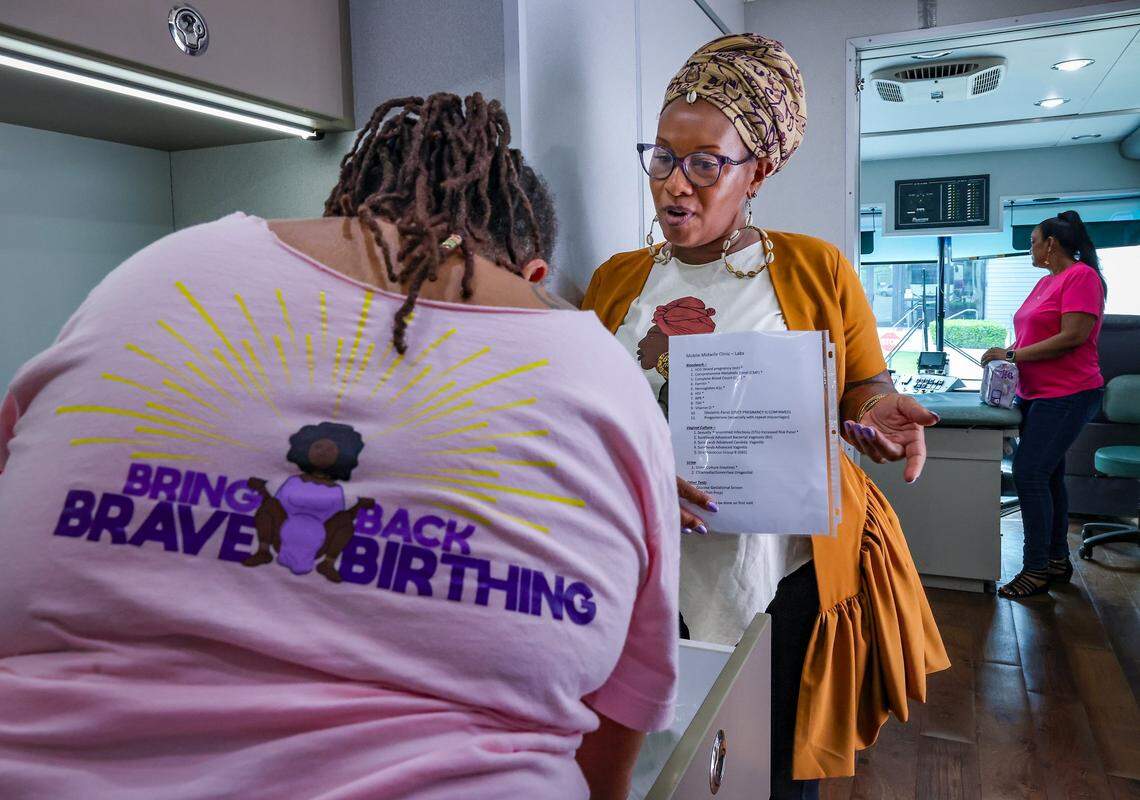
Now 45, Amani is a midwife in Miami-Dade County and has led statewide and local efforts on birth justice for Black women through Southern Birth Justice Network (SBJN), a nonprofit she co-founded in 2015 after receiving a mobile clinic from one of her mentors. The nonprofit provides access to free and low-cost midwifery and doula care and trains midwives and doulas.
As SBJN’s executive director, Amani has spearheaded statewide efforts on birthing rights legislation and co-founded the National Black Midwives Alliance to honor the legacy of Black midwives and advocate for health equity. Amina, along with two other midwives, gained national attention last week as plaintiffs in a lawsuit filed by the Center for Reproductive Justice against the state of Georgia for preventing midwives from being in hospital rooms – something Amina experienced first hand when she was giving birth.
But as that legal battle brews, Amani stays focused on the work. On Saturday, the SBJN unveiled a new mobile clinic during North Miami’s Black Maternal Health Symposium Resource Fair, coinciding with Black Maternal Health Week. The mobile clinic will travel to parts of Miami-Dade County and includes two exam rooms, offering screenings such as pap smears, blood tests and checking for sexually transmitted infections. The nonprofit recently received a $250,000 grant from the North Miami Community Redevelopment Agency for a birth and wellness center set to open in 2027 that will allow them scale up and fill a gap left from local maternity wards shuttering.
“We’re building on the foundation that our ancestors gave us and building it for the next generation to continue it,” she said. “Hopefully in five years, we have a robust sustainable birth center that is providing free and accessible care to the community.”
RELATED: Why are maternity wards across South Florida closing? There’s more than one reason
Path to Midwifery
For Amani, midwifery is both a calling and a form of activism. Growing up with a mom involved with the Black Arts Movement and a father who was a Black Panther shaped Amina’s world view. By 15 she was organizing walkouts at school and advocating against police brutality.
After graduating from the University of Pennsylvania in 2001 with a degree in Africana Studies, she moved back to her native California where she worked for Black Infant Health in Long Beach and became deeply involved in reproductive rights and justice. That work would eventually lead her to Atlanta where she became an advocate for reproductive justice.
During the birth of her second child in Georgia, she found herself having to be her own advocate. Unlike her experience in Philadelphia, Amani said her birthing experience in Georgia, a state that has strict requirements to become a midwife, was one of discomfort and that the nurse consistently ignored her needs.
That experience further fueled Amani to become a midwife. “Having to advocate for myself…that put a fire in me,” she said.
She moved to Florida in 2008 and enrolled in the International School of Midwifery and started developing a movement for birth justice in Miami through her childbirth education classes at Lotus House while she was a student.
“She was clear and serious about birth work,” said Sheila Simms Watson, one of Amani’s mentors and an early SBJN board member. The two met when Amani was still a student midwife. “She was very clear that this was her mission and her passion. You can’t be a midwife and not be political. She understood that.”

Amani founded the Southern Birth Justice Network with Anjali Sardeshmukh in 2015 after taking over a mobile clinic called Mobile Midwife from her mentor, Ada “Becky” Sprouse, who had started the clinic that operated out of an RV to address the needs of migrant farmworkers and mothers in Homestead.
“She had gotten sick and she didn’t want her nonprofit to die with her, so she asked myself and Anjali to take it over and keep it going,” Amani said.
The clinic stops throughout various partner locations in Miami-Dade County and will also provide referral services for clients’ needs such as a lactation consultant or a mental health therapist. SBJN has certified over 100 doulas, trained at least 2,000 doulas and 43 midwifery assistants, and provided services 200 families through the mobile clinic. With their new mobile clinic, Amani hopes they can triple the number of people they serve.
“We’re trying to double that this year and triple it next year, just to really scale this birth justice model of care, which is centered around human rights and cultural safety,” Amani said.
Black maternal health challenges
In her work, Amani has seen what many Black women experience when it comes to birthing, including Black women undergoing C-sections without their consent, pointing to the recent cases in Jacksonville about two Black women court-ordered to have a C-section.
Amina said the high cesarean rate for Black women points to the disparities they face and highlights the need for a midwife, who helps advocate for patient care. Between 2022 and 2024, 37 percent of Black women had C-sections, outpacing white women (31 percent), Hispanic women (32 percent), and Asian women (34 percent), according to the March of Dimes.
“Because of the role that we play in reproductive health and perinatal health, we get a lot of backlash because we are the experts in physiologic birth,” Amani said. “So if you bring a team of midwives into any birthing institution, you are going to have a culture shift.”
For Black women, that could be the difference between life and death. Black women are more than three times as likely to experience a pregnancy-related death than white, Hispanic or Asian women, according to data from the Centers for Disease Control.
These disparities have shaped Amani’s advocacy in birthing justice and midwifery. In 2011, she partnered with the ACLU to end the shackling of pregnant incarcerated women in Florida. In 2019, she helped organize a statewide campaign against forced jail births, in the wake of Tammy Jackson, a Broward County inmate who was forced to give birth in a jail cell alone. That eventually led to the passing of the Tammy Jackson Act.
Despite the obstacles she’s seen, Amani said she’s finding a growing number of Black midwives and doulas. One of them is Angelique Adderly, a West Palm Beach doula who said Amani’s never ending fight for justice coupled with her own negative birthing experience fueled her journey to become a doula.
“To see (her) journey and endurance to fight for our justice and our rights and to have all these resources for us, the moms and communities, is so imperative, not just to the Black culture, but BIPOC culture as well,” Adderly said at the city of North Miami’s Black Maternal Health Symposium Resource Fair, which featured the unveiling of SBJN’s latest mobile clinic.
For Amani, her work is rooted in community: “We are here for you, your life matters, your baby matters, your choices matter,” she said.

Raisa Habersham
Miami Herald
Raisa Habersham is the race and culture reporter for the Miami Herald. She previously covered Hollywood and Fort Lauderdale for the Herald with a focus on housing and affordability. Habersham is a graduate of the University of Georgia. She joined the Herald in 2022.