

NORRIS, SOUTH DAKOTA — While drums are a familiar sight at the Worthington International Festival, the festival itself will be a new one for the Black Pipe Singers. Hailing from South Dakota’s Black Pipe Community on the Rosebud Indian Reservation, the musicians from Norris Elementary School will be singing and drumming songs of honor, ceremony, victory, honor and more from 11 a.m. to 12:30 p.m. Saturday, July 12.
Norris Elementary Principal and Drum Group Moderator Brian Brown said the group has grown considerably — and not just in number — since they first began just two years ago.
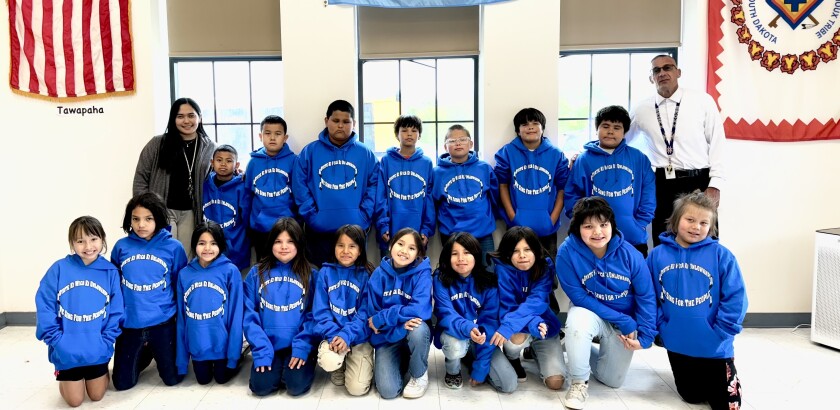
Contributed / Brian Brown
“There were students there that wanted to sing. From my past experiences, anytime kids are closely involved in their own culture and language, they excel better. They perform better, academically and socially,” he shared. “There was an interest, and so I started off with about three boys and one girl. From there, it transformed into 10 boys (on drums) now and 11 girl singers (or wicaglata).
“If you’re not performing well at school, listening to your teacher or doing your work, you can’t be on the drum,” he added. “Grandma calls me at home and says you’re backtalking to her, not doing your chores at home or listening, you can’t be on the drum. If you have any infractions at school, fighting around, getting in trouble or being mean to other students, you can’t be on the drum.”
Brown said the students now are very particular about how they act and behave and they want to participate. It makes them better performing students, he said, especially for something they really want to do.
I want people to know that the Lakota people are thriving and are still a strong people, that we are proud of our heritage and culture and that we’re able to preserve our language through songs.
Brian Brown
Since their formation, the group has gone on to perform at South Dakota’s State Capitol rotunda in Pierre, South Dakota, music halls at South Dakota State University, a History and Civics concert in Sioux Falls, South Dakota in front of 1,000 school faculty members from across the state and for Hot Springs, South Dakota’s first-ever feather-tying ceremony for the area’s local Lakota students.
Brown said such performances have been deeply powerful for the students, the Rosebud Lakota people and, most importantly, their way of life.
“The community members love it, the parents love it and the elders love it. It makes us unbelievably proud,” Brown said. “It makes us very happy and the kids feel worthy because they’re performing in our language. They’re performing songs of our people.”
Brown said there aren’t many many young drum groups around anymore because of changing times in society.
“That is something that I’m trying to preserve and keep going because if you don’t have singers, then you can’t have ceremonies, a sweat (inipi) or a powwow,” Brown shared. “If you don’t have singers for a powwow, then people can’t have a good time and we can’t celebrate in our old ways. If you don’t have singers for inipi, then people cannot get healed or doctored.”
Brown said his goal is to transform these young singers into singers for life.
“That way, when our people here need help, then they can provide that by singing those songs,” he added.
With Rosebud ranking as the third poorest town in the United States, performing at the Worthington International Festival will bring the students lifelong memories and experiences they would almost never get at home.
“We don’t get to travel or see things. My kids don’t ever get to leave the community, much less the reservation, so they don’t get to go to places,” Brown said. “This experience for the kids is gonna be a lifetime experience. They’re gonna see people, do things and go places they’ve never been before.
“The drum is the heartbeat of the Lakota people. (At the International Festival), you’re gonna have all these other nations and countries bringing in all their drums from all over the world, and we’re a part of that. It’s gonna give them the opportunity to see other drums,” Brown added. “The kids will be exposed to that and get to see that. They’re never ever gonna see that again in their life. This is gonna be phenomenal for them to be able to get this experience and to be out. Even just going to a hotel room and eating at a restaurant is gonna be a big deal and super exciting to them. To be there to perform for everybody, it’s gonna be a great experience and good exposure for them.”
Brown said the performance is bound to be as eye-opening an experience for festival-goers as it will be for the group.
“I want people to know that the Lakota people are thriving and are still a strong people, that we are proud of our heritage and culture and that we’re able to preserve our language and preserve our language through songs,” he said. “When we first started, (then-South Dakota Governor) Kristi Noem kept hearing about all of these Black Pipe singers and didn’t know where they were from, but she does now. It’s good for the people to know outside of the reservation where Black Pipe is, where these kids come from and who they represent.”
Brown said he’s working to empower the students, and for people to acknowledge and recognize them — know where they come from.
“That’s a big feat right there in itself,” he said. “I want people to know that kids do amazing things and that when you give them hope and opportunity, then great things prevail.
“I want them to know that kids from the Rosebud Reservation are thriving, that we’re good people, we’re smart and that we believe in a good life that preserving these ways will make us better people in the end. That way, the language and the culture is never lost,” he continued. “As an educator, I do everything I can to preserve our language and culture through song and by example.”


