Nationally, over 56,000 people have been detained by Immigration and Customs Enforcement (ICE) since Donald Trump’s inauguration in January 2025. Immigration raids have targeted brown skinned people on street corners, in parks, at bus stops and at work. People have been . There have been a particularly large number of raids, arrests and kidnappings in Los Angeles, CA that have targeted Mexican and Central American immigrants. In response to these arrests, large scale sustained protests took place against ICE raids in downtown Los Angeles throughout June 2025. While many might assume that these immigration raids are a “Latino issue,” many Black leaders and organizations are standing in solidarity with the Latino immigrant community.
Black leaders like Melina Abdullah of Black Lives Matter have been vocal about their opposition to ICE and their support for immigrant communities. Black civil rights organizations including the NAACP and National Action Network issued statements in solidarity with immigrant communities. These recent displays of solidarity are a part of a long history of Black and Brown communities working together for racial justice. Even still, historically, the media highlights the “fragile” alliance between Black and Brown people as well as the tensions that have existed between these communities. In fact, some worry that these coalitions may only exist strategically between political elites and fail to represent the feelings of everyday people. With this in mind, we examine recent results from 2020 Collaborative Multiracial Post-Election Survey to demonstrate that Black and Latine solidarity around issues of immigration remains strong.
The Roots of Black and Latine Solidarity
Black and Latine solidarity came together in the 1970s and 80s with the wave of civil rights protests that were taking place across the United States to demand equality and just labor conditions . In Los Angeles, the Chicano movement borrowed heavily from the Black Panther party, as the Brown Berets took center stage in many of the walkouts that were taking place in East Los Angeles. In Chicago, the Rainbow Coalition came together with the help of the Black Panthers, Young Lords, and Young Patriots. It was during this time that a political consciousness and knowledge about systematic racism grew within each of the communities, especially among its youth. While leaders like Cesar Chavez were successful at uniting workers, organizations like the Brown Berets created a narrative around structural inequality that helped the younger generation develop a more critical understanding of discrimination and its impact on other communities of color.
Black and Latino Solidarity Today
To explore the extent to which Black and Latino people continue to feel solidarity with one another, we make use of the 2020 Collaborative Multiracial Post-Election Survey (CMPS). The CMPS is unique in its collaborative nature. Over 200 scholars across 100 different universities/colleges contributed to their survey instrument. The CMPS is particularly useful for the purposes of this research, because they oversample Black and Latine respondents. There are a total of 4,071 Black respondents surveyed and 3,529 Latine respondents. We also examine Black and Latino support and opposition for ICE.
To examine solidarity between these two groups. We analyze the extent to which Black and Latino people believe that when it comes to the treatment of Black people by the police and the treatment of Latine immigrants by immigration officials these officials are racially biased. We find that a majority of Black (70%) and Latino (54.7%) people feel that this treatment is racially biased.
Notably, Black people are significantly more likely to view the treatment of both groups as racially biased. This may stem from their understandings of systemic racism in the American context.

Source: 2020 Collaborative Multiracial Post-Election Survey
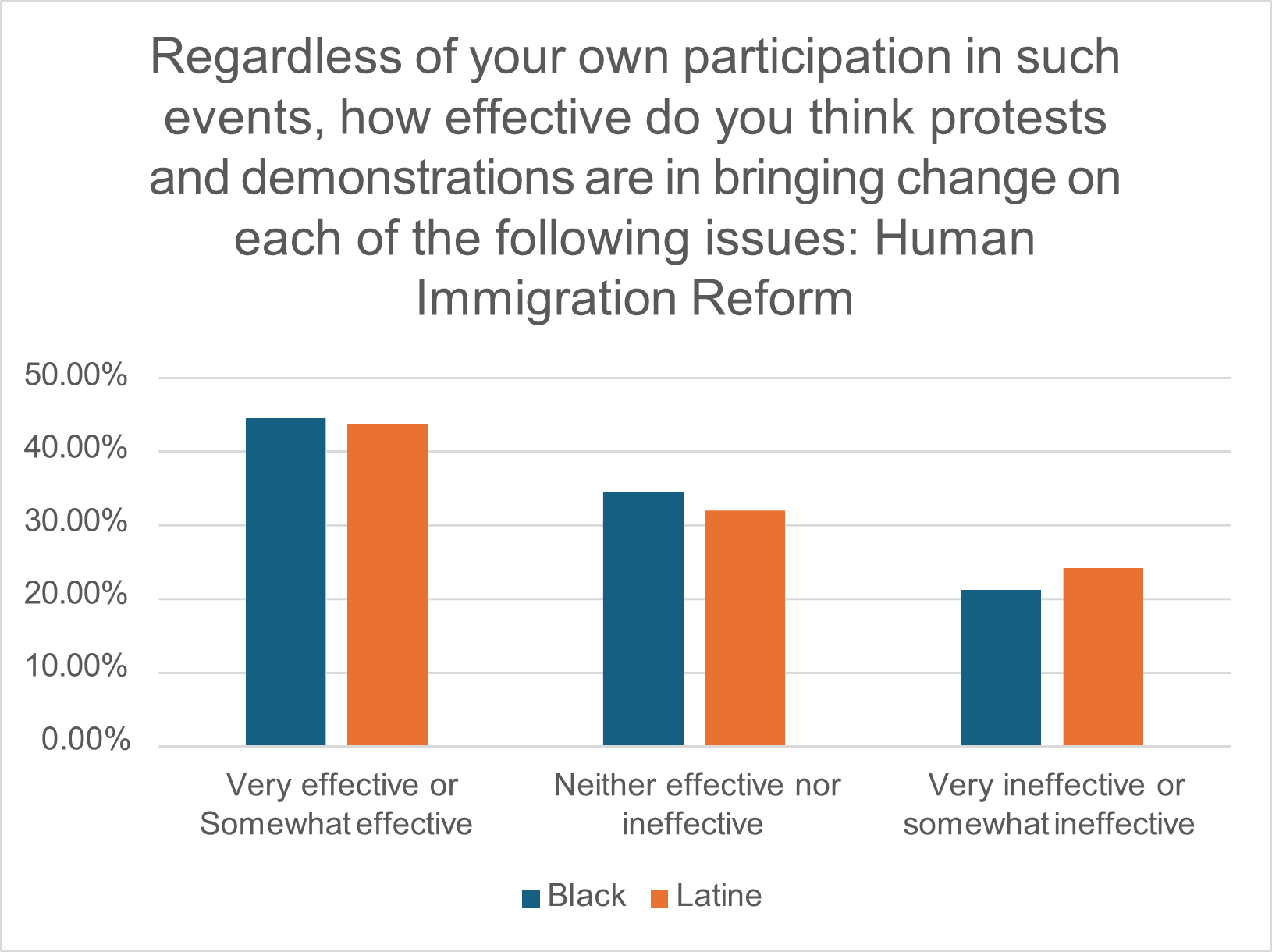
When asked whether protests and demonstrations in support for humane immigration reform are effective or ineffective, Black people (44.4%) are just as likely as Latino (43.8%) to agree that these protests are effective.
Source: 2020 Collaborative Multiracial Post-Election Survey
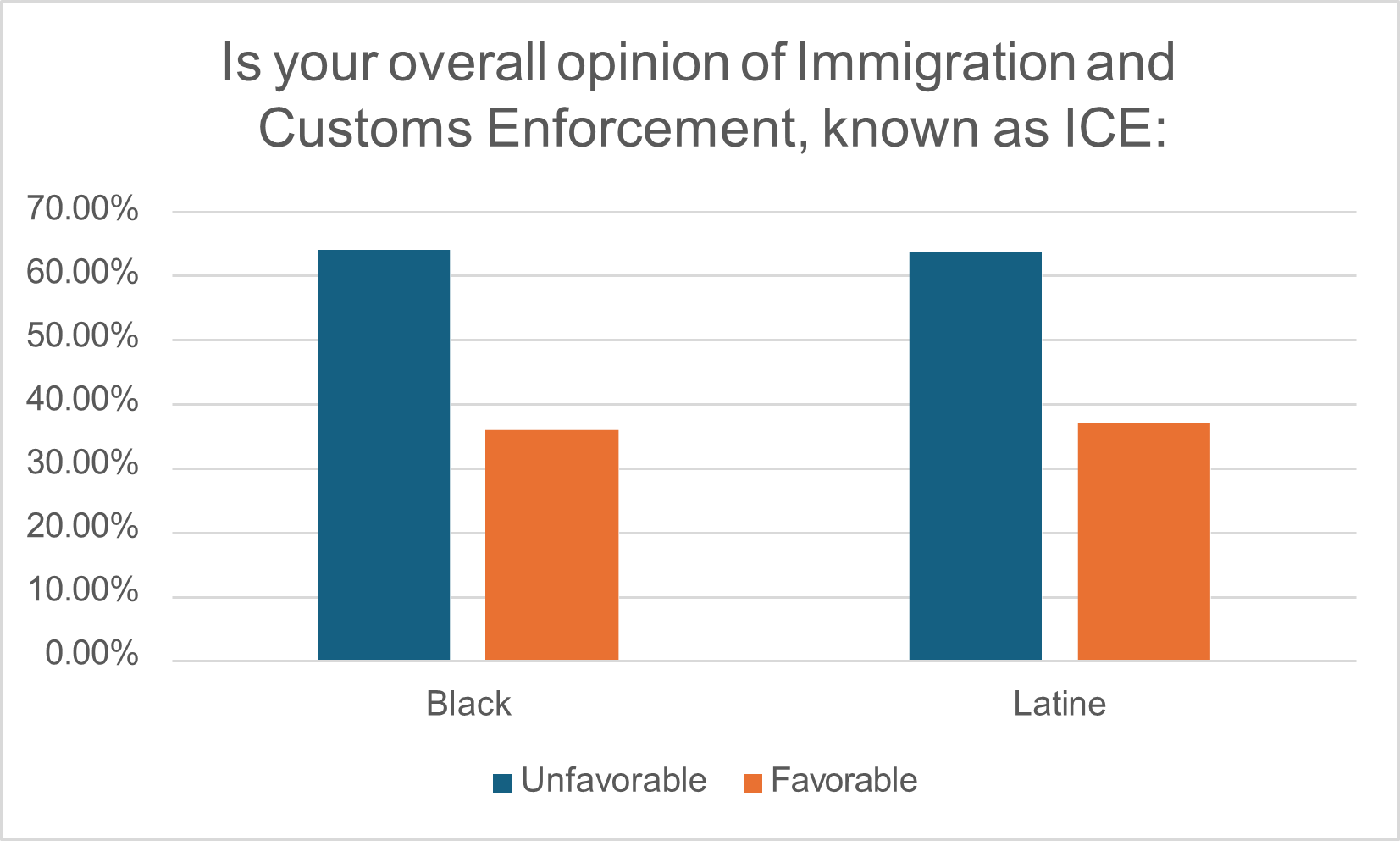
Additionally, Black (64.1%) people view ICE just as unfavorably as Latino people (63.7%). This data reveals strong solidarity from Black people when it comes to the handling of immigration enforcement in the United States.
Source: 2020 Collaborative Multiracial Post-Election Survey
As the demographics shift in the United States point to a majority minoritized population, it is important for both Black and Latine communities to realize the potential political power this growth brings. While neither Black nor Latine folks individually will be a majority, the combination of various minoritized communities will outnumber White Americans by 2045. The data from the 2020 survey shows that both Blacks and Latinos understood the racial implications of police and immigration officials on their communities. However, this was less so for Latinos on all three measures. As the Trump administration continues to target Brown folks indiscriminately, even formally suggesting that “physical appearance” can be used to determine which individuals are kidnapped regardless of actual citizenship status, we may be seeing the beginning of a new era of racial consciousness among Latinos.
While some Latinos have historically benefitted from or aligned with whiteness when it served them socially or politically, they have also struggled with deep anti-Black attitudes. These recent immigration tactics may help Latinos see that their own racial oppression at the hands of the state mirrors the struggles African Americans have faced for decades. This is an important moment towards solidarity given that both Latinos’ proximity to whiteness and anti-Black attitudes, as well as concerns about economy, partly contributed towards the 8 percent increase in support for Trump between 2020 and 2024. Ultimately, while Trump’s immigration strategies have intensified cruelty, fear, and division, they may be inadvertently creating a racial consciousness that will benefit Black and Latino solidarity and allyship for generations to come.