

During his lifetime, Charles W. Chesnutt (1858-1932) was an acclaimed novelist, a public intellectual, and a peer of some of the most influential figures of his time, including Booker T. Washington and Walter Hines Page. He was a guest at Mark Twain’s 70th birthday party and saw his work adapted for the screen by the pioneering Black filmmaker Oscar Micheaux. Chesnutt’s life and work can also be viewed as a bridge between two distinct literary eras and a way of redefining American literature.
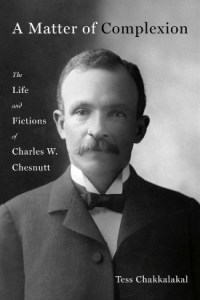
“A Matter of Complexion: The Life and Fictions of Charles W. Chesnutt” by Tess Chakkalakal. St. Martin’s Press. $32.
In her new biography on Chesnutt, “A Matter of Complexion: The Life and Fictions of Charles W. Chesnutt,” Bowdoin College Professor of Africana Studies and English Tess Chakkalakal explores this complex figure and makes a strong case for his place in literary and political history. Chesnutt was, in many ways, a groundbreaking Black writer — and one who was acutely aware of the prejudices of the day. “Chesnutt, as those close to him knew, was one of those, with skin so light that he could be white, who could pass,” Chakkalakal writes. “But he never did.”
Chakkalakal points to Chesnutt’s parents’ roots in Fayetteville, North Carolina, as having informed their son’s views of race. Both of his parents were considered “free people of color” in the time before the Civil War ended slavery. His father AJ — named for Andrew Jackson — was elected as a justice of the peace in the wake of Reconstruction. As Chakkalakal explains, this aspect of Fayetteville’s population made for a different kind of Reconstruction than took place elsewhere in the South:
“In Fayetteville, free colored people could teach the newly freed, and this made for a Howard School unlike most others; this was a Howard School that sat on land owned by free colored people and was taught by free colored people for the newly freed.” (The school, and others like it, was named for Oliver Otis Howard, the head of the Freedmen’s Bureau and a Union general in the Civil War.)
The importance of Reconstruction was significant for Chesnutt, and Chakkalakal writes that it left him with a long-standing affinity for the Republican Party. “Chesnutt understood himself as belonging to a political party rather than to a race.” He began working as a teacher from a young age, seeing what Chekkalakal calls “a new intersection between teaching and writing.” With many educational opportunities denied him because of his race, Chesnutt guided himself through an education in classical literature. Eventually, he moved to New York City, where he reported on Wall Street for a time before relocating to Cleveland and working as a lawyer and stenographer.
Along the way, Chesnutt developed an interest in the stories and songs of North Carolina residents. Chakkalakal observes that “he made literature by recording the voices of the colored people, copying their speech patterns in writing, a practice that he would first develop in his journal.” In time, this led him to write the short stories that he would publish in an increasingly prominent series of publications; a meeting with The Atlantic’s Walter Hines Page proved especially significant for Chesnutt’s career as a writer.
“That these two North Carolinians, living on opposite sides of the color line, found common cause in the pages of The Atlantic among the literary elite of Boston is just the beginning of a new story about an old American problem: the problem of racial and regional divisions in the United States.”
Chakkalakal’s biography includes memorable portraits of other writers and thinkers whose paths intersected with Chesnutt’s, including educator Booker T. Washington, publisher S. S. McClure, and writer and attorney Albion W. Tourgée, who represented Homer Plessy in Plessy v. Ferguson. That case, Chakkalakal points out, had a significant impact on Chesnutt’s own conception of race in America. “Based on the Plessy decision, your race was not something you could determine for yourself; race was a matter left to others, the courts, the government, society,” she writes.
“A Matter of Complexion” contains plenty of descriptions of Chesnutt’s stories and novels, and Chakkalakal is candid in her appraisals of them, including a few cases where Chesnutt’s ambitions, she thinks, exceeded a given project’s execution. She chronicles the evolution of one long-gestating story “Rena,” which grew into a novel, “The House Behind the Cedars.” And she notes the significance of his literary reception; his earlier collection of stories, “The Conjure Woman,” was published by Houghton, Mifflin and Company. “Never (before) in the history of American publishing had a major publishing firm produced a work of fiction by a non-white, or slightly colored, or African American writer.”
Chakkalakal’s biography concisely shows how larger cultural forces affected Chesnutt’s writing and its reception. The influential critic William Dean Howells’s championing of Chesnutt’s work, for instance, helped elevate his profile — and in the aftermath of the assassination of President William McKinley, Chesnutt’s novel “The Marrow of Tradition” got a lukewarm reception, disappointing the author. His career also saw, Chakkalakal writes, the shift of the country’s literary scene from Boston to New York — another way in which Chesnutt bridged distinctive eras in the nation’s history.
“A Matter of Complexion” is a thoroughly researched look into the life of an influential literary figure. Many of Chesnutt’s writings remain in print today in lovingly curated editions; Tess Chakkalakal’s book makes an emphatic case for seeking them out, and for Charles W. Chesnutt’s place in American letters.
New York City resident Tobias Carroll is the author of four books, most recently the novel “Ex-Members.” He has reviewed books for The New York Times, Bookforum, the Star Tribune and elsewhere.


