Athens has long stood as a center of creativity and passion, shaped by its deep roots in music, education and social progress. The small town gave birth to the first state-chartered public university in the country, sparked music revolutions that echoed around the world and cultivated leaders who broke down barriers in the government and education.
Meet the Athenians who shaped the city’s past, opened doors to the future and defined the city’s creative spirit.
Making history
To understand the history of Athens, there are three names to know: John Milledge, Abraham Baldwin and Elijah Clarke. Each played a vital role in laying the foundations of the town and the university that defines it.
In 1785, Baldwin and members of the Georgia legislature chartered the University of Georgia, the first publicly funded institution of higher learning in the U.S. Milledge, a prominent Georgia politician and later the founder of Athens, donated land which the campus was officially built on in 1801. That same year, Clarke County was established and named in honor of the Revolutionary War hero, Elijah Clarke.
Several years later, in 1805, Milledge officially founded the city of Athens, naming it after the ancient Greek city in hopes that it too would become a thriving center of education and culture. Athens was formally incorporated in 1806.
“Without Milledge, Baldwin and Clarke, so many of our city’s attractions or streets would not exist,” Engagement Coordinator of Historic Athens Denise Sunta said. “Of course the county itself would not exist. The university would not exist.”
Two more Athenians that made history are Alfred Richardson and Madison Davis, ex-slaves that became the first Black state legislatures to represent Clarke County in the late 1800s. They were able to win, according to Sunta, because this was before the implementation of Jim Crow laws that would later disenfranchise Black voters.
“Reconstruction was an interesting time in our history because it was just post-Emancipation so you had all of these people who suddenly had the power and ability to vote,” Sunta said. “Athens itself had a pretty large Black population at the time, so that’s how they won.”
Davis was more conservative and “white-passing,” according to Sunta, so he was better equipped to navigate the social and political systems at the time. Richardson, on the other hand, was not “white-passing” and more politically radical, making him a target of mob violence, particularly from the Ku Klux Klan.
“We’re hoping to bring more awareness to these two people because I think that it’s important for us to recognize the fact that in Athens, during Reconstruction, we kind of had this elevation of Black life,” Sunta said.
Davis is buried at Gospel Pilgrim Cemetery in Athens and Richardson’s burial place is unknown, according to Fred Smith, executive director of the East Athens Development Corporation.
Trailblazers in government and beyond
Long after UGA was founded, several notable Athenians shattered racial and gender barriers — the first Black citizens elected to public office, the first woman to climb the ranks of the local government and the two Black students that desegregated UGA.


Nancy Denson, Mayor of Athens, listens to a speaker at the unveiling of the new hybrid Athens Transit Buses, on February 23, 2018, in Athens, Georgia. (Photo/Christina R. Matacotta, crmatacotta@gmail.com)
Before Athens and Clarke County became a unified governmental body, Ed Turner and Nancy Denson paved the way for future local politicians. Turner was the first Black Athenian to be elected to Athens City Council and served for 18 years from 1970 to 1988.
Turner attended UGA in the mid 1960s, quickly becoming influenced by Black empowerment and Civil Rights Movement leaders like Malcom X and James Baldwin. Around the same time, Black voter registration rates in Athens were on the rise and locals were looking for someone in the Black community to run for Athens City Council. Little did Turner know, the community had their eyes on him.
At the time, 10 middle-aged white men represented Athens’ five districts. Turner won in a runoff, defeating the two white candidates — including the incumbent. Though the response was overwhelmingly negative, Turner stood his ground on the council; he was often ignored or stonewalled. Despite his struggles, Turner got the ball rolling. A couple of years later, the second Black man was elected and soon after that, the first Black woman.
In 2025, half of the commission seats are held by people of color for the first time in the Athens-Clarke County Unified Government’s history.
Nancy Denson became the first woman on Athens City Council in 1980. Denson, a mother of four and running a part-time accounting and alterations business out of her home, had no prior political experience. Still, Denson beat her opponent, four-term incumbent Bryan Craft, in a landslide.
What began as a passion for speaking out against unfair zoning practices in her neighborhood soon led to her becoming president of the neighborhood association — and eventually, going door to door to campaign for the District 5 council seat. Although she was often the subject of sexist comments and the butt of the men’s jokes, Denson was not afraid to disagree — and anger — the councilmen. This attitude got her re-elected three times to the council, a win in the tax commissioner’s office and eventually the title of ACC mayor.
Charlayne Hunter-Gault and Hamilton Holmes were the first Black students admitted to UGA in 1961, effectively desegregating the university and breaking down barriers in public education in Georgia. Both graduated from Henry McNeal Turner High School in Atlanta, Holmes as valedictorian and Hunter-Gault as third in the class. Holmes had dreams to become a doctor, Hunter-Gault a journalist — they both saw those dreams coming true at UGA. However, their applications were denied, again and again.
In 1960, their legal team filed for an injunction seeking to prohibit UGA from “refusing to consider [Holmes’ and Hunter’s] applications and those of other Negro residents of Georgia for admission to the university.” Their request was initially denied, but a full trial was held later that year. On Jan. 6, 1961, Judge William Bootle issued a ruling, stating that Holmes and Hunter “would have already been admitted had it not been for their race and color,” and they were immediately admitted to UGA. Three days later, they became the first Black students to enroll in classes.
“Oftentimes, the change that we see on campus extends into the community,” Sunta said. “For the community of Athens, what was so important about the two of them and the courage and bravery that they had to attend the university as the first Black students is that it showed Black Athenians that it was possible to receive the same education as white people.”
The community stood strong behind Hamilton and Holmes, according to Sunta. In fact, when Holmes was subjected to threats and feared for his safety, he would stay with one of the sheriff’s deputies.
“It showed that the community was behind these people coming to the University of Georgia and making that kind of stand in order to change the social systems that precluded them from higher education,” Sunta said.
Shaping culture: native musicians
Athens has earned its reputation as one of the South’s most vibrant music towns, where live music spills from nearly every corner. Iconic venues like the Georgia Theatre and 40 Watt Club have become launching pads for rising artists. Much of Athens’ rich musical identity today traces back to the legendary acts of the ’70s and ’80s — bands like R.E.M., the B-52s and Widespread Panic — who put the town on the global stage and transformed the genre of indie rock.
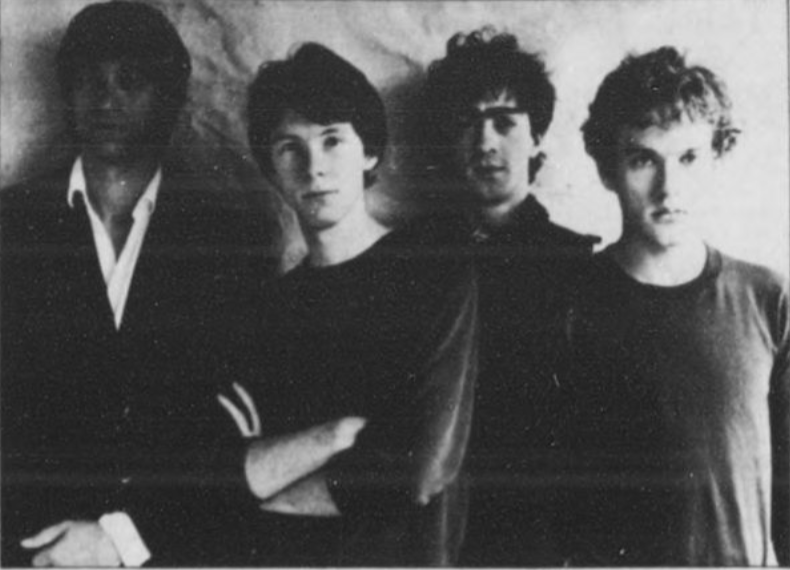

R.E.M. performed a free concert for University of Georgia students at Legion Field on Oct. 3, 1983, hosted by University Union.
“I do think that Athens had a burgeoning [rock and folk] scene for a very long time,” Sunta said. “But I think that what the B-52s and R.E.M and then later Widespread Panic did … it kind of proved that Athens was what we all believed that it was: this town for creatives, for musicians, for artists to come and be in community with each other and kind of find their way here.”
The B-52s formed at a local Chinese restaurant in 1976, and played their first show at a Milledge Avenue house party on Valentine’s Day in 1977. The Red & Black watched and covered the band as they made it big — reporting on their first performances at frat houses and hearing them on the radio, describing their sound as strange and eccentric.
R.E.M. formed in Athens in 1980 when UGA students Michael Stipe and Peter Buck met in Wuxtry Records, bonding over shared musical interest. After teaming up with two more band members, who also attended UGA, they debuted at St. Mary’s Episcopal Church — with no idea that they would eventually sell more than 90 million albums worldwide and shape alternative rock forever.
Widespread Panic got its start in 1982 when UGA students John Bell, Mike House and Dave Schools formed a band named after Houser’s nickname, “Panic.” In the mid-80s, they began performing at Uptown Lounge and soon became known for staying on stage for hours, sometimes up to four.
Sunta attributes this stardom to Athens being an inherently creative town and having so many avenues — such as the Georgia Theatre, 40 Watt Club, Flicker Theatre & Bar, Buvez and more — for artists to collaborate and showcase their work. These bands gave and continue to give contemporary and future local musicians the motivation to continue with their craft, Sunta said.
“More than anything, there’s a scene here that’s always looking for … indie rock alternative music, new wave post-punk music,” Sunta said. “Coupled with the fact that Athens is this weird, creative community at its heart, made it a safe space for some of these bands to cultivate their own sound and their own identity.”