

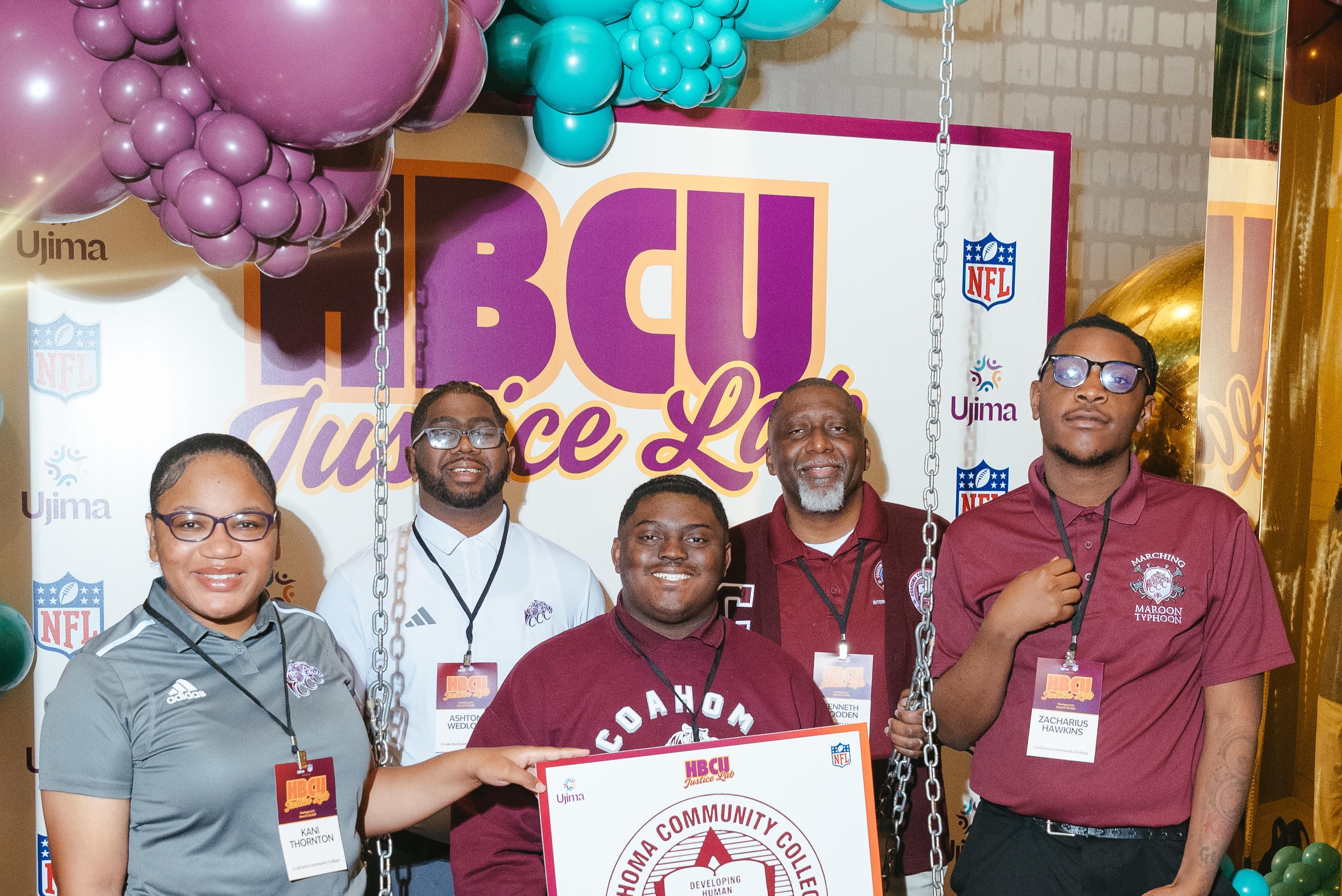
(Clarksdale, Mississippi) — Coahoma Community College participated in Ujima’s HBCU
Justice Lab, where four student leaders joined peers from across the nation to examine
and reimagine justice systems impacting black campus communities.
Coahoma Community College was among a select group of institutions invited to the
national convening hosted by Ujima, the National Center on Violence Against Women
in the Black Community. The Justice Lab created a space for students to critically
assess how harm is defined, addressed, and resolved within higher education environments,
with a focus on culturally responsive practices.
Representing the College were Keijuan Neese, Zachery Hawkins, Kani Thornton, and Ashton
Wedlow. Each student contributed to collaborative working groups that examined systemic
challenges and proposed student-informed solutions centered on accountability, healing,
and community care. Kenneth Gooden, project director of the Interpersonal Violence
Program, served as an advisor and facilitator throughout the experience.
“The HBCU Justice Lab provided a meaningful opportunity for our students to engage
in national dialogue and contribute to solutions that reflect their lived experiences,”
Gooden said. “Their voices are essential in shaping systems that are equitable and
rooted in community values.”
Throughout the three-day lab, participants engaged in workshops, dialogue sessions,
and strategy development exercises that emphasized storytelling traditions, restorative
practices, and peer-led accountability models. Students explored alternatives to punitive
systems, including campus disciplinary procedures and reliance on law enforcement,
while identifying approaches that prioritize prevention, education, and collective
responsibility.
Participants also analyzed case studies and shared personal perspectives on navigating
harm within their own campus communities. These exchanges fostered a deeper understanding
of the social and cultural dynamics that influence justice outcomes for Black students.
The experience encouraged critical thinking and leadership development, equipping
participants with tools to advocate for change on their respective campuses.
The consortium included representatives from Central State University, Howard University,
West Virginia State University, North Carolina A&T State University, Southern University,
Huston-Tillotson University, Macalester College, and the University of Iowa, among
others. The diversity of institutions provided a broad range of perspectives, strengthening
the collaborative effort to develop innovative and sustainable approaches to justice
in higher education.
Participation in the HBCU Justice Lab aligns with Coahoma Community College’s ongoing
commitment to student development, leadership engagement, and community-centered learning.
By supporting opportunities that extend beyond the classroom, the College continues
to prepare students to lead, advocate, and contribute meaningfully to society.
The experience concluded with student-led presentations outlining recommendations
for implementing transformative justice practices on college campuses. These proposals
emphasized policy reform, increased student involvement in decision-making processes,
and the integration of culturally relevant support systems.
Boilerplate
Founded in 1949, Coahoma Community College is a public, comprehensive, historically
Black community college serving the heart of the Mississippi Delta. Coahoma offers
Associate of Arts degrees, Associate of Applied Science degrees, and specialized certificates
across dozens of diverse academic and career pathways. Located on a 99-acre campus
in Clarksdale, Mississippi, the College is celebrating 77 years of academic excellence.
In addition to its affordable tuition and generous scholarship opportunities, Coahoma
has earned widespread recognition in nursing and health sciences, career-technical
education, and university transfer programs. Outside of the classroom, students are
involved in competitive NJCAA athletics as well as a variety of organizations and
clubs, including student government, the celebrated college choir, and the renowned
Marching Maroon Typhoon Band.


