

In August 1989, the abstract artist Bill Ainslie was driving from an international arts workshop in Zimbabwe to his home in Johannesburg when the unimaginable happened. A car collided with his vehicle and killed him.
In an instant, South Africa had lost a visionary. A catalyst for change, he had fought against the country’s apartheid system by teaching students at his multi-racial art school, the Johannesburg Art Foundation, how to express themselves and find their voices even when the oppressive regime was trying to silence them.
But Sophia Ainslie, who was only 21 at the time and just starting her own journey as an artist, also lost her father.
“I was very young when he died, and I never really managed to have a very long conversation with him about art and being in the world,” Sophia Ainslie said.
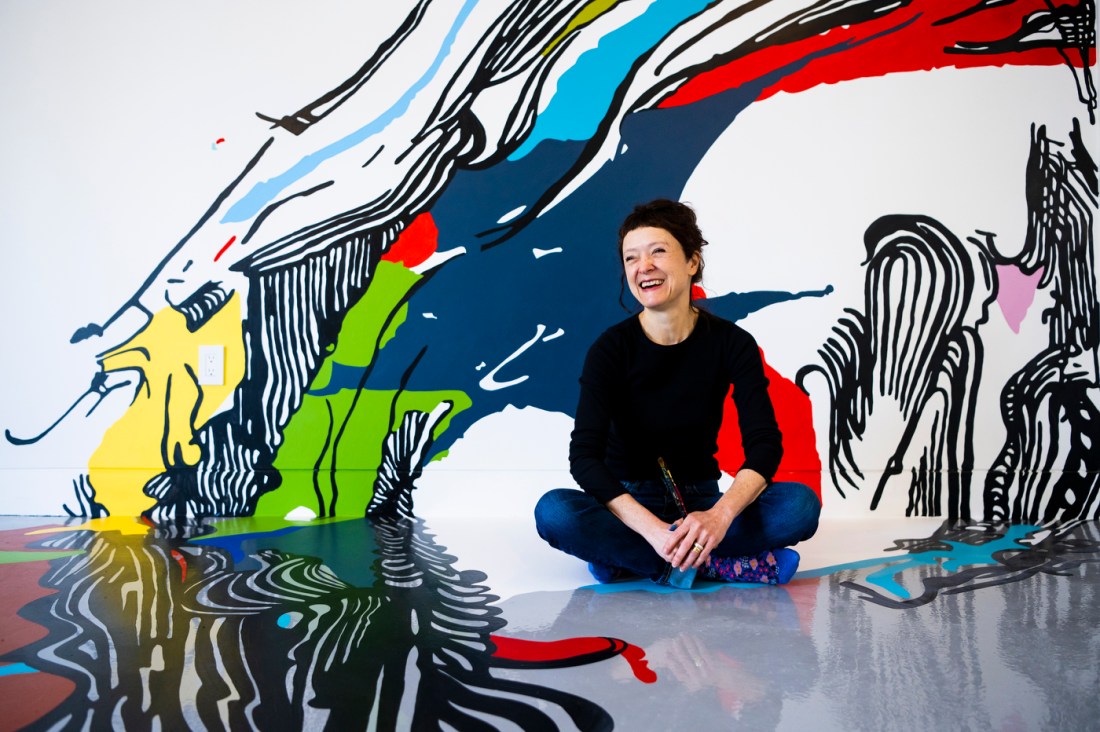
Almost 40 years later, she is finally having that conversation. With her first book, “Bill Ainslie: South African Artist and Cultural Catalyst,” Sophia Ainslie, who is an internationally recognized artist in her own right and arts educator at Northeastern University, is educating a new generation about her father’s stature as an artist.
Despite all the time that has passed, there were still so many stones unturned in their relationship.
“We can fall into these patterns as a child and father. Here you’re having a very different kind of conversation that you may otherwise not have,” she said.
The book follows Bill Ainslie’s development from a boundary-pushing abstract artist to an educator who inspired a generation of South African artists through his school. Pulled together using hundreds of photos, recordings, documents and 40 interviews with her father’s friends, former students, artistic contemporaries, Sophia Ainslie wanted the book to pierce the veil between past and present, life and death, bringing her father into the spotlight.
“I felt like he was ostracized at that time, but now people are coming to [his work] and realizing … what they didn’t see at the time,” Sophia Ainslie said.
A visionary’s early days
From an early age, Bill Ainslie was attuned to something beyond himself.
Born on April 10, 1934, in Bedford, a town in South Africa’s Eastern Cape province, he originally intended to become a priest but discovered art while studying at the University of Natal in South Africa’s KwaZulu Natal province in the early 1950s.
Upon graduating in 1955, he immediately started using art as an educational tool, teaching at schools in South Africa and Zimbabwe. But it was a critical meeting in 1956 with artist Selby Mvusi that alerted him to the critical role art could play for Black people under the segregationist apartheid system.
In 1960, he married Sophia Jansen-Schottell, known as Fieke, and, in 1964, started a private teaching practice so he could take on any student he wanted, including those who were Black. Over the next four years, he began adding teachers to this school, which remained under the radar for fear of openly running afoul of apartheid laws.
That school served as the roots for the Johannesburg Art Foundation that Bill Ainslie and his wife established in 1982.
All the while, he continued evolving as an artist, shifting from more realistic figurative drawings and paintings of mothers, children and farm laborers in the 1960s to abstract art in the 1970s and 1980s.


“He felt at a particular point that [figurative works] were illustrative in a certain way rather than really encompassing this wholeness of being,” Sophia Ainslie said of his early work. “[Abstractism] seemed to go deeper than the surface.”
Sophia Ainslie recalled watching her father working outside, laying down massive canvases that he would pour entire paint buckets on. These canvases were so large he had to use a broom, not a paintbrush, to form shapes, lines and strokes out of bright colors.
It was a labor- and energy-intensive process, Sophia Ainslie said, and one that her father was never satisfied with. He would add layer after layer of paint, resulting in paintings that were not only towering but thick.
“I think it was just about the struggle to try to find something deeper that was inside his whole being,” Sophia Ainslie said.
A man apart
At the time, Bill Ainslie’s abstract paintings were far from in vogue in South Africa.
He received plenty of criticism for his art and teachings not only from the apartheid establishment but also from members of the African National Congress (ANC), which formed the tip of the spear in the fight against South Africa’s system of racial segregation.
“The ANC felt that artists’ role should be to work in the struggle, to work in a social realist manner depicting the struggles of the oppressed,” said Wilhelm van Rensburg, who recently curated an exhibition of Ainslie’s work at Johannesburg’s Wits Art Museum.

Bill Ainslie’s paintings didn’t conform to that ideal. Instead of functioning as clear political imagery, his work stubbornly avoided simple, didactic interpretation.
“I went to him and I said, ‘What are your paintings about?’ and he would never explain them to me,” Sophia Ainslie said. “He didn’t want me to feel like painting needed words, I suppose.”
Education as action
Bill Ainslie’s abstract art might have been dismissed by artists and activists at the time for not being political enough, but the foundation itself was a kind of political action, Sophia Ainslie said. It gave people the freedom to find their voice under a regime that sought to strangle every opportunity for non-white people to educate and express themselves.
“He really wanted to dig deep into each person and pull out that voice in each person and allow them the space and the freedom to create in the manner that they felt was relevant,” Sophia Ainslie said. “It was a way to undo all of the conditioning people had, the way they felt they needed to be in the world.”
Nestled in the affluent Johannesburg suburb of Saxonwold, the Johannesburg Art Foundation always inhabited the “grey area of arts education” because of how much it ran up against apartheid law, van Rensburg said. Despite the hostile forces arrayed against it, the foundation still managed to grow deep roots throughout the city’s segregated communities. After talking with artists like Dumile Feni, who were isolated in South Africa’s segregated Black communities, or townships, Bill Ainslie realized his school could be “a place where people can come together and use art as a common denominator,” not a tool for exclusion, Sophia Ainslie said.
At its peak, the foundation enrolled upwards of 500 students from every background in part-time and full-time classes in everything from painting to graphic design.
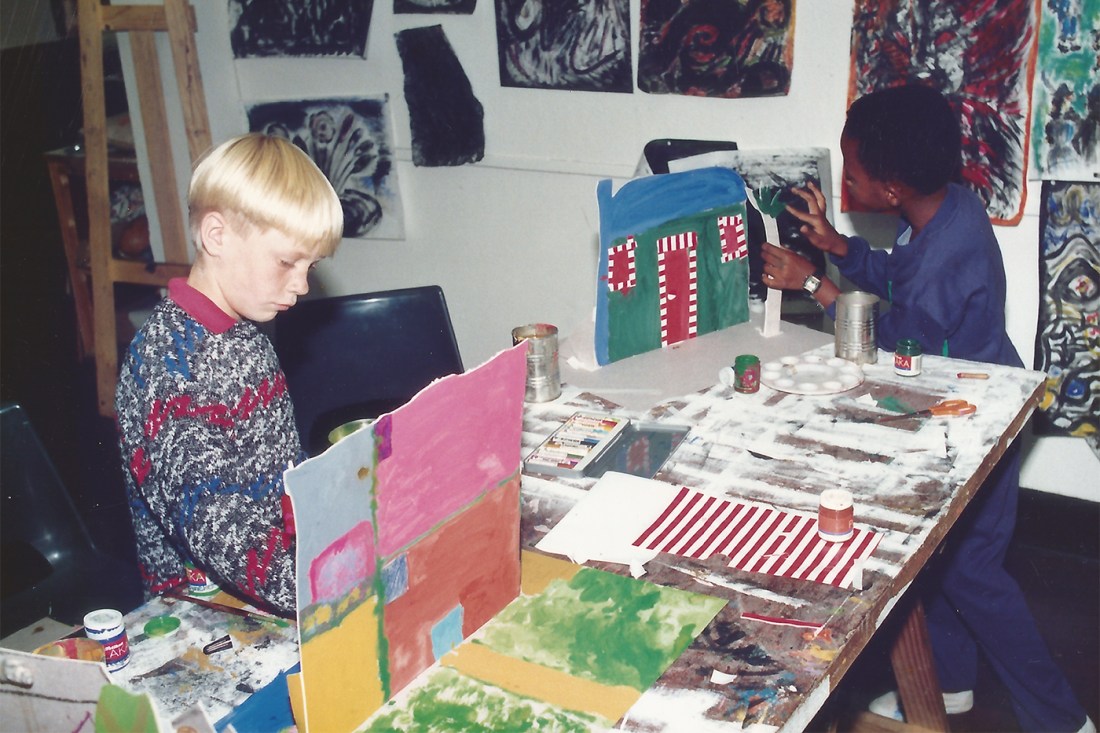
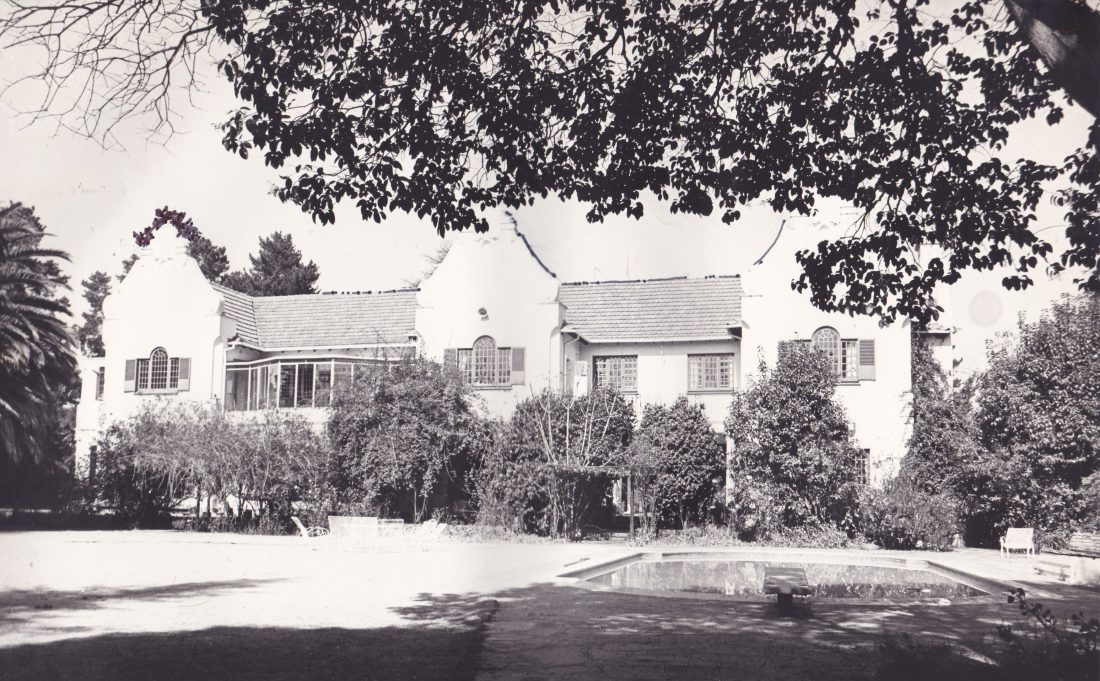
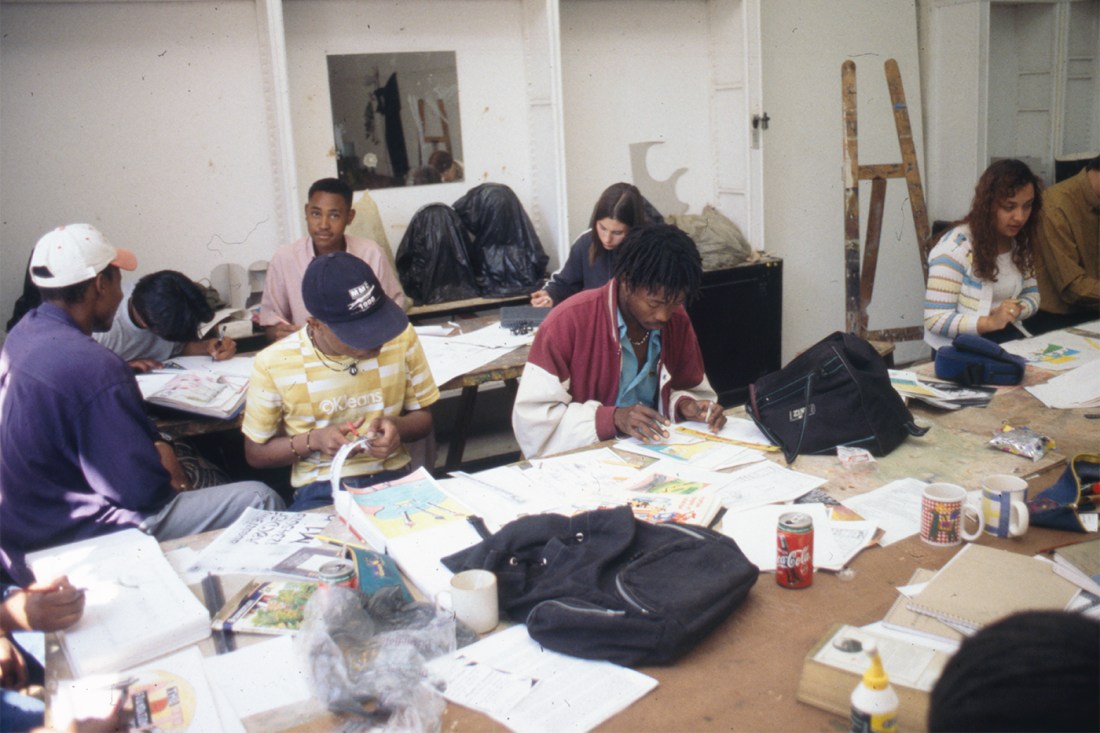
Every teacher was also a practicing artist. Students got the time and studio space, two basic yet rare resources for Black artists at the time, to explore and find their own style. They also got in-depth lessons in art history that, unlike the curricula at South African universities, focused on more than just the Western canon.
Instead of grades, students had three-hour critique sessions where teachers and students openly discussed each other’s work.
“There was time to critique the artwork and get in depth with what you see in a very professional and empowering way,” said Thabiso Phokompe, a visual artist who attended the Johannesburg Art Foundation from 1990 to 1993. “To have your voice be listened to, that was really significant.”
By working alongside people from racial groups who had been separated geographically and socially by apartheid, it showed the “fake façade that had been put around us,” Phokompe said.
When Rudzani Nemasetoni arrived at the Johannesburg Art Foundation in 1984, he was a guarded, self-conscious 17-year-old artist. He had little formal training, had hardly set foot outside of his township, Soweto, and had never been in a classroom with non-Black people.
“When it came to painting, [Bill] would emphasize just letting go of inhibitions, which was not an easy thing for me at the time,” Nemasetoni, who went on to become an internationally renowned artist, said. “You would have to let go of your inhibitions to make real art. … It opened my mind.”
Piercing the veil
Nemasetoni was not the only one of the school’s famous graduates.The likes of Helen Sebidi, William Kentridge and David Koloane came through the foundation, and even though the foundation closed in 2002, it inspired many to start their own art schools, like Cape Town’s Thupelo Arts Project and the Bag Factory in Johannesburg.
And while the South African art world has finally caught up to Bill Ainslie, the public at large has largely forgotten his work in the decades since his sudden death.
But Sophia Ainslie remembers.
After her mother died of cancer in 2009, she took it upon herself to tell her father’s story in a way no one had done yet. After a decade of work, the end result is her first book, a monument to an artist, a father and a history.
The process of writing the book was as much an opportunity to bring him back to life, even for a moment, she said. In talking with the people whose lives he changed, she came to intimately understand his impact on not only the art world but her own.
She had become an artist by watching him. Her own artistic journey, from black and white figurativism to colorful abstractism, mirrored his, even as they have vastly different approaches, one built on structure, the other on spontaneity. She even became a teacher because of him.
“It’s almost like I’ve caught his paintings and I’ve flattened them out, and I’m almost tracing them in a way,” Sophia Ainslie said. “I think I understand more about him now than I did then.”


