Principal Investigator: Mel Williams
Introduction
As a 2025-2026 NULab Graduate Fellow, I partnered with the Mapping Black London project in collaboration with Dr. Nicole Aljoe (Northeastern Boston) and Dr. Oliver Ayers (Northeastern London). The Mapping Black London project is a digital initiative that aims to make the presence, movement, and intellectual contributions of Black individuals in eighteenth-century London more visible. Through a combination of archival research, mapping, digital curation, and educational learning materials, the project has developed an online platform that makes literary and historical materials accessible to the general public. Recently, the Mapping Black London project relaunched its website, featuring expanded exhibits and materials.
My work on the project focused on developing digital exhibits that translated literary research into engaging, accessible narratives for the general public. Drawing on my research into Black presence in Georgian London, these exhibits highlight how Black authors participated in eighteenth-century cultural and intellectual life, particularly through intertextual engagement with Enlightenment discourse. I was given significant flexibility in selecting and implementing digital humanities tools for this work, which allowed me the freedom to experiment with different approaches and identify the most effective way to present literary insight in an accessible format, while also tailoring the project to my own research interests. In this post, I reflect on the process of developing these exhibits and explore how digital humanities tools can provide alternative, accessible ways to read, visualize, and understand the past.
Critical Framework
Within the political and cultural setting of Britain during the long eighteenth century, print culture forms a conversational network across genres, revealing thematic patterns centered on virtue, refinement, sympathy, and civility. This intertextuality is crucial for understanding how repetition across genres reinforced specific traits regarded as inherent to British identity. Additionally, it established the vocabulary through which citizens understood themselves, while simultaneously functioning as a constitutive exclusion. As Simon Gikandi argues in Slavery and the Culture of Taste, this moral philosophy was not actually universal: “both the institution of slavery and the culture of taste were fundamental to the structure of modern identity” (xii). The culture of taste, which revolved around refinement, sensibility, and aesthetic judgment, was made possible by the material conditions of slavery. That is to say, things like leisure time, education, consumer goods, and the financial wealth needed to participate in “polite culture” were largely funded by the profits of the slave trade and plantation labor. Enlightenment humanism, which advocated sympathy, sentiment, and refinement, depended on the material and symbolic exclusion of others, who were denied these qualities. Therefore, the exclusion of Blackness from Enlightenment humanism was epistemological, serving to define the limits of rationality, morality, and aesthetic judgment.
Since genre functioned as a principal means by which refinement, intellectual legitimacy, and, therefore, cultural alignment were determined, the participation of Black authors within established literary forms constituted a strategic intervention rather than a mere assimilation of style. By composing within established genres, such as epistolary novels, travel narratives, and neoclassical verse, Black authors subjected themselves to the field’s intrinsic evaluative standards and asserted their involvement in Enlightenment discourse. This participation carried substantial political implications, as Black intellectual capacity was consistently challenged or dismissed, rendering genre mastery a strategy for demonstrating humanity and intellectual legitimacy within a culture that systematically excluded Blackness from its conception of reason and taste.
Yet, the ideological exclusions that Gikandi describes do not exist only in the past. In Silencing the Past, Michel-Rolph Trouillot argues that historical silences are not simply absences but the result of power operating at every stage of the archival process, from how events are recorded to how they are preserved and from whose stories are deemed significant enough for recognition. Therefore, the archive is not a neutral space but rather a site where marginalized voices continue to be excluded. For Black authors in eighteenth-century London, this means that the institutions that marginalized their voices then have also shaped what survives, what is digitized, and what remains difficult to access.
Case Study 1: Encoding Ignatius Sancho’s Letters
One of the exhibits I developed centers on using text encoding as a tool to analyze the letters of Ignatius Sancho, making them accessible to a broader audience. Charles Ignatius Sancho (c. 1729–1780) was a Black British writer, musician, shopkeeper, and avid abolitionist living in 18th-century London. This exhibit began with the goal of developing a TEI encoding of some of Sancho’s letters in collaboration with the Mapping Black London team. However, translating my findings and explaining TEI in a way that was accessible to a wider audience proved challenging. The central question was not only what encoding reveals about Sancho but also how to present these findings in a way that preserved their significance while remaining meaningful to readers without a background in digital humanities or eighteenth-century literature.
The exhibit opens by reframing the role of letter writing in the eighteenth century, showing how letters served as a means of communicating ideas, conducting business, and sharing what was happening in their private lives. For Ignatius Sancho, letters were an important form of communication. Through these letters, he wrote friends, patrons, and political figures on topics including spirituality and morality, friendship, racism, and injustice. Sancho’s letters are particularly important because they preserve one of the earliest and richest first-person Black voices in Britain. Beyond a claim to literary legitimacy, Sancho’s ability to write letters reflecting the popular conventions of belles lettres (or “polite letters”) performs a recognizable form of Enlightenment personhood. Felicity A. Nussbaum’s “Being a Man: Olaudah Equiano and Ignatius Sancho” argues that Sancho’s letters emerge during a time in which “the question of the humanity of Africans superseded all other elements worthy of consideration, including gender and sexuality” (55). As such, the production of literary work itself moves beyond simple aesthetic form and into the realm of political self-authorization. As Nussbaum continues, the works of authors such as Equiano and Sancho function as “original enactments” of Black masculinity, which both engage and destabilize racialized norms in eighteenth-century British society (57). However, today’s reading of these letters has stripped them of many of the original structural features that shaped their presentation. I provided this framing to establish the stakes for a general audience before introducing the methodology.
The exhibit then walks readers through what encoding makes visible. Encoding a letter helps us pay close attention to how Sancho wrote, who he wrote to, which literary works he drew upon, and how the letter as a whole contributes to meaning, rather than just being a piece of text. One of the most important aspects of Sancho’s letters is their intertextuality, as he regularly alludes to literary works, historical figures, and religious texts. Across his letters, Sancho refers to a wide range of well-known writers, including Alexander Pope, William Shakespeare, John Milton, Henry Fielding, and Laurence Sterne, among others, demonstrating his sustained engagement with satire, moral philosophy, and the exploration of themes such as human nature, order, and ethics. Sancho often draws on the work of these authors, particularly Laurence Sterne, to strengthen his critique of racism, hypocrisy, and the moral failures of society. In demonstrating these patterns by naming authors alluded to in the letters, my goal was to introduce how Sancho utilized intertextuality as a concept accessible to a general audience. Rather than focusing on a more theoretical approach, this exhibit demonstrates how specific authors and concepts are cited throughout the letters at key points, illustrating how intertextuality can be traced through text encoding.

Case Study 2: Computational Text Analysis in Sancho’s Letters
Building on the encoded letters, my second exhibit extends this work through computational text analysis. In this exhibit, I focused on demonstrating how word embedding models (in this case, Word2Vec) can show that belonging within a discourse is not only expressed through allusions but also through semantic structure. When we say that a writer participates in Enlightenment discourse, for example, what does that actually mean at the level of language? Can we see that participation is sustained throughout an author’s literary trajectory? Or are there moments when they align more strongly with particular moral or sentimental ideals?
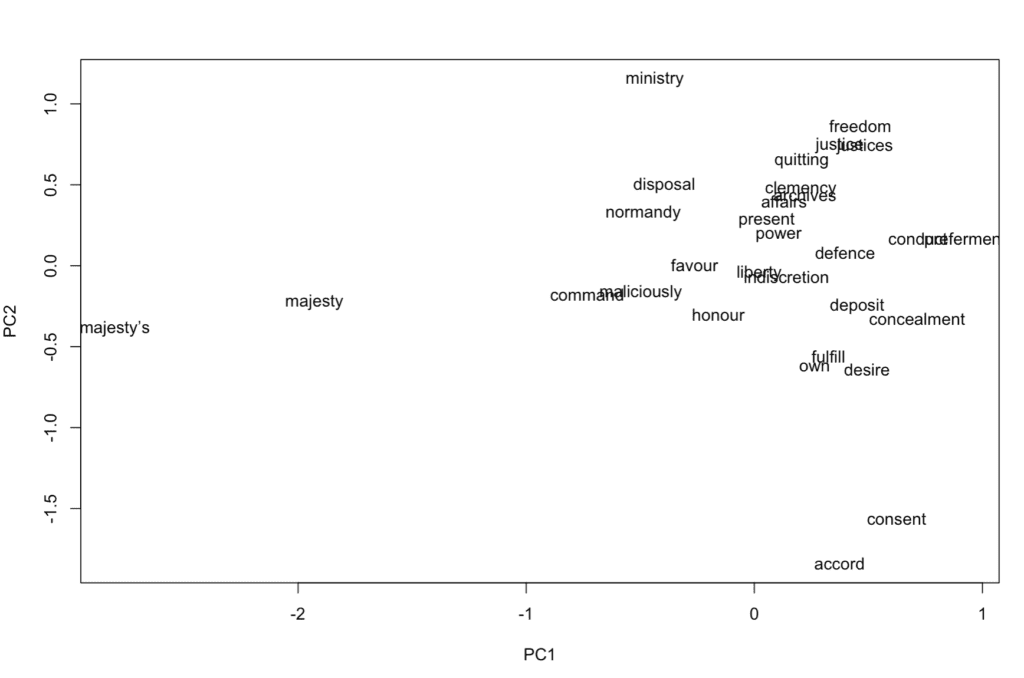
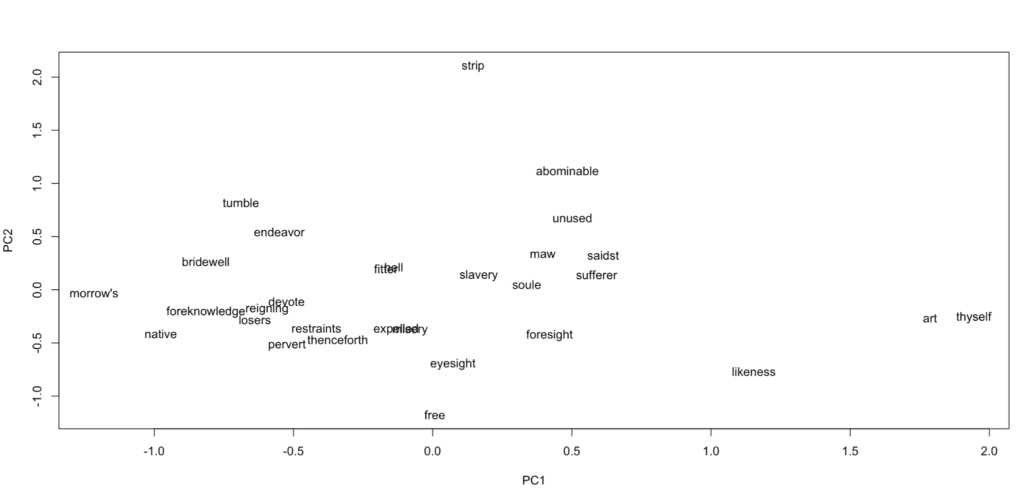
To explore these questions, I trained a Word2Vec model on approximately 158 of Sancho’s letters, roughly 68,000 words. The model maps words based on the contexts in which they appear. For example, words that regularly occur in similar contexts end up closer together, while words that rarely overlap sit farther apart. This exhibit frames how Word2Vec modeling can help us visualize language on a larger scale: rather than reading one letter at a time, this model enables us to see how Sancho uses language across all his letters.
The exhibit walks readers through six key words that I identified as I read the corpus more closely: friend, humanity, taste, power, liberty, and slavery. Then, I used each cluster of words with the highest cosine similarities relative to those keywords to demonstrate how Sancho’s language both participates in and complicates Enlightenment discourse. The word “humanity,” for instance, operates at the intersection of intellectual capacity and moral feeling. To be human, in this semantic field, is not only to think but also to feel ethically and relationally. For a general audience, this cluster visualizes something that isn’t as easy to demonstrate through a close reading of the letters. Similarly, “taste” moves most closely with knowledge, cultivation, and sublimity rather than with the senses, suggesting that for Sancho, good taste is a form of practical wisdom acquired through serious engagement, a direct challenge to the racialized assumptions that denied Black authors aesthetic judgment.
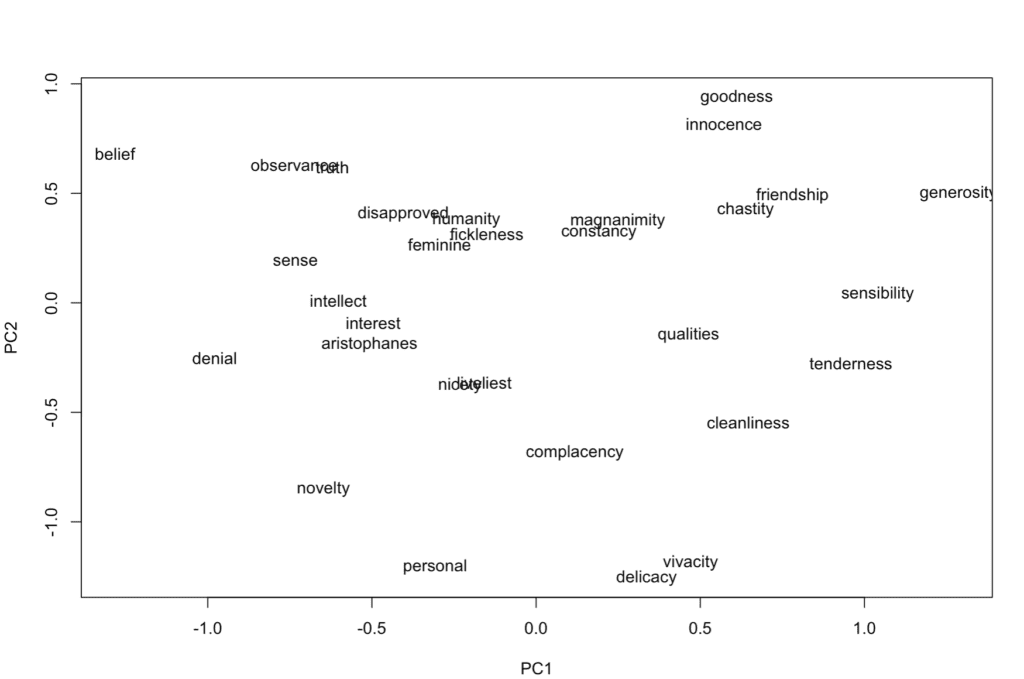
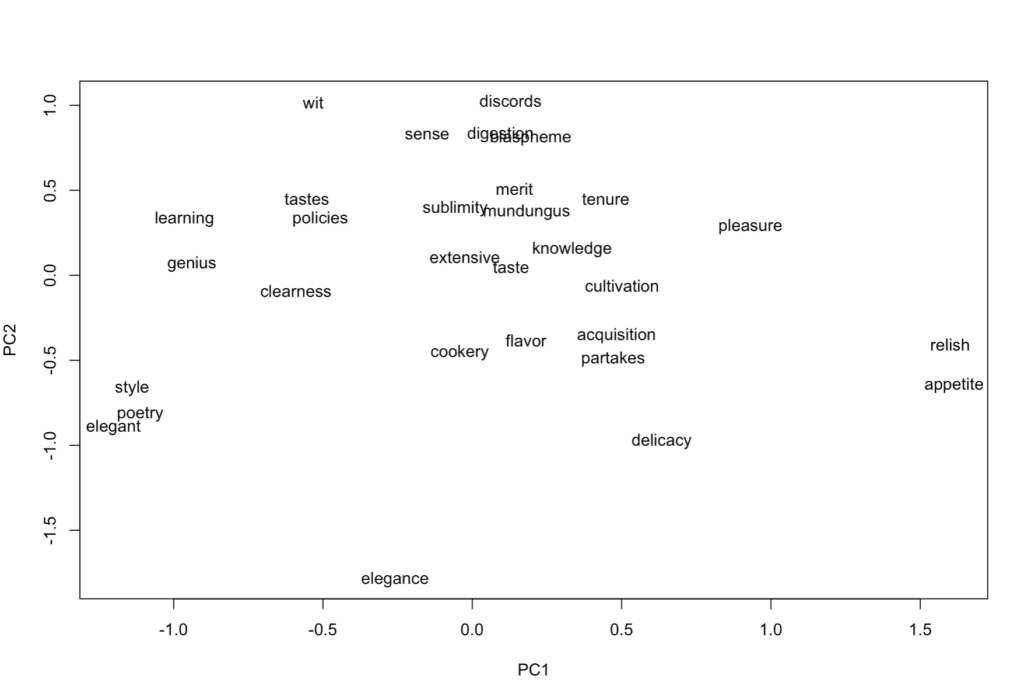
The politically charged terms reveal a more complex semantic terrain. The model separates “liberty” from “freedom,” with freedom clustering near justice and clemency, while liberty sits closest to favor, command, and indiscretion. “Slavery,” meanwhile, is not framed abstractly as a political issue but is deeply associated with moral, embodied, and structural injustice, situated beside soul, sufferer, and abominable. Rather than explaining word embedding models in more technical terms, I approached this exhibit by inviting readers to interpret the clusters themselves while offering some initial thoughts on what they might suggest. The idea was to demonstrate that the model does not tell us what something means. But it does show patterns of association, and those patterns give a new way to interpret structure across the corpus as a whole.
Case Study 3: Mapping Location in The Interesting Narrative of the Life of Olaudah Equiano, Or Gustavus Vassa, The African
A third exhibit utilizes StoryMapJS to trace the life and travels of Olaudah Equiano. While the first two exhibits introduced intertextuality and discursive belonging through Sancho’s letters, my goal with this exhibit was to introduce how we might map movement through digital humanities tools.
Olaudah Equiano (c. 1745-1797), a formerly enslaved African who later became a sailor, writer, and abolitionist, adopts the autobiographical travel narrative genre to claim narrative authority over his life and movement across the Atlantic. The Narrative traces Equiano’s trajectory from enslavement to freedom while simultaneously illustrating the brutality and abandonment experienced by enslaved individuals. When read intertextually, Equiano transforms a genre traditionally used to observe and classify otherness into a vehicle for self-authorship, political critique, and a claim to British belonging.

Equiano’s Interesting Narrative subverts traditional observational logic by reversing it, assuming the role of the mobile subject rather than the static subject being depicted, thereby asserting his authority to observe European societies, institutions such as the slave trade, and moral practices from within the empire. His narrative consistently redirects its focus to Britain and its colonial enterprise, assessing the implications of Christianity and the role of those beliefs in the context of imperial violence and ethics. In contrasting Christian values with the brutal treatment of enslaved individuals, Equiano exposes the ethical inconsistencies between Christian values and imperial practices. In his juxtaposition of economic calculation and ethical judgment, Equiano demonstrates mastery of Enlightenment modes of reasoning while revealing the injustices of the slave trade.
Each location Equiano passes through becomes evidence of his capacity for observation, reflection, and moral judgment and makes a case for his belonging within the broader world of Enlightenment humanism. By mapping these movements, the exhibit visualizes Equiano’s rhetorical strategy and situates his individual narrative within the transatlantic network of slavery, abolition, and intellectual exchange that shaped Black life in the eighteenth century. The point of this exhibit is also to make an argument about how geography functions within literature, extending the project’s central focus on the literary archive into physical space.
Case Study 4: Reception and Voyant
A fourth exhibit (still in progress) intends to use Voyant Tools to analyze the language used to describe Black-authored texts in reviews, criticism, and public commentary. This exhibit focuses on revealing how Black authors were read and what that reading revealed about the mechanisms of exclusion within eighteenth-century print culture.
Critical responses to Black authors during the long eighteenth century demonstrate that recognition was rare and never straightforward. In Notes on the State of Virginia (1785), for example, Thomas Jefferson dismisses the poetry of Phillis Wheatley Peters as mere imitation. This review of her work also functions as a rhetorical strategy to preserve the erroneous belief in white intellectual superiority. His critique of the letters of Ignatius Sancho gains additional power through its archival afterlife, as it is preserved, cited, and reiterated within Enlightenment and American intellectual history. Similarly, The Gentleman’s Magazine‘s review of Equiano frames his intellectual legitimacy as an exception rather than evidence of Black intellectual capacity in a broader sense. Recognition, in this context, is not an example of inclusion but rather of containment, positioning Equiano as an exception to ensure that his authorship does not challenge racial hierarchies that support claims to Black humanity and citizenship. To build the corpus, I am currently mining British periodicals such as the Monthly Review, the Critical Review, and The Gentleman’s Magazine through Gale Primary Sources and the British Periodicals database. My goal is to extend this search to philosophical and political texts in which Enlightenment thinkers name and dismiss specific Black authors, such as the mention of Francis Williams in the work of David Hume and Immanuel Kant. Furthermore, I plan to look more in-depth at American periodicals and newspapers, documents surrounding the authentication of Wheatley’s authorship, and abolitionist and counterargument literature.
Voyant Tools allows us to trace these patterns of co-ocurrence at scale by analyzing word frequency, keyword clusters, and linguistic patterns across a corpus of critical responses to reveal how the vocabulary of exclusion operated. The hope is that this exhibit will introduce the idea that criticism is never neutral, as the language used to evaluate Black authorship was itself a mechanism of the same system of taste and refinement that their writing challenged.
Reflection
My goal with choosing these particular topics and methods was to invite readers to consider how digital humanities can illuminate literary texts at scale and trace conceptual shifts, intertextual relationships, and patterns of engagement that traditional close reading alone cannot reveal. Looking closely at the work of 18th-century Black authors, such as Ignatius Sancho and Olaudah Equiano, also reveals their active participation within Enlightenment discourse, challenging the archival silences that have long obscured Black intellectuality. By making these texts visible, searchable, and citable, this work also participates in counteracting the active erasure of Black history from school curricula, national parks, and public archives. This work also raises questions of who gets cited, credited, and connected to intellectual traditions, but also who doesn’t and what that erasure means for our understanding of Black intellectual history.
Gikandi, Simon. Slavery and the Culture of Taste. Princeton University Press, 2011.
Nussbaum, Felicity A. “Being a Man: Olaudah Equiano and Ignatius Sancho.” Genius in Bondage: Literature of the Early Black Atlantic. edited by Vincent Carretta & Philip Gould. Lexington: University Press of Kentucky, 2001. pp. 72-88.