Inside the Arcola Lakes Library multipurpose room, residents of Westview and surrounding neighborhoods voiced growing concern during a recent Twin Lakes/North Shore Gardens Homeowners Association meeting. The focus: a nearby “AI-ready” data center many say they only recently discovered was being built in their backyard.
The project, spearheaded by New Hampshire-based information management company Iron Mountain, is known as the MIA-1 data center. The 150,000-square-foot facility is under construction on a 3.4-acre industrial site in Westview, a predominantly Black, unincorporated Miami-Dade community, as first reported by The Miami Herald.
The development has sparked debate over transparency, environmental health, and whether promised economic benefits will reach residents. It also comes amid a nationwide expansion of artificial intelligence data centers, often concentrated in overlooked, minority communities.

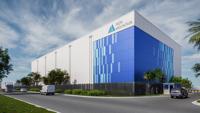
A rendering of the MIA-1 data center.
Not properly notified
A February 2025 groundbreaking announcement from the Miami-Dade Beacon Council described the center — a former storage facility — as a $150 million investment supporting the county’s “tech revolution,” stating that it would run on 100% carbon-free energy.
But many neighbors say they were unaware. Amy Dawkins, who lives less than half a mile away, said she was never notified. Elizabeth Favier Bellamy, who lives 1.8 miles away, expressed similar frustration.

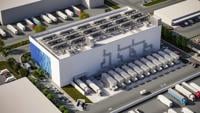
An aerial view of the MIA-1 data center in the industrial zoning area.
“I passed by there all the time, and when I found out that that’s what was being built there, I couldn’t believe it, especially with all the national news and coverage that data centers are given,” Bellamy said. “I hold the politicians responsible for this because they should have done a better job with their assessments.”
County officials maintain the project followed existing rules. Eric Silva, assistant director for development services at the Miami-Dade Department of Regulatory and Economic Resources, said the site’s industrial zoning meant the project was “permitted by right,” with an application submitted in 2023.


The Twin Lakes/North Shore Gardens Homeowners Association meeting was held on Monday, April 27.
Under county code, the facility is classified as a “telecommunications hub” rather than a “data center.”
“The request was not for the use, because the use is permitted by right. The request was for the height of the building,” Silva said, noting the company sought to increase height from 70 to 75 feet and reduce parking from 91 to 26 spaces.
Because no rezoning was required, notices were only mailed to properties within 500 feet.

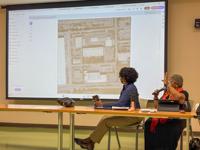
HOA President Vanessa Woodward Byers, holding the mic, and next to her, Elisha Moultrie, chairwoman of the NAACP Miami-Dade Branch’s Environmental and Climate Justice Committee.
“For a data center, only a 500-foot radius?” said HOA President Vanessa Woodward Byers. “When the noise issue and all of those other issues are beyond that.”
Residents say their unincorporated status leaves them vulnerable.
“It’s not getting that much attention because this is marginalized communities that historically have been overlooked and underserved,” Bellamy said. “We don’t have that extra layer of protection if we were incorporated. We are kind of almost treated like stepchildren in a sense.”
Oliver Telusma, District 2 senior policy and legislative strategist — a representative from the office of Commissioner Marleine Bastien, who represents the area — added that some project details were not fully available during the review due to confidentiality or non-disclosure agreements (NDAs)with local officials. Such agreements can limit public access to information about project scale, resource needs and potential impacts.
“There’s confidentiality agreements, which several states are dealing with around the country,” he said. “In this context, the full scope of the project was not even available for the board to review. It was even under a different project name.”
Environmental and utility concerns


Residents listening to county representatives at the Arcola Lakes Library.
Data centers house massive arrays of computer servers, cooling systems and backup power equipment. As of April 2026, Miami-Dade hosts 27 of Florida’s 110 data centers.
While Iron Mountain claims the site will use renewable energy, the specific sources remain unclear.Nationally, the surge in AI has drawn scrutiny for immense resource demands.
TheWorld Resources Institutereports that a single modern AI data center can consume as much power as 100,000 homes. Furthermore, a 2025 Bloomberg analysis found that residents living near such facilities saw energy bills jump as much as 267% over five years.
Mid-sized data centers can use up to 300,000 gallons of water per day, and large ones can consume as much as 5 million gallons per day.
Residents also fear for their air quality. Data centers often rely on diesel generators for backup power, which release nitrogen oxides and fine particulate matter linked to asthma and heart disease.
“By the time we figure out what the long-term effects are, it’s going to be irreversible, and we can’t afford to do that,” Dawkins said.
The NAACP has taken notice, launching a national“Stop Dirty Data” campaign.
“We are bound to make certain that our members and community are informed about the pros and cons as it relates to data centers in our community,” said Miami-Dade Branch President Daniella Pierre.
Elisha Moultrie, chairwoman of the branch’s Environmental and Climate Justice Committee, said the “Stop Dirty Data” framework calls for transparency, environmental health monitoring, public records requests, community input and moratoriums when needed.
“We all know that AI is the future,” Moultrie said. “We want to make sure that everybody understands there’s a risk. Does that risk outweigh the benefit?”
Jobs and accountability
While the Beacon Council claims the project will create 30 jobs with average salaries over $71,000, residents remain skeptical.
“Who are these jobs going to? Are they going to go locally? Are they going to establish a relationship with some of the nearby colleges or universities or high schools?” Bellamy asked.
Dawkins added that she wants to see a formal Community Benefits Agreement.
“Someone show us something that outlines in very clear detail what exactly the benefit is for us placing this particular facility in our community?”
Legal safeguards also appear thin. Florida Senate Bill 484— currently sitting on the governor’s desk — was designed to protect ratepayers by requiring large-scale data centers (50+ MW) to pay for their own utility infrastructure. However, because MIA-1 is rated at 16 MW, it falls below the threshold, meaning many of the bill’s safeguards won’t apply.
For residents like Bellamy, the lack of transparency has created a climate of deep distrust.
“If there was a data center right in our backyard in hiding, that makes me wonder every time I see a crane or a construction site, well, what else is being built?” she said. “What else are they not being transparent about?”