


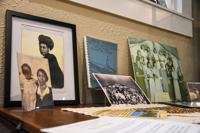
Photos are displayed June 14 at Fielder House Museum. The photos show what life was like for Black people in early Arlington.
Editor’s note: This story is part of a series that covers historical events, buildings and people that have made Arlington the place it is today while celebrating the city’s 150th anniversary.
In Arlington today, there is little remaining of what once was. Few buildings have withstood time, leaving entire sections of history remembered by those who lived it.
When walking down the streets of Arlington, it’s an ever-growing college town, but once it was a fledgling town, home to a segregated Black community who lived in a roughly six-block area, its residents called The Hill.
In the late nineteenth century, a community was slowly being established. E. F. Wilkerson, a wealthy white resident of Arlington, purchased land north of the town, which was later incorporated into Arlington as the Wilkerson Addition in 1907, according to the Texas State Historical Association.
The land was one of the only residential options for Black residents of the city, and later became the heart of The Hill. Further expansion later led to the community spanning from Division Street, Sanford Street, Taylor Street and N. L. Robinson Drive, according to the Texas State Historical Association.
Geraldine Mills, Fielder House Museum director, said the addition was formed with the intention of building rental houses for Black families. Mills said several families were able to purchase or rent property within the confines of the addition.


Reverend Carl Pointer speaks before a screening of “Echoes from The Hill” June 14 at Fielder House Museum. Reverend Pointer relays his life story in the five-part documentary.
Churches, a grocery store, a school and more were built in the early twentieth century. In the 1920s, a community began to grow in The Hill. By the 1940s, it was a bustling neighborhood of less than 200 people.
Fort Worth resident Carl Pointer, 73, grew up in The Hill in the late 1950s and 60s. He said the church was an important part of the community.
“It was a very tight-knit, small, self-contained community with the center of the community being the two major institutions, was the churches and the school,” he said.
Old ladies used to sit on their front porches with a fan in one hand and iced tea in the other, Pointer said. He said they were the watchmen of the community.
“They saw everything and it was like having a hundred eyes on you at all times, so you didn’t have a chance to misbehave because they would correct you on the spot, and the worst thing they could do was tell your parents because those old ladies had status,” he said.
Growing up during the end of Jim Crow, Pointer lived in a world some only know from history books and documentaries. Everything was segregated by race, Pointer said. Black people were limited to living in the Wilkerson Addition because white people would not rent or sell property to a Black person in Arlington, he said.

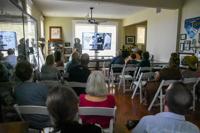
Event-goers watch a screening of “Echoes from The Hill” June 14 at Fielder House Museum. The documentary showed the history of Arlington’s early Black community.
Black people could not go into white restaurants, nor could they go to the library, Pointer said. If they tried, they would be arrested.
“The Hill was a safe place, because you didn’t have to deal with all the institutional racism – legal institutional racism – or being insulted,” he said.
Booker T. Washington was the only elementary school for Black children in Arlington at the time. The school went up to the eighth grade. Pointer said I. M. Terrell High School in downtown Fort Worth was where Black students would have to go if they wanted to continue their education.
“Segregation was the law. It wasn’t one person acting up or being inconsiderate; it was the law of the land,” he said.
When segregation ended in 1964, Black students were allowed to attend other Arlington schools. Later, Booker T Washington was turned into a special needs school, Pointer said. He said the influence of the institution had vanished, all of its history gone.
By the time Pointer left high school, The Hill was changing.
“It happened gradually. Several of the old timers stayed there because they owned their homes; they didn’t move out or sell,” Mills said.
Mills said by the 70s and 80s, most of The Hill’s residents had moved out. The decades of community, of camaraderie and resilience, were gone. She said the churchgoers still came, but they no longer lived there.

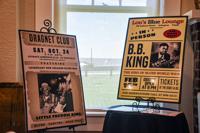
Live entertainment posters are displayed June 14 at Fielder House Museum. Clubs such as Lou’s Blue Lounge were founded by Black Arlington residents.
On June 14, the Fielder House Museum hosted Revisiting Arlington’s Historic Hill Community. The event featured a viewing of the documentary “Echoes from The Hill,” the first in a series of several documentaries, as well as collected artifacts highlighting the stories, people and places that made The Hill.
Family portraits and personal essays could be found in the display cases, nightclub posters were laid out with a photo album of visitors and much more was displayed on the bottom floor of Fielder House Museum.
Arlington resident Debra Rundles, 61, said she learned about the event through Facebook. Though she did not know much about The Hill prior to the event, she said the event was well-represented and the documentary shown made her understand the city more.
“Reverend Carl Pointer was my neighbor as a little girl growing up, and I wanted to come and hear him speak and also find out what The Hill meant in Arlington,” she said.
Now all that remains today of The Hill community are the three churches, Emmanuel Church of God in Christ, Mount Olive Baptist Church and the Armstrong Chapel AME as well as several historical plaques placed around the area.
@atclements03
news-editor.shorthorn@uta.edu


