
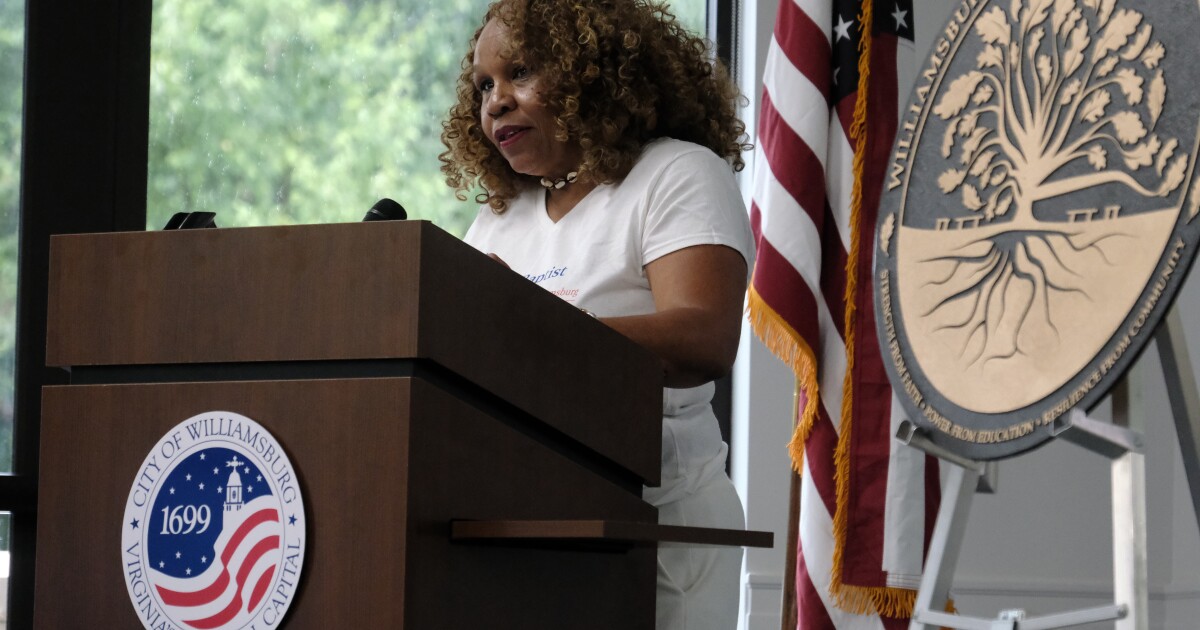
Williamsburg moved the groundbreaking for its African American Heritage Trail indoors to the police headquarters near the planned trailhead on a rainy Juneteenth morning.
While some may have seen the weather as an inconvenience, Connie Harshaw didn’t.
“That’s a symbol for most of us who are in the African American community that it’s a cleansing and also preparation for what’s to come,” said Harshaw, president of the Let Freedom Ring Foundation, which preserves history at Williamsburg’s First Baptist Church.
The church will be the first stop on the trail.
“We had a dream and together we made it happen.”
The heritage trail was introduced as a city project about six years ago. It will stretch two miles through downtown Williamsburg along existing and new walkways with markers at a dozen stops highlighting important places, people and moments for the longstanding Black community. It was supposed to open on Juneteenth. The city got the last piece of funding through a Virginia Museum of History & Culture grant in early March.
Meetings with members of the Descendant community, African Americans with roots in Williamsburg’s earliest days, began in 2023.
Marketing agency JMI in 2024 took that input and shaped it into a storyline. Three themes underpin the narrative: strength derived from faith; power gained from education; and resilience built from community.
When finished by the end of 2026, the trail will include a dozen important spots such as Braxton Court, built by Robert Braxton and housing Black residents uprooted by Colonial Williamsburg’s restoration starting in the 1920s; and the Cooke Building, built where the city’s first NAACP office stood and named for businessman and civil rights leader Herbert Cooke. It also reaches onto the William & Mary campus to include the Sankofa Bird Statue and Hearth: Memorial to the Enslaved.
“Today we break ground on more than just a trail,” said City Manager Michele DeWitt. “We break ground on a community commitment to tell a fuller story of Williamsburg and its enduring contribution to the American story — a story that has always been there, but has not always been fully recognized.”
Johnette Weaver served on the trail’s advisory committee. A historian of local Black history, she spoke at Friday’s groundbreaking about the legacy of her family and African Americans in Williamsburg. Weaver didn’t know the fullness of her history while growing up in the Magruder and Highland Park neighborhoods, but she said her granddaughter Emma will.
“She will not grow up not knowing who she was or where she came from or why honor must be paid,” Weaver said. “I grew up riding my bike out of that neighborhood that was all Black into the historic area, going up and down the streets, being told sometimes by visitors to the town that I didn’t really belong over there; now there’s a trail that tells the story.”
Instead of a ceremonial shovel of dirt, those in attendance on Friday signed the back of a bronze medallion bearing the image of the iconic Compton Oak in Colonial Williamsburg. A medallion will mark each stop of the trail once completed.
A virtual version of the trail, which also includes an augmented reality view at stops along the trail, is available online.


