“Lift Every Voice and Sing,” often referred to as the Black National Anthem, was the main inspiration for the design of Fayetteville’s Black Voices Museum.
The hymn’s lyrics cover the exterior of what will be the museum’s modern four-story building. Their meaning — a solemn yet hopeful appeal to liberty — guided what the museum will offer, according to Roger Smith, principal and design director with the museum’s contracted architecture firm. Smith presented the renderings during a public information session on Wednesday night at Segra Stadium.
“We thought, ‘What if the museum was conceived as a series of galleries, each lifting the unique voices of African Americans higher and higher as you move through the space?” Smith said to the dozen residents in attendance. “What if we could create a space that gave you that kind of feeling and actually contributed to that lifting up of voices?”
First conceptualized by Fayetteville native Joel Fleishman around 2020, the Black Voices Museum and Centers for Equity at 122 Person St. is dedicated to honoring and preserving the contributions of local Black residents, according to the museum’s website. The 83,000-square-foot museum will feature two exhibition halls and a theater, an economic development hub, and a center dedicated to advancing equity in health care, education and environmental issues, according to the renderings presented by the Gensler architecture firm.
The design process was funded using $90,000 from the Cumberland County Board of Commissioners and the Fayetteville City Council.
“It needed to be audacious,” Bill Cassell, Black Voices Museum project coordinator, said of the design. Cassell was an original partner on the museum project and took up its mantle after Fleishman died last year. “It needed to be a piece of the puzzle that was equivalent to the National Museum of African American History and Culture, to Charleston, to Montgomery, to the best in class, a must-see stop on Civil Rights tours.”
-

Initial renderings of 83,000-square-foot Fayetteville’s Black Voices Museum were presented to residents at Segra Stadium on Sept. 30, 2025. Credit: Morgan Casey / CityView -

A rendering of an aerial view of the Fayetteville’s Black Voices Museum showing how the repeated lyrics to “Lift Every Voice and Sing” covering the exterior of the building would look was presented on Sept. 30, 2025. Credit: Morgan Casey / CityView -
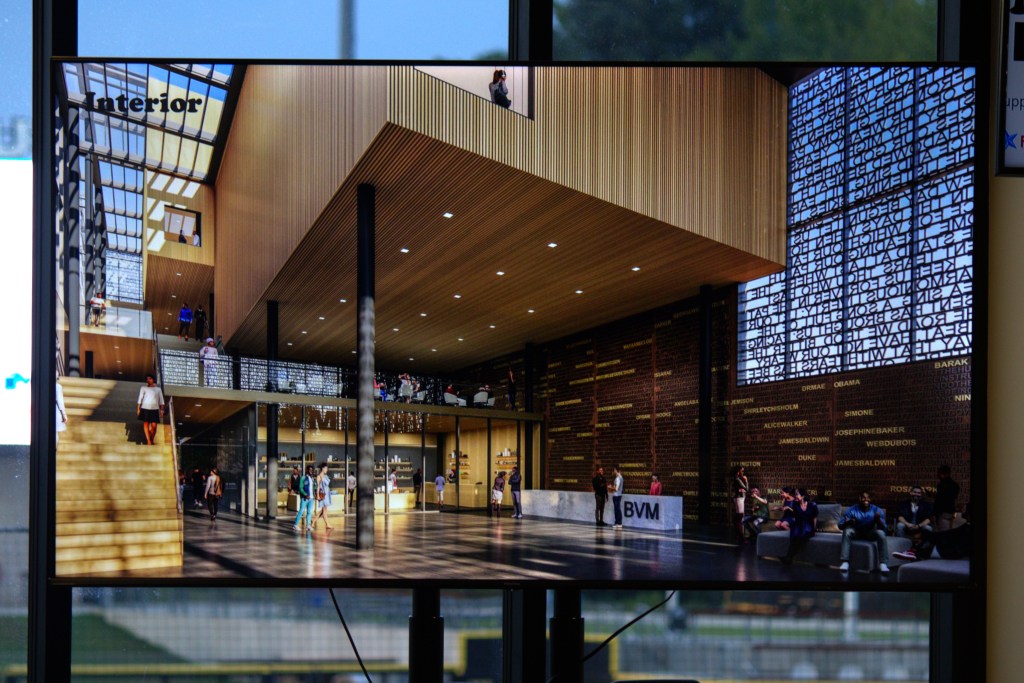
A rendering of the interior of Fayetteville’s Black Voices Museum, which is still in the early phases of development, was presented to residents at Segra Stadium on Sept. 30, 2025. Credit: Morgan Casey / CityView
Galleries distributed across the museum’s two exhibition floors will be organized in a way that shows how Black voices built off one another throughout history, Smith said, starting with activists and civic leaders, then transitioning to scholars and poets, and ending with artists and musicians.
What and who exactly will be featured in those galleries is still to be determined, with plans for a museum master plan and exhibition design to begin in the next development phase.
The proposed design was based on about 10 months of community feedback led by Dauv Evans, the museum’s community outreach coordinator. The outreach included nine individual interviews with community leaders, three public workshops attended by 47 people and 51 responses to an online survey.
Museum project leadership team members also took inspiration from the design and offerings of cultural and history museums across the country — including the National Museum of African American History and Culture in Washington D.C., the Harvey B. Gantt Center for African-American Arts and Culture in Charlotte and the Equal Justice Initiative’s Legacy Museum in Montgomery, Alabama.
The museum’s economic development hub and equity-advancing center were partially modeled after Impact Hub Baltimore, a coworking and skills-sharing space in Maryland. The economic development hub, called the Empowerment Hub, will connect Fayetteville residents with vocational training and small business development courses to create “pathways to education, employment and long-term opportunity,” according to the museum’s presentation.
The equity-advancing center, named the Centers for Social Equity, aims to connect residents with researchers and advocates to influence local, state and federal policy.
“This is actually a service and a hub to the community that really will serve as a beacon,” Reginald Truxon, an architect at Gensler, said. “It will serve as an icon and serve as support, not just a look-see place.”

To get the Black Voices Museum off the ground, project leadership budgeted start-up costs, which include personnel, temporary office and rent to store its collections, at $10.2 million. Between $175 and $215 million is needed to execute the museum’s design, assuming construction begins sometime between January and March of 2029 and finishes between July and September of 2031.
The museum’s annual operational costs are estimated at over $3.6 million. Those costs are offset by an expected almost $2.2 million in revenue from admission and membership fees, retail sales and event space rentals. The $1.45 million revenue deficit, accounting for 40% of operational costs, would need to be made up through annual fundraising and grants. This amount is in line with comparable museums, according to Truxon.
Cassell said the details are still highly conceptual, and the museum’s opening will heavily depend on community support and private donations. Evans said city council members and county commissioners will receive the same presentation sometime in November or December and will decide whether to allow the team to move on to the museum’s second development phase.
“We’re really still very early,” Truxon said. “There’s still a lot to go.”
CityView Reporter Morgan Casey is a corps member with Report for America, a national service program that places journalists into local newsrooms. Morgan’s reporting focuses on health care issues in and around Cumberland County and can be supported through the News Foundation of Greater Fayetteville.