CARL MURPHY WAS TEACHING and serving as chair of the
German language department at Howard University in 1918 when
his father sent word that he was needed in Baltimore. The time had come to return home and work for the family paper.
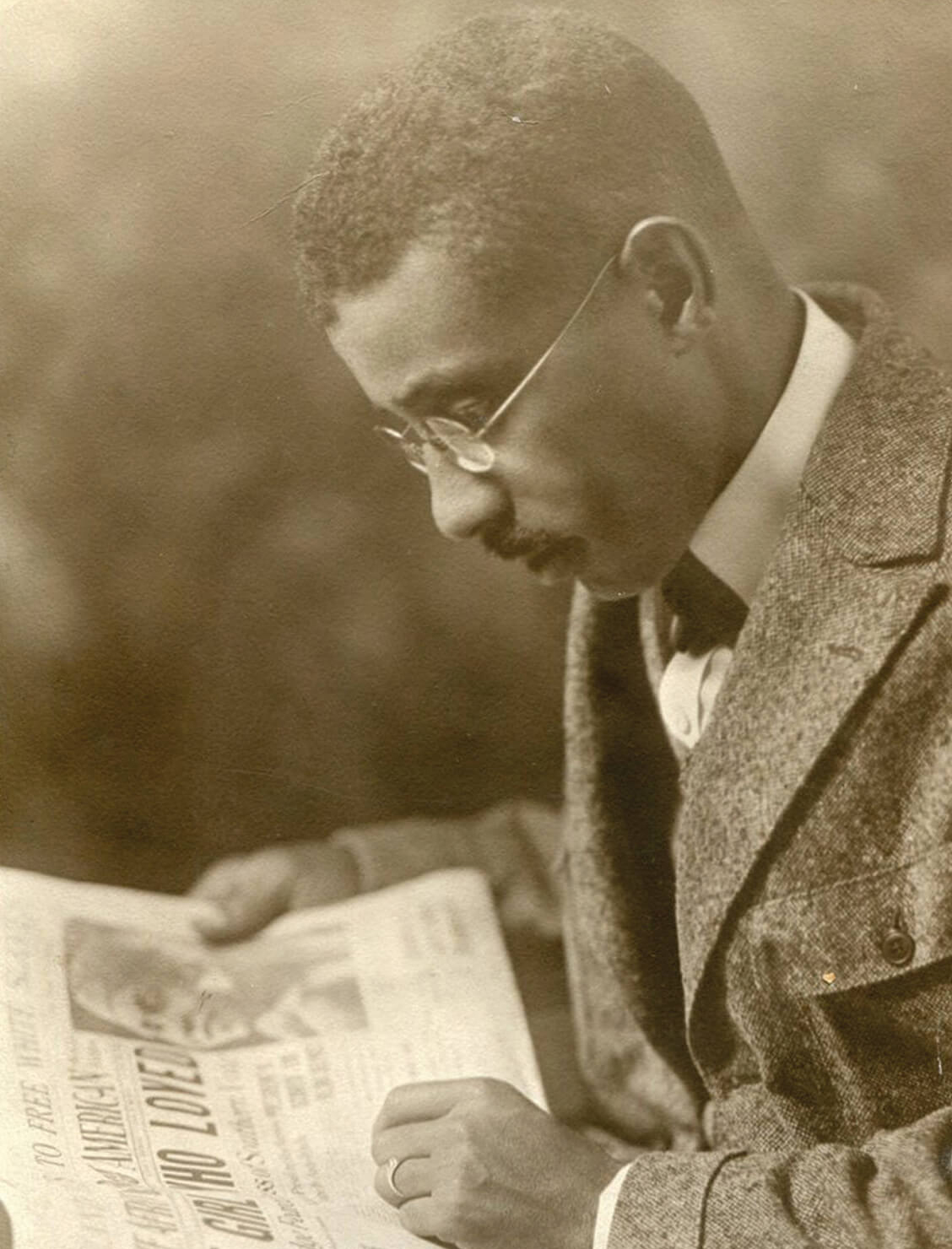
A portrait of visionary
publisher Carl Murphy. —Courtesy of The Afro American Newspaper Archives
publisher Carl Murphy. —Courtesy of The Afro American Newspaper Archives
Four years later, John Murphy Sr. died and the surviving Murphy
clan elected Carl to fill the shoes of The Afro founder in his role as
publisher and chief editor. A graduate of Frederick Douglass High
School, and Howard and Harvard universities, the younger Murphy
immersed himself in his new career, learning every aspect of the
newspaper and publishing business.
Under Carl Murphy’s leadership, The Afro-American became the
largest circulating Black newspaper on the East Coast, and one of
the most influential and financially successful Black newspapers
in the country. He hired the best writers, photographers (see “The Daily Hustle,” on the photographs of I. Henry Phillips Sr., below), and artists, including the renowned Bearden, who served as
The Afro’s weekly cartoonist in the mid-1930s. Almost 50 years
later, Bearden would create “Baltimore Uproar,” the iconic mosaic
celebrating Billie Holiday and American Jazz at the Upton Metro
Station on Pennsylvania Avenue.
Acclaimed journalists under Murphy’s tenure include the aforementioned
Mitchell, who would become known as the “101st Senator”
for his lobbying on behalf of the 1960s Civil Rights legislation;
the courageous Civil Rights Era journalist Moses Newson (see “Editor Has a Close Brush With Death,” below); William Worthy, who would defy U.S.
Department of State travel restrictions
and cover revolutions in China, Cuba,
and Iran; J. Saunders Redding, an influential
literary critic and the first Black
faculty member of an Ivy League school
(Brown University); and Baltimore-native
Simeone Booker, who later became The
Washington Post’s first Black journalist.
Booker, in fact, had grown up around The Afro—Carl Murphy was a relative. He later explained in
an interview with the Library of Congress that he
had been inspired by his uncle to attend Harvard,
winning a competitive Neiman scholarship, though
it did not jumpstart his career the way he hoped.
“When I finished, I wanted to go to The Washington
Post, which I thought would be an advancement,”
recalled Booker. “But when an opening came, I was
so far down the ladder, I found my experience and
Harvard background, unlike my Neiman colleagues,
were of no use. I was a cub reporter.”
“I kept thinking about it,” he says. “I thought I could
do something like it.”
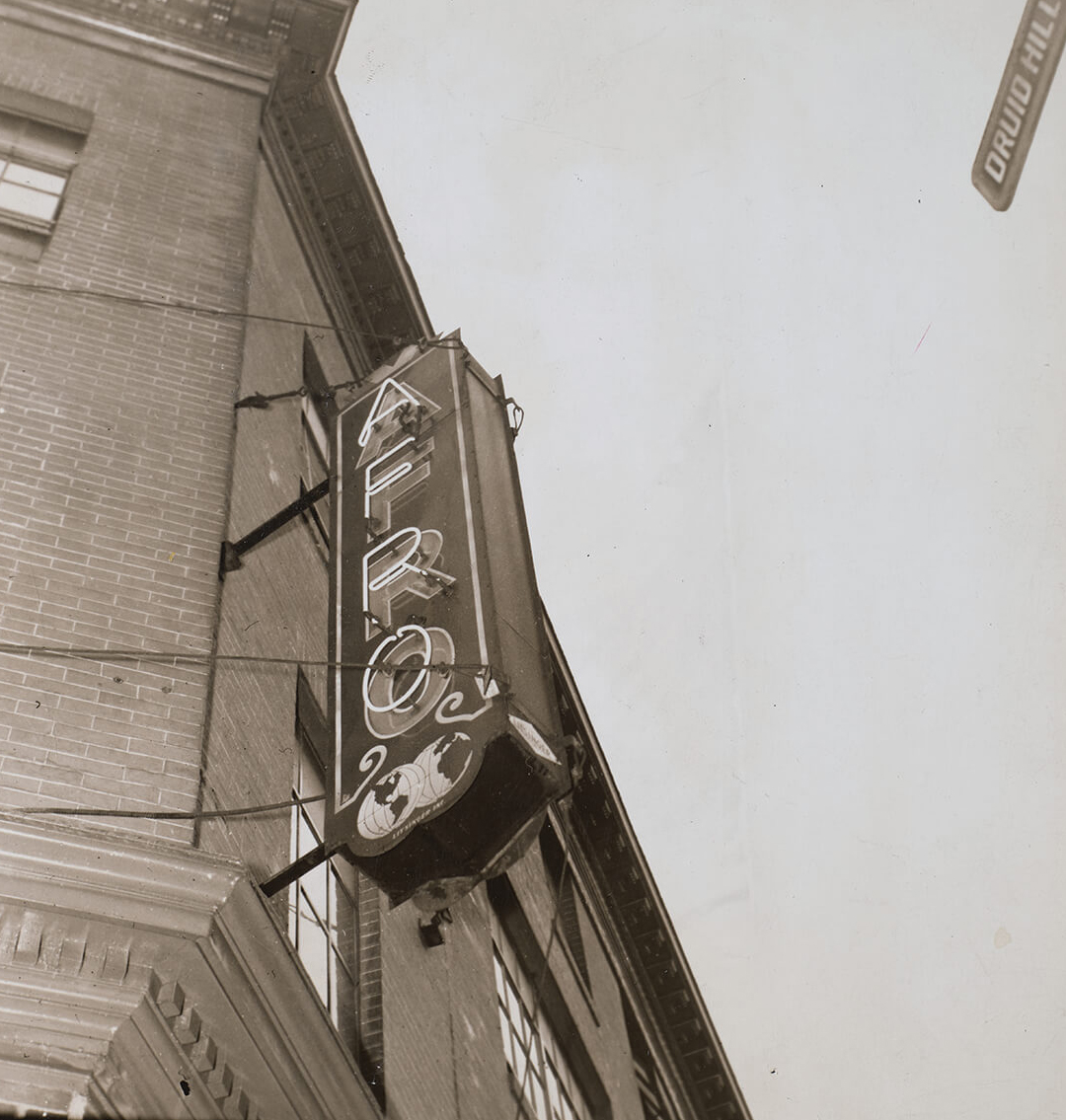
The
historic exterior of The
Afro. —Courtesy of The Afro American Newspaper Archives
The
historic exterior of The
Afro. —Courtesy of The Afro American Newspaper Archives
In 1951, Booker left The Washington Post for
startup Jet magazine, where he served as Washington
bureau chief, writing for it and its sister publication,
Ebony, for more than 50 years.
Also hired under Murphys’ tenure: Howard grad
and former semi-professional ballplayer Sam Lacy,
who penned the must-read “A to Z” sports column for
nearly 60 years. Lacy waged a decade-long campaign
to integrate baseball as he chronicled the exploits of
Negro League stars like Satchel Paige, Josh Gibson,
Cool Papa Bell, as well as Hall of Fame Baltimore Elite
Giants catcher Roy Campanella and Campanella’s
future Brooklyn Dodgers teammate Jackie Robinson.
Simply covering Robinson’s first spring training with
the Dodgers proved stressful, Lacy later wrote.
“I felt a lump in my throat each time a ball was hit
in his direction those first few days,” Lacy recalled in
The Afro. “I was constantly in fear of his muffing an
easy roller under the stress of things. And I uttered a
silent prayer of thanks as, with eyes closed, I heard
the solid whack of Robinson’s bat against the ball.”
Lacy distinguished himself as No. 42 did. He became
the first Black sportswriter to join the Baseball
Writers’ Association of America and earned entrance
into the writers’ wing of the Baseball Hall of Fame.
Presciently, given its founding investor and women-led staff today, The Afro-American also became
home for trailblazing women. In the 1930s, it was
the first Black paper to hire female sportswriters when
it brought Nell Dodson and Lillian Johnson on board.
Predating Lacy, Dodson highlighted the disparity between
Black and white ballplayers in pay and working
conditions. She would be promoted to sports editor,
writing a column called
“Lady in the Press Box” in
the late 1930s before covering
arts and culture for New
York outlets, including the
Amsterdam News.
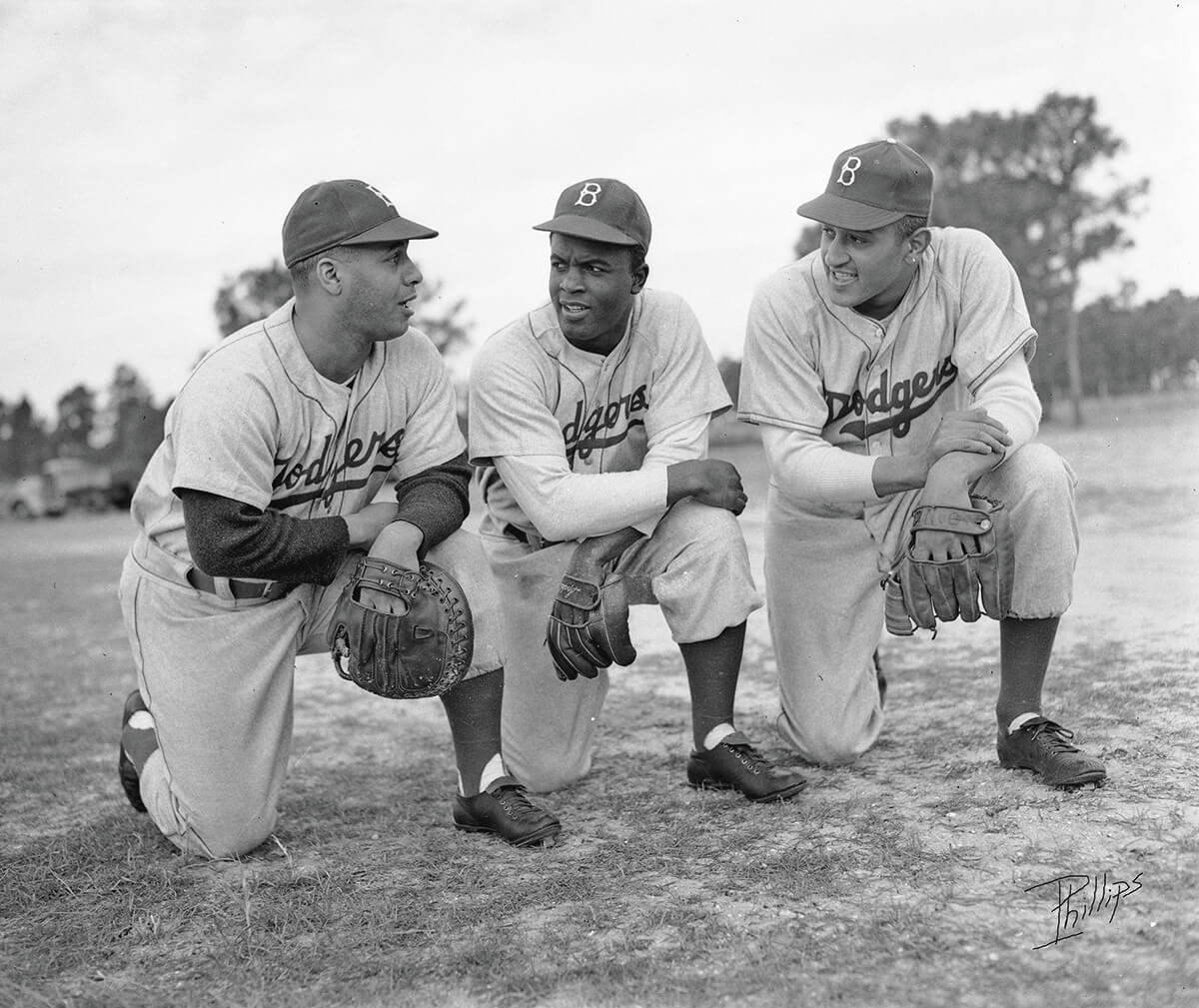
Brooklyn Dodgers
Roy Campanella, Jackie
Robinson, and Don Newcombe
at spring training. —Photography by I. Henry Phillips Sr., courtesy of Webster Phillips
Brooklyn Dodgers
Roy Campanella, Jackie
Robinson, and Don Newcombe
at spring training. —Photography by I. Henry Phillips Sr., courtesy of Webster Phillips
Johnson, too, spread her wings and covered arts and culture, including a sit-down with Billie
Holiday herself for a timeless Royal Theatre dressing room interview
in 1937, gleaning some delightful details about the Baltimore background
of the “New Swing Sensation” and Lady Day’s love of fashion.
“It’s a throwaway line here, but our history, our comprehensive
history cannot be told through government records alone,” says Corey
Lewis, one of two assistant archivists at the Maryland State Archives,
which is holding The Afro-American archive until the Upton Mansion
renovation is complete. “Without The Afro to fill in the blanks, to tell
these stories, to show the humanity that you cannot find in government
records, where would we be? Where would people who looked
like the people in the communities that The Afro covered see themselves?”
Lewis continues during a walking tour through the long rows
of the newspaper’s bound volumes at the temperature-controlled
facility. “You might hear or learn about traumas during Jim Crow and
segregation, but where would you read about the neighborhoods that
were built? The businesses, theaters, and local shops? The camaraderie
of those neighborhoods and places?
“The more I’ve come to learn about particular people, I’m astonished
by their lives and what they did.”