

On a sunny Sunday earlier this month, at the corner of 75th Avenue and Renton Avenue South, the community gathered for the opening of Skyway’s Black Panther Park. Inspired by the Black Panther’s Free Breakfast for School Children program that compelled the federal government to provide breakfast in schools, Black Panther Park is a community garden—planted, preserved, and protected by the surrounding residents of Skyway.
“When the name got settled on, we knew it was the first,” says Jake Harris, owner of Stone Soup Gardens, a design and installation company and one of the partner organizations responsible for making the vision of Black Panther Park come to life. “We knew in Oakland, there’s a park named after one of the fallen Panthers, and in other cities. In Chicago, there was a park that was dedicated to fallen Panthers, but none are called ‘Black Panther Park.’”
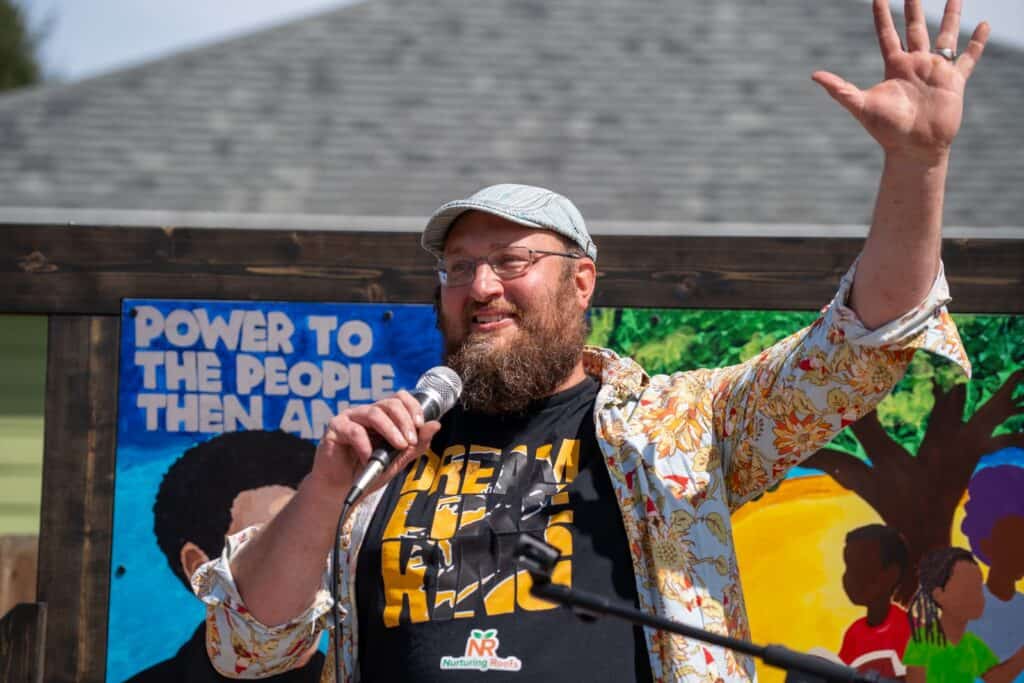
Jake Harris of Stone Soup Gardens speaks at the opening of Black Panther Park, one of the partners who helped bring the community-led project to life.
Photo by Susan Fried
Black Panther Park is designed so that anyone walking past may come and pick from its garden, which was planted by volunteer hands from Skyway’s surrounding neighborhoods.
“They rallied all winter to make this happen. When we started this, we were originally trying to plan for breaking ground last spring, so that we’d have summer work parties, but we ended up breaking ground in September,” says Harris. “As soon as it got cold and rainy is when we started inviting the community out, and people showed up. The first work party we had was in the pouring rain.” Harris says Michael Dixon, the son of one of the original Black Panthers of the Seattle chapter, attended one of the work parties.
Harris says once they saw the work parties, people became curious, “We had so many people pulling up once they saw work parties happening here. It was like the dream team of urban farm activists.”
Nyema Clark, founder of Nurturing Roots and primary lead for the project, fought back tears as she struggled to find the words to convey what it meant to finally be able to present Black Panther Park to the Skyway community.
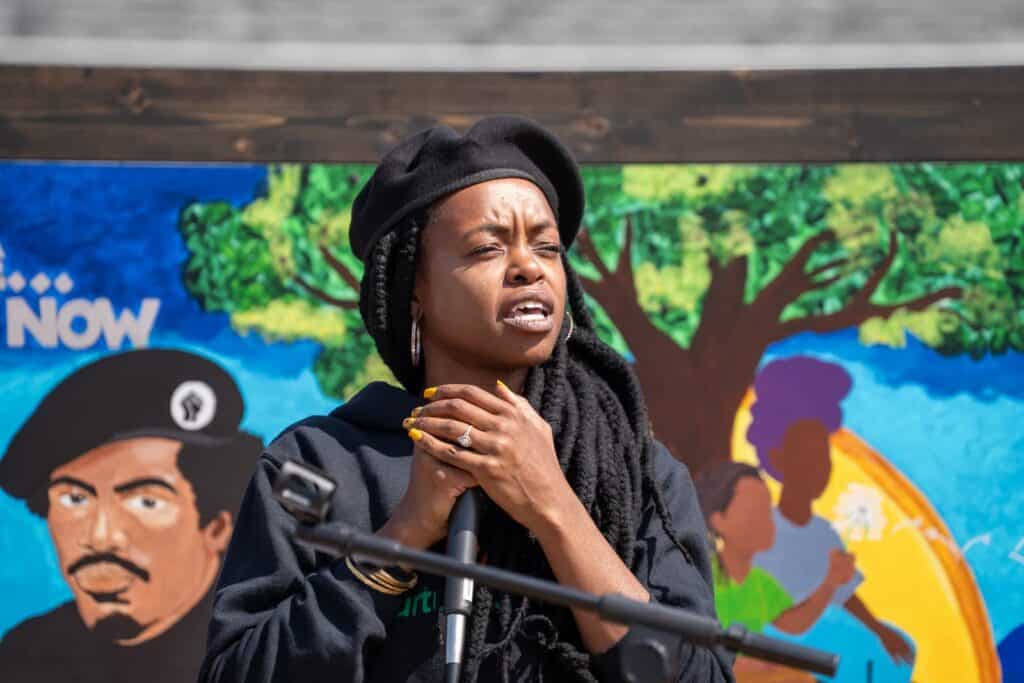
Nyema Clark reflects on the community effort behind the garden and what it means to see it open.
Photo by Susan Fried
“I feel elated. I feel like the English language does not have the true words that I’m feeling,” says Clark while sitting on a rock, trying to balance her young child in her lap. “I’m humbled, I’m appreciative, I’m in shock. I’m just happy looking at my community everywhere. I’m overwhelmed with gratitude.”
Clark admired the Black Panthers from the moment she learned about them and the role they played in Seattle’s civil rights movement. Aaron and Elmer Dixon were 19 and 17 years old in 1968 when they established the first Black Panther chapter outside of California. Clark was not much younger than they were then when she started a Black Panther awareness program at her high school.
“In high school, I looked up to the Black Panthers—I wanted to be a Black Panther. I had the honor of producing a Black Panther awareness program at Rainier Beach High School because of my teacher, Mark Epstein, who was also my first donor when I opened up Nurturing Roots. He’s believed in me for so long,” says Clark..
Clark says Epstein’s encouragement planted a seed in her that sprouted and refused to die, “He allowed us to dig deep into our education and learn what was going on with our systems and in our community, and created an agency in me that never died.”
Standing over the rows of planted vegetables and raised beds are original art pieces from artists across the country, all implementing Blackness as a major motif.
Skyway artist Ari Glass, who has a painting displayed in Black Panther Park, calls the park’s transformation alchemy.
“For them to put in the alchemy, to transform something that was just nothing—just grassland—to this living park is amazing,” says Glass. “It was lead, now it’s gold. Now it’s something that’s shining. You see the energy that’s vibrating off of it. That’s something that we can all absorb and get that energy, that charge, through the artwork and the agriculture, through the education and the legacy of the Panthers.”
Alongside the artists and the urban farmers, Black Panther Park was brought to life with the help of the only Black-owned and led concrete supplier in the state of Washington, Trinity Development Corporation.
“My father started this business in 1999. We were the first Black contractors on the light rail project,” says Terry Calloway, Jr. “We’ve done thousands of projects all over the city of Seattle. This specific project was cool because it allows us to leave a footprint on the ground, an imprint.”
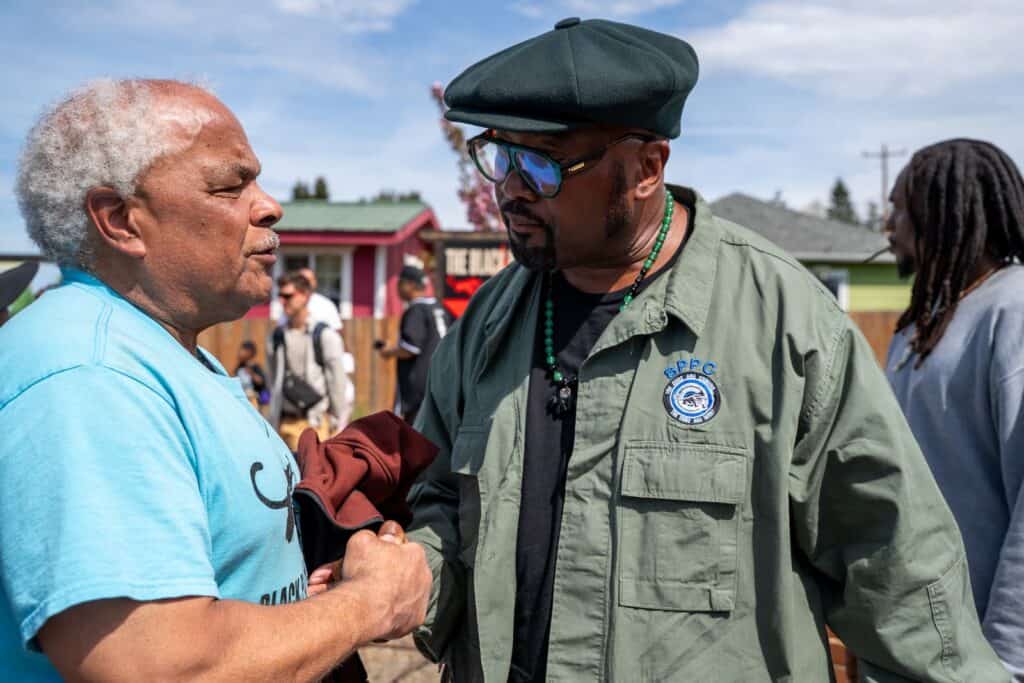
Michael Dixon, the brother of Aaron and Elmer Dixon, founding members of the Seattle Chapter of the Black Panther Party shakes hands with Fred Hampton Jr. at the opening of Black Panther park.
Photo by Susan Fried
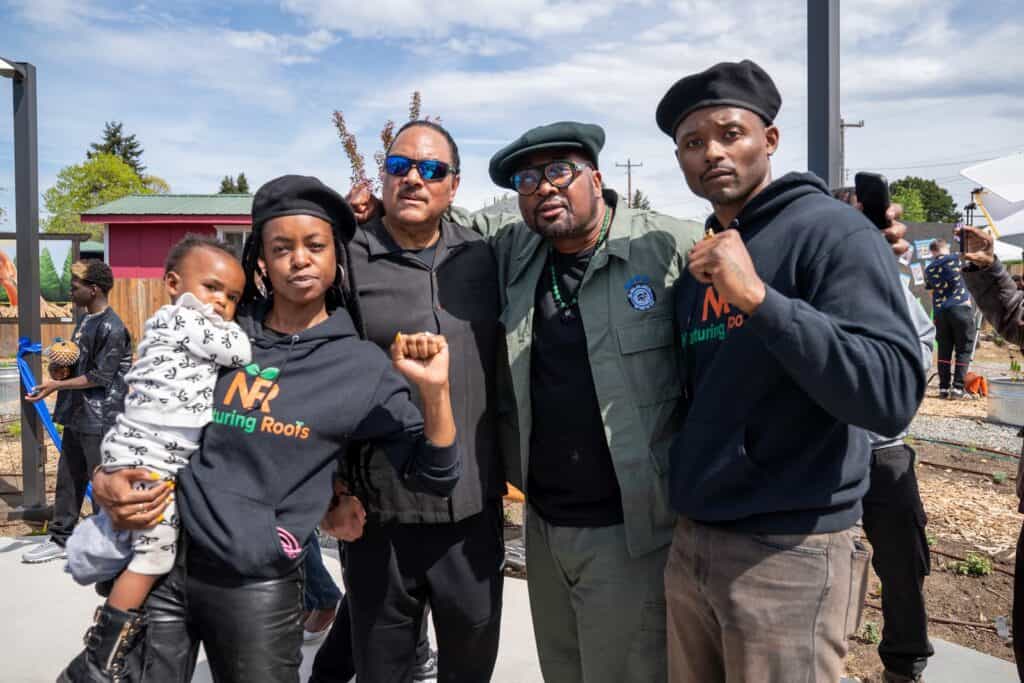
Nyema Clark, Elmer Dixon, Fred Hampton Jr., and Najee Ladd-Ali.
Photo by Susan Fried
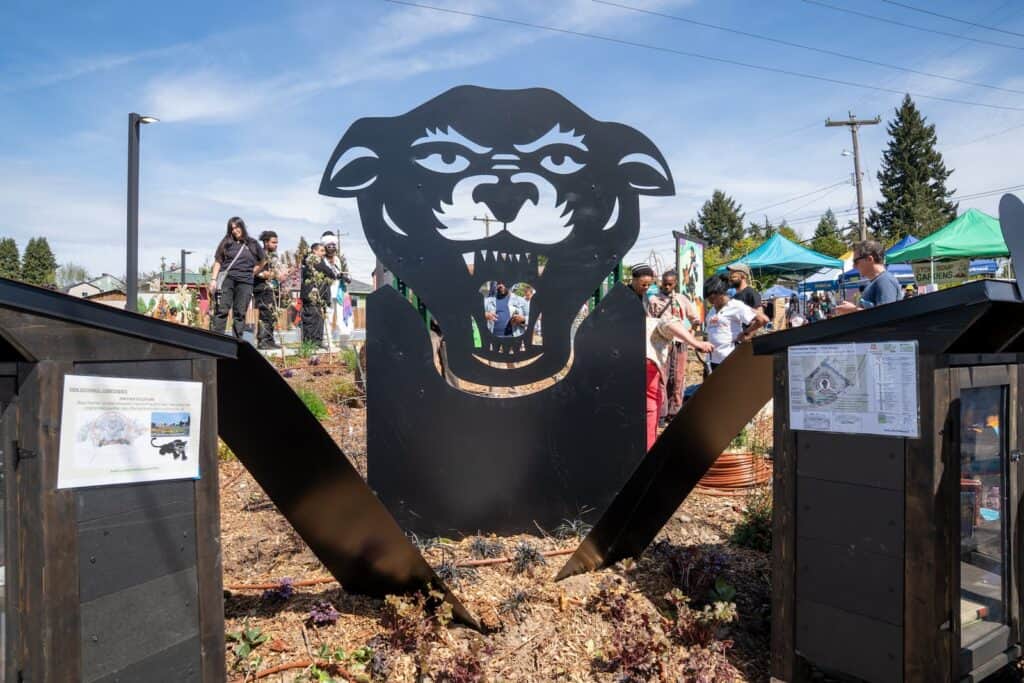
According to the 2020 census, Skyway’s population is 23.1% Black. For Calloway, and many others, the creation of Black Panther Park is like planting a flag.
“Skyway is like our last stand. This community has the highest Black home ownership in Washington state. Skyway represents us,” says Prince Reece, a Skyway community leader who organizes with Skyway Coalition, a nonprofit organization that centers community-led growth to uplift and protect Skyway. “We don’t really have any streets named after the Black people that have historically been here, so having the Black Panther Park right here, having Black faces right here, means a lot.”


