

For decades, much of Pittsfield’s Westside was shaped by decisions made in rooms many Black residents were never meant to enter.
In the 1930s, federal redlining policies and racially restrictive housing practices helped determine who could buy homes, where investment flowed and which neighborhoods would be allowed to build wealth. In Pittsfield, those patterns became deeply embedded in the city’s landscape. Black families became concentrated in neighborhoods like the Westside while homeownership opportunities, political influence and economic mobility remained unevenly distributed for generations.
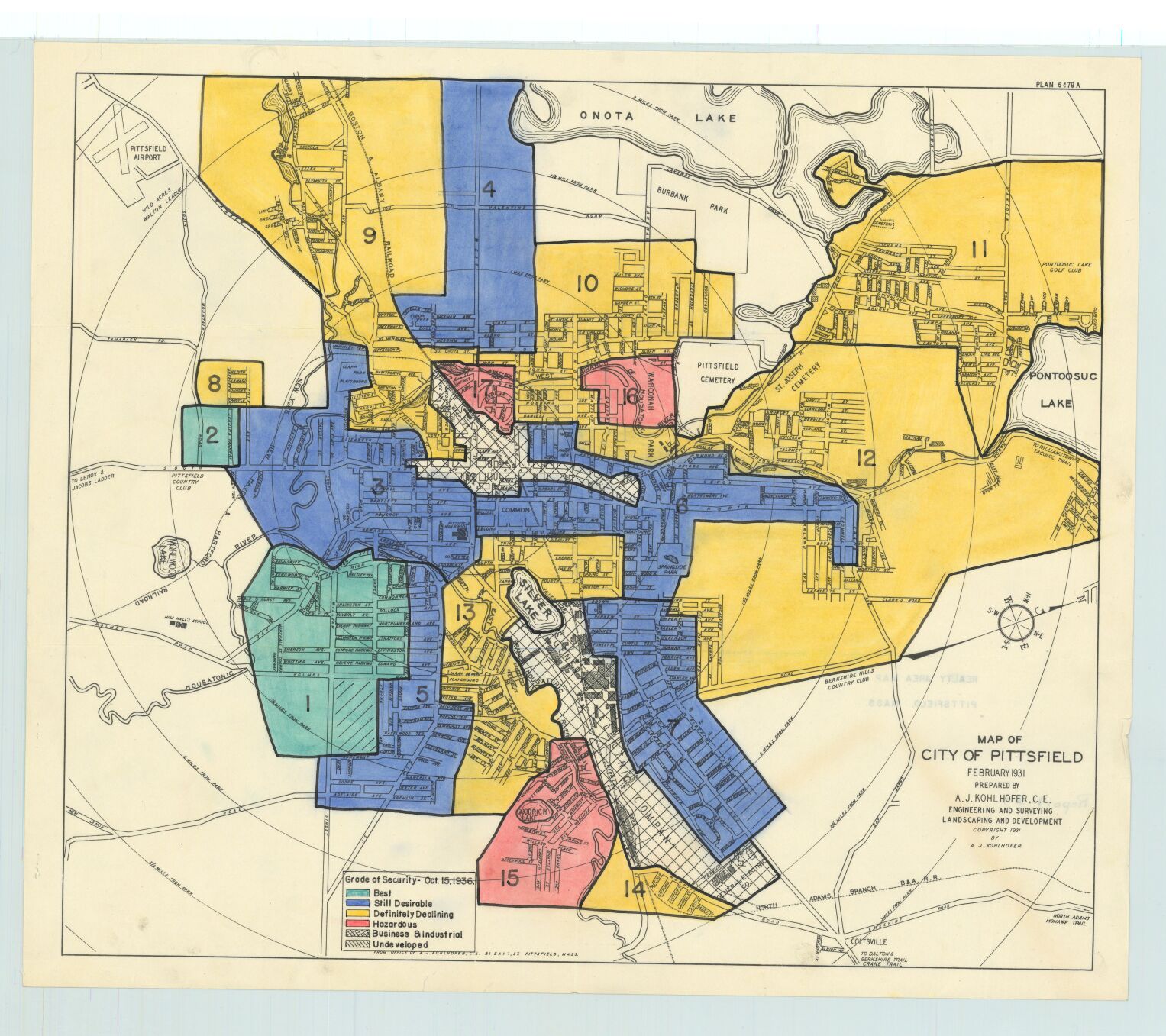
The Homeowners Loan Corp. map of Pittsfield created in 1931 shows color-coding based on lending risk for mortgages. The areas in red tended to be blighted, and were also the home to Blacks and marginalized people. The practice of “redlining” stripped those neighborhoods of investment.
The effects never fully disappeared.
A recent case study on redlining in Pittsfield’s Westside neighborhood found that 52.2 percent of Pittsfield residents who identified as African American lived within just three census tracts. The report also found a stark racial homeownership gap. While Pittsfield’s overall homeownership rate sits above 62 percent, Black homeownership is approximately 25.5 percent — lower than it was for Black residents in 1950. The report further identified a nearly decade-long life expectancy gap between residents in the Westside and more affluent areas of the city.
The findings point to something larger than housing alone. The report describes what it calls “oppression by omission” — the cumulative effects of exclusion from decision-making spaces, economic systems and institutional leadership. Over time, the consequences extended beyond housing into health outcomes, economic opportunity, neighborhood investment, arts access and political voice.

A house at 56 Deering St. on Pittsfield’s West Side, photographed in 1966 and razed in 1969. It is now the location of Berkshire Peak Apartments.
That broader pattern became impossible to ignore for Blackshires Executive Director John Lewis.
“Before Blackshires started, there were no Black institutions that were set up for what I would call evidence-based change and impact,” said Lewis. “There were no boardrooms or commissions or tables.”
Founded in 2020, Blackshires emerged during a period of national reckoning around race, equity and institutional access. But rather than focusing a single issue, the organization began examining how disparities across the Berkshires connected to one another.
Housing. Arts and culture. Health equity. Workforce development. Civic leadership. Again and again, the same themes surfaced.

Blackshires’ leadership team Julie Haagenson (Secretary), John Lewis (Executive Director) and Dubois Thomas (Board President & Lead Facilitator).
In Blackshires’ 2025 Arts and Culture Report, Black artists described barriers that went far beyond creative work itself. Participants spoke about gatekeeping, lack of representation in leadership, limited funding pathways and exclusion from institutional networks. Many said existing arts opportunities often felt inaccessible or disconnected from Black communities.
“We need consistent funding support,” one recurring theme from the report stated. Another was even more direct: “Gatekeeping stifles Black creativity.”
Artists described struggling to find affordable creation spaces, mentorship opportunities and sustained visibility within Berkshire arts institutions. At the same time, cultural organizations acknowledged gaps in accountability, outreach and representation within leadership structures.
The organization’s 2024 Health and Wellness Report revealed similar patterns in healthcare. Black residents cited long wait times, lack of culturally responsive care and deep mistrust toward healthcare systems shaped by experiences of racism, neglect and poor communication. Participants described feeling dismissed or unheard within medical settings, while healthcare providers acknowledged broader structural barriers involving transportation, housing and access to care.
Across sectors, the conclusions echoed one another: lack of access, lack of representation, fragmented resources and exclusion from spaces where decisions were being made.
For Lewis, those recurring patterns pointed toward a larger question: “What does a comprehensive blueprint and framework for success look like for the Black community?” said Lewis.
That question became the foundation for the Blackshires Leadership Accelerator Program.

Inside Pittsfield City Hall, 2026 Blackshires’ Leadership Accelerator Cohort engaging in a fishbowl session built on a simple but radical idea: that the people most impacted by the decisions made in these rooms should have a seat at the table.
The accelerator was designed not simply as a leadership seminar, but as a direct response to the barriers Blackshires kept documenting across its reports and community conversations.
If residents lacked access to decision-making spaces, the program would create direct pathways into those spaces. If aspiring entrepreneurs, organizers and artists lacked mentorship, the program would surround them with coaches, institutional partners and peer networks. If Black residents lacked access to financial systems, civic leadership opportunities or professional relationships, the program would connect them directly with the people and institutions controlling many of those resources. And if generations of exclusion had created isolation, distrust or self-doubt, Blackshires wanted the accelerator to function as something deeper than professional development alone.
It needed to become community infrastructure — something sustained not by a single organization, but through a network of mentors, institutional partners, coaches, nonprofit leaders, local officials and cohort members working together to help participants navigate systems that had long felt out of reach.
The Leadership Accelerator took shape as a 15-week cohort-based program combining leadership development, civic engagement, mentorship, business training and community partnership-building. But unlike many traditional leadership programs, the accelerator was intentionally built around accessibility and equity from the beginning.
Participants receive stipends, meals, transportation support and completion grants designed to reduce the financial burden of participation and help launch projects, businesses or nonprofits after graduation.
“We know people have to take time from work and other things to be a part of the leadership program,” said Lewis. “We looked for ways to relieve that burden.”
Over the last several years, the program has graduated more than 40 cohort members and distributed more than $100,000 in fellowship and completion grants.
But the support extends far beyond funding. Participants move through workshops, retreats and collaborative “fishbowl” sessions that place them directly in conversation with city officials, healthcare leaders, arts organizations, financial institutions and regional planning groups throughout Berkshire County.

One session may take place inside Pittsfield City Hall discussing governance and civic engagement. Another may focus on health equity with Berkshire Health Systems. Others center on arts and culture, Black business development, neighborhood revitalization or economic opportunity.
The goal, Lewis said, is create a direct pipeline to systems and institutions that many Black residents historically lacked access to.
“We introduce you to all the resources and the independent teams,” said Blackshires Vice President Ari Zorn. “But more importantly, we also encourage those individuals to serve on boards and commissions, so their voices are heard, and that we are represented in those rooms.”
The accelerator’s growing network of partners now includes organizations such as Berkshire Health Systems, 1Berkshire, Berkshire Regional Planning Commission, Jacob’s Pillow, MASS MoCA, local banks, nonprofit organizations and municipal leaders across the region.
Those partnerships, Lewis said, are what allow the accelerator to function as more than a standalone leadership course. Institutions across Berkshire County contribute mentorship, expertise, funding pathways and direct access to professional networks, while also gaining a clearer understanding of the barriers many Black residents still encounter. The result is a program built as much on collaboration and shared investment as on leadership training itself.
This often creates immediate opportunities for participants. Lewis described one cohort member recently connecting with city leadership to advocate for a policy proposal — a meeting that likely would not have happened before entering the program. Another participant, an artist, was able to complete an artist residency at MASS MoCA and later stage a production at Jacob’s Pillow after being introduced to institutional partners through Blackshires.
“She didn’t even know that existed until she came into Blackshires,” said Lewis.

The organization also built the accelerator around what it calls an “Impact Charter” process — a framework Lewis describes as part business plan, part community development blueprint.
“The Impact Charter process we’ve developed systematizes the journey from community impact idea to implementation, helping participants build clearer plans, communicate their value and increase both their confidence and likelihood of success,” said PJ Danahey, Leadership Coach for the Blackshires Program and founder of Impact Hacker.
Participants use the process to define goals, identify stakeholders, clarify funding needs and create actionable strategies they can later present to investors, grantmakers or institutional partners. This helps participants move from ideas into implementation.
“When they decide to go get funding, people say, ‘Well, you need to send me something so I can better understand what you’re talking about,'” said Devin Shea, Impact Charter & Innovation Coach. “They instantly have that with the Impact Charter.”
For some participants, the completion grants have helped secure LLC paperwork, accounting support, certifications or operational systems needed to grow a business. Lewis described one cohort member using grant funding to establish payment processing systems for a food truck business, dramatically expanding the business’s ability to operate.
The accelerator is constantly evolving and growing in response to feedback from participants themselves. Lewis said one of the organization’s biggest early realizations involved the emotional and psychological barriers many people carried into leadership spaces.
“The barrier to leadership is overcoming your own inner voice that says you can’t do it,” said Lewis.
In response, through the leadership of Julie Haagenson, leadership coach of New Pathways, Blackshires incorporated wellness coaching, emotional support and mentorship directly into the program structure. Participants receive ongoing access to coaching, technical support and peer collaboration throughout the accelerator.
The organization refers to the model as “distributive leadership” — an approach where cohorts actively learn from and support one another.
That collaborative structure extends beyond the workshops themselves. Participants are encouraged to build lasting relationships not only with institutional partners, but with one another, which creates support systems and professional networks that often continue long after the 15-week program ends.
“What community leadership is all about is having those conversations and learning,” said Dubois Thomas, Lead facilitator for the program and President of the Board for Blackshires.
That sense of shared support has become one of the program’s defining features.
“Being a part of the Blackshires Leadership Cohort has been an incredibly empowering experience,” participant Chynna Williams wrote in a testimonial for the program. “The sense of community was immediate.”
The program’s impact has also drawn wider recognition across the region. In 2023, the Blackshires Leadership Accelerator received the 1Berkshire Trendsetter Award for “Breaking the Mold,” recognizing its innovative approach to leadership and community development. The following year, the City of Pittsfield officially proclaimed June 14 as Blackshires Leadership Accelerator Day in recognition of the initiative’s growing impact on regional equity efforts.
For Lewis, however, the larger goal extends beyond individual success stories.
Blackshires sees the Leadership Accelerator as part of a longer effort to rebuild pathways into systems where Black voices were historically absent — whether in local government, economic development, healthcare, arts leadership or nonprofit governance.
“We are an empowerment organization, and we take that role very seriously”, said Thomas.
In a region where generations of exclusion were often allowed to persist beneath the surface, Blackshires is attempting to build something many residents say did not previously exist in the Berkshires: a sustained ecosystem of Black leadership, institutional access and community-driven development — one built not by a single leader, but through partnerships, mentorship and a growing network of people working collectively to create pathways that had long been closed off.
The Blackshires Leadership Accelerator will celebrate the graduation of its fourth cohort on Friday, June 19, in recognition of Juneteenth, at Ventfort Hall in Lenox.
WHAT IS SPONSORED CONTENT?
The Berkshire Eagle offers professional writing, editing, design, web and social media services to help businesses maximize their story’s reach. Let us help you. Email cmcclusky@berkshireeagle.com.


