

Longform
More than places to buy books, these neighborhood institutions serve as classrooms, gathering spaces, and engines of change.
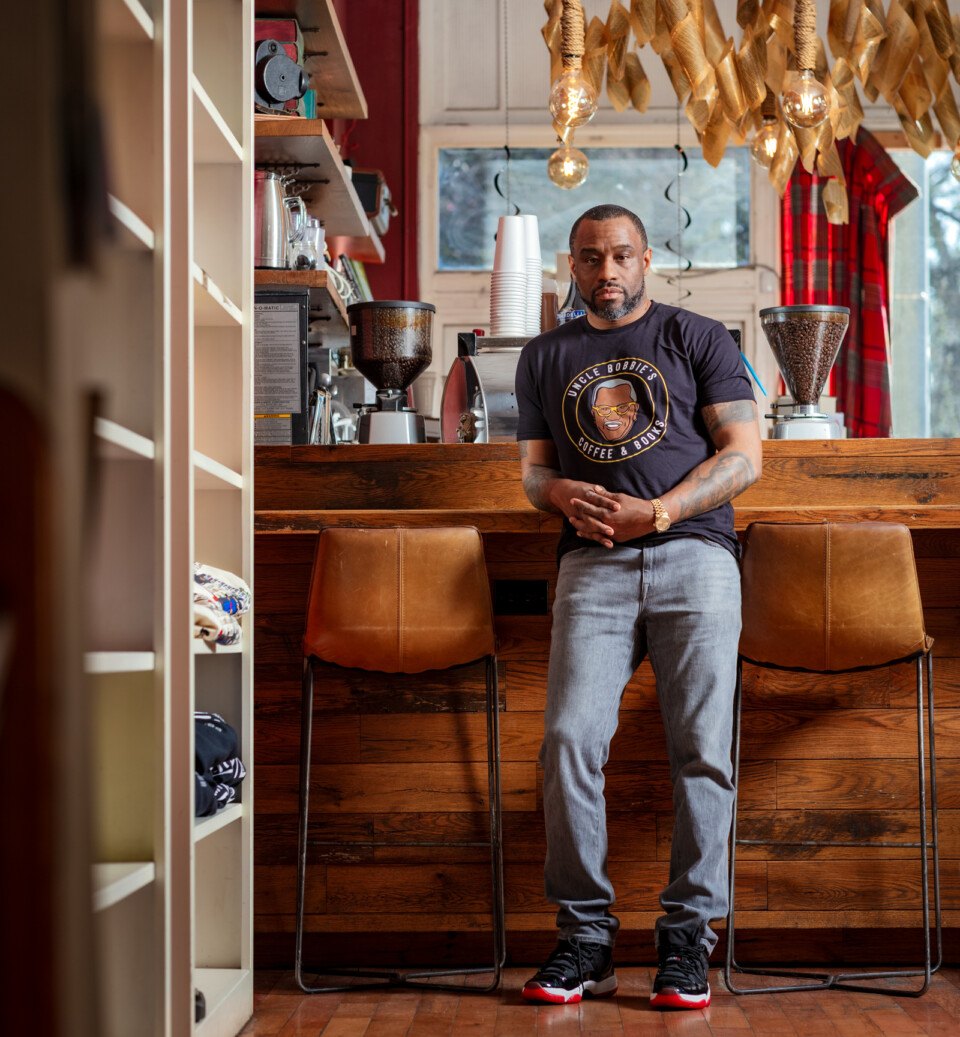
Marc Lamont Hill at his Uncle Bobbie’s Coffee and Books / Photograph by Sahar Coston-Hardy
Marc Lamont Hill was never the same after his brother Anthony gave him a copy of The Autobiography of Malcolm X when he was a teenager.
The iconic 1965 account of the life of the revolutionary, from his impoverished childhood to his rise as a civil rights leader, took Hill on a journey for knowledge of the self, to understand not only who he was, but — an important facet of Malcolm X’s philosophy — who he could transform into. The book transformed a kid whose reading skewed more toward the wrestling magazines he bought at the Bridge-Pratt El station into a reader who told himself, I want to do what Malcolm’s doing. And it did one other important thing.
“It took me to maybe my favorite bookstore in Philadelphia at the time,” he says. “It took me to Hakim’s on 52nd Street.”
On many weekends in his youth, Hill would head from basketball games at the nearby West Philadelphia YMCA right to Hakim’s, where he proceeded to spend “hours and hours and hours” reading, talking, and hanging out. Bookstores in general, and Hakim’s above all else, were where he was able to make sense of the world around him. He knew that if he ever had the chance to create that for someone else, he would.
In the meantime, though, he went on to become an author, educator, and media personality, with gigs as a host on VH1, a commentator on CNN, a news correspondent on BET, and a media studies professor at Temple. In 2016, while driving through Germantown, he spotted a vacant storefront with metal gates on the doors and tin ceilings inside, a remnant of the neighborhood’s deep architectural heritage. Remembering his teenage trips to Hakim’s, he decided this was the spot — and the moment — and opened Uncle Bobbie’s Coffee and Books in November of 2017, adding his stamp to Philadelphia’s long history of Black-owned bookstores.
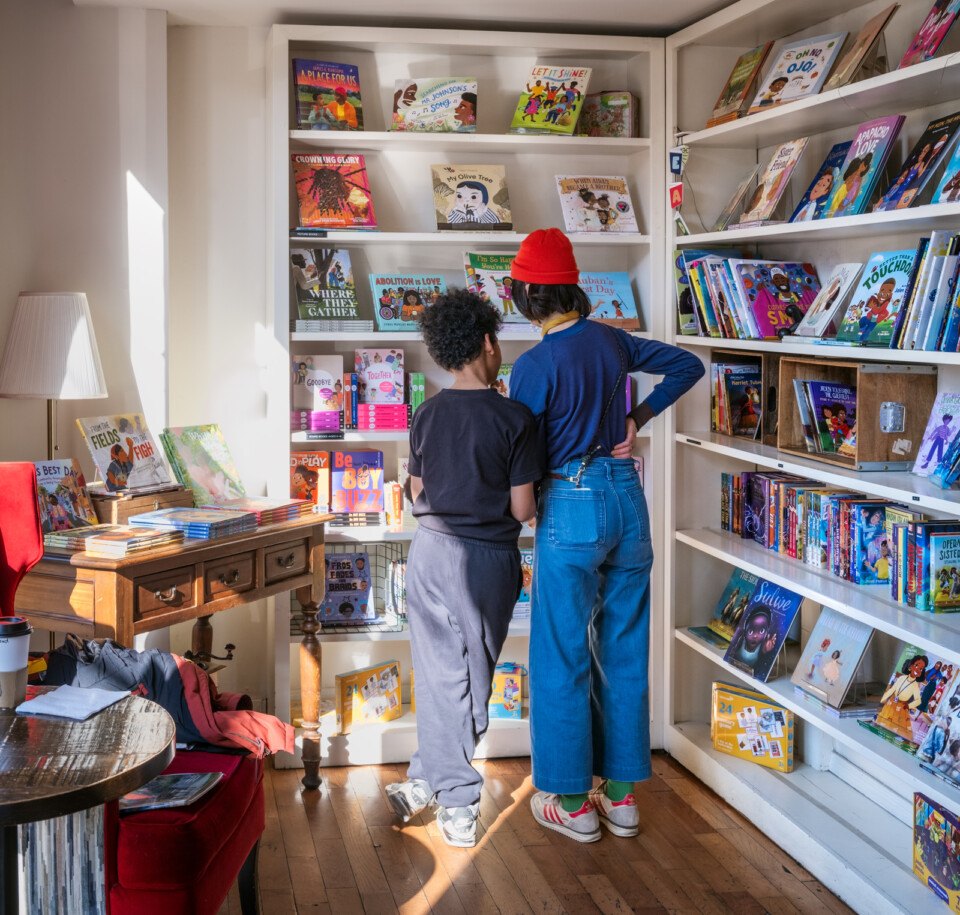
Uncle Bobbie’s Coffee and Books / Photograph by Sahar Coston-Hardy
Today, Hakim’s, Uncle Bobbie’s, and a slew of other Black-owned bookstores that have opened in between are dexterous staples in their neighborhoods; they serve as coffee shops, libraries, community centers, classrooms, event venues, and more. They’ve been lifelines for information in times of political turmoil, for mutual aid in times of need, and for camaraderie among locals.
In March, the National Association of Black Bookstores — a nonprofit founded in 2025 by former NBA star and Sacramento mayor Kevin Johnson to promote literacy and support Black booksellers — released its inaugural State of the Black Bookstore Report, the only formal, comprehensive inquiry into independent bookstores run by Black owners. The NAB2 report and its directory (306 brick-and-mortar, mobile, pop-up, and online shops in total) went viral. According to the report, only eight percent of all independent bookstores in the country are Black-owned. More shockingly, there are 14 states in the country with no Black-owned bookstores at all, the report claims. (New York, Georgia, California, Florida, and Texas, in that order, top the list.)
Noticeably absent from this top-performing list is Pennsylvania, clocking in with 12 Black-owned bookstores across the state. But look a little closer at the directory, and you’ll notice something: The vast majority are in within Philadelphia city limits. In addition to Uncle Bobbie’s and Hakim’s, there’s American Grammar, Atomic City Comics, Black and Nobel, Harriett’s, Ibrahim Books, Kareemah’s Books, Multiverse, and Umoja House, spread across this city from all the way up in Chestnut Hill to Southwest Philly to Queen Village.
Many other states, though they have a larger number of stores overall, don’t share the same concentration. Of the states topping the list: Nearly half of Georgia’s 27 shops are spread across counties just outside Atlanta’s boundaries. Florida’s 21 and Texas’s 18 dot the entirety of their respective states somewhat evenly. But here in the commonwealth, the majority of Black-owned bookstores exist inside Philly, each of them a brick-and-mortar somewhere near you — making up essentially a quarter of all indie bookstores in the city.
How is it, exactly, that Philly — where more than 50 percent of adults ages 18 to 64 read and comprehend at the equivalent of a fifth-grade level or below — became a city on the hill for Black bookstores? The answer is where a long, fascinating history meets modern struggles.
•
The roots of Philly’s Black bookstore scene date back to the 19th century, says Char Adams, a West Philly–born journalist and author of Black-Owned: The Revolutionary Life of the Black Bookstore. Philadelphia, she says, has been a place of Black intellectual pursuit for centuries, “a place where Black people at large valued intellectual development.”
The country’s first Black-owned bookstore was founded by abolitionist David Ruggles in New York City in 1834, but Philly boasts a slightly older Black intellectual history. Just a few years before Ruggles’s efforts, in 1828, the country’s first Black literary society — the Reading Room Society — was created by prominent Pennsylvania businessman William Whipper as a book-lending service and discussion club for people of color in Philadelphia. Some decades later, hundreds of scrapbooks on Black life compiled by wealthy Philadelphia historian and collector William Henry Dorsey became the basis in part for W.E.B. Du Bois’s 1889 study, The Philadelphia Negro.
Then, more than a century after Ruggles’s bookstore appeared in New York, amid the intensifying Civil Rights Movement, the contemporary era of Black bookstores touched down on 52nd Street with Hakim’s.
Dawud Hakim was 27 in 1959 when he opened his shop at 52nd and Walnut, eager to share his passion for Black history and provide texts that would be difficult to find in mainstream bookstores. Sales were slow for the first few years, but increased as the ’60s pushed on and demand for writing on Black life and civil rights grew. The FBI began surveilling Hakim and the store in 1968, following a memo issued by bureau director J. Edgar Hoover deeming the growing number of Black-owned bookstores across the nation “centers for extremism.” But Hakim never wavered, nor did his daughter, Yvonne Blake, who became owner when Hakim died in 1997 and who now runs the storied shop with the help of her own children, grandchildren, and friends.
“I adhere to the life lessons my father gave us when we were growing up and stay aware of the political climate and the need for African Americans to be educated,” Blake says of keeping the store and her father’s legacy going over 60 years later. “And not just African Americans but everyone. … That’s why I’m able to continue to do what I’m doing because it’s really necessary.”
Philly has this deep, rich Black cultural history. I see the Black-owned bookstores that exist there as not only preservers of that rich history, but I see the passion of these booksellers when it comes to growing the next generation.” — Char Adams
It’s a marvel that Hakim’s, the East Coast’s oldest Black-owned bookstore, still stands today, when so many similar stores from that era (like Drum and Spear in Washington, D.C., and the National Memorial African Bookstore in Harlem) didn’t survive past the ’80s.
“Philly has such a strong tradition of Black radical politics,” Hill says, noting the strong presence of organizations like the Revolutionary Abolitionist Movement and the Black Panther Party, as well as Black Panthers co-founder Bobby Seale’s time as a Temple professor in the ’80s and a significant Muslim population in the area. “We’re at the vanguard of so much stuff that it makes sense that the Black bookstore will be an extension of that. Radical political activism and organizing requires political education.”
Meanwhile on the national scale, over the intervening decades since Hakim’s opening, the prominence of Black-owned stores in the U.S. rose and fell, often mirroring society’s conversations about race. Twelve stores existed in 1960, according to NAB2’s report; that number leaped to 75 stores by 1975. By the end of the ’90s — widely considered to be the golden age of Black bookselling, driven by popular authors like Terry McMillan, media attention like Oprah Winfrey’s book club TV segment, and events that spurred discussions on racism like the 1991 beating of Rodney King — that number peaked at 325 stores.
Then, a nosedive: By 2014 only 54 Black-owned stores remained. Between competition from big bookstore chains and Amazon, the rise of e-books, and gentrification spreading in neighborhoods where these shops thrived, swaths of Black-owned bookstores just couldn’t survive the early 2000s. Even Hakim’s nearly closed for good in 2015, only to be brought back from the brink by a Daily News column from Helen Ubiñas warning that the store was struggling to stay open and an ensuing avalanche of social media attention.
But with this current era comes a new wave of hope and growth. Up from 120 Black-owned bookstores nationally in 2020, and despite the economic ramifications of a pandemic, the figure again sits in the 300s. And with this new generation of shops, particularly in Philly where 42 percent of the county population is Black, comes a dynamism that reflects the city’s legacy of Black intellectualism and activism, says Adams.
“Philly has this deep, rich Black cultural history,” she says. “I see the Black-owned bookstores that exist there as not only preservers of that rich history, but I see the passion of these booksellers when it comes to growing the next generation.”
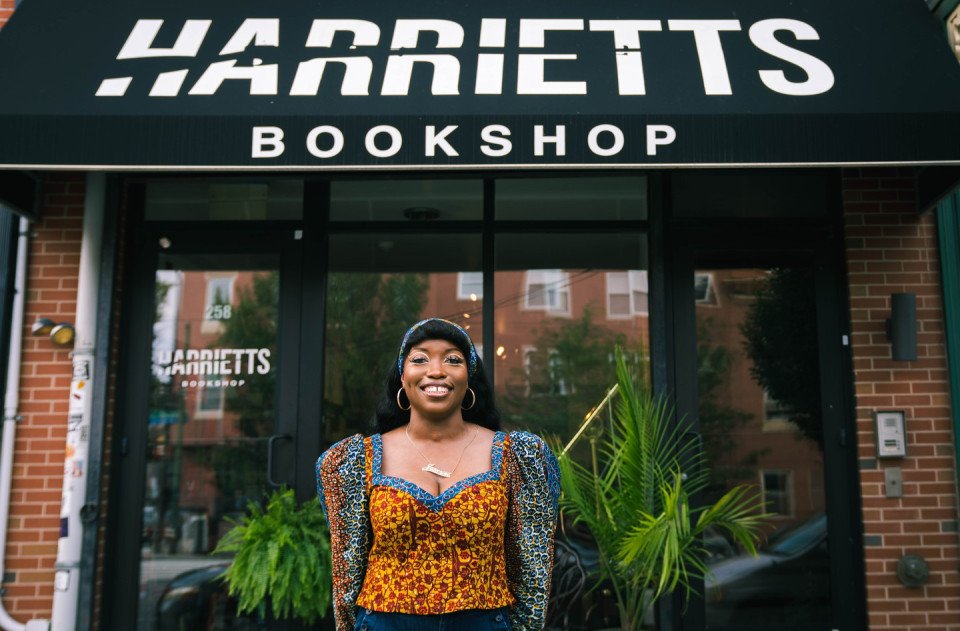
Jeannine A. Cook at Harriett’s Bookshop / Photograph via Visit Philly
To see that trend in action, look no further than Harriett’s, in Fishtown. In 2000, Jeannine A. Cook, then 17, moved from Hampton, Virginia, to study media and communications at the University of the Arts. She had grown up reading to her mother as she began to lose her sight, but it was at a stall in Reading Terminal Market during those early college days where she met Isaac Martinas of the now closed Miscellanea Libri bookstore, and her love of bookselling was first sparked.
“One of the first people that I met was Mr. Isaac,” says Cook. “I remember being enamored of him, but at that time, I wasn’t even thinking [about opening a bookstore]. I thought maybe someday when I was, like, an old lady.”
Still, from a table outside of UArts she began selling titles that weren’t readily available at the university alongside incense and friends’ artwork. After graduating, she became an educator at community centers and youth programs, all the while working here and there on her far-off dream of owning a bookstore, driven by a “moral imperative” to make sure young people have access to reading and education outside of traditional classroom settings. In February of 2020, she opened Harriett’s in the ground floor of a building on Girard Avenue, brightly lit from the massive floor-to-ceiling windows in the front.
Six weeks later, COVID hit. Bookstores depend on the appeal of being in-person, community-driven spaces, and many struggled and sought to pivot. Cook launched her “Essentials for Essentials” project, which allowed shoppers to purchase and send books to essential workers. Hakim’s even received grant assistance in the early days of the pandemic. As beloved as stores like Harriett’s and Hakim’s were, they — like Black bookstores across the city and the nation — strained to find ways to make it through the earliest days of the pandemic.
And then came George Floyd. Two months after the start of the pandemic, police in Minneapolis murdered Floyd in plain view of the country. More police killings of Black civilians followed throughout the summer. Protests filled the streets, racial justice dominated the national conversation, and books on anti-racism flew off the shelves.
“Our internet sales more than tripled,” says Blake, who faced such demand that she began filling Hakim’s orders from her home. “It was like somebody pushed a button and, like, in one day, I might have had, like, 30 internet sales, whereas previously I was only having three or four.”
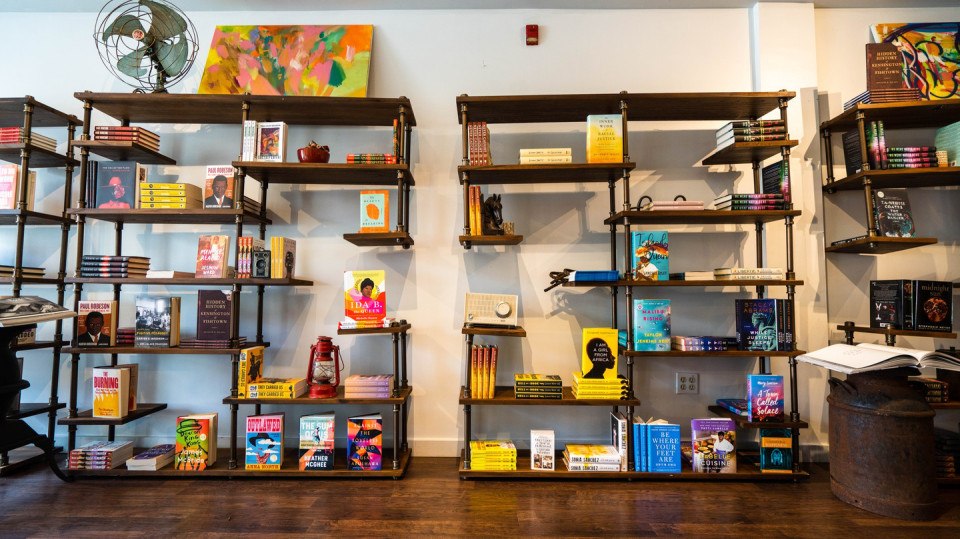
Harriett’s Bookshop / Photograph by R. Rabena for Visit Philadelphia
And it wasn’t just her. In addition to selling out of stock multiple times, Cook’s opportunities, both in and out of Harriett’s, exploded. The shop’s Instagram followers ballooned from 3,000 to 30,000. Cook traveled to Minneapolis to donate books to activists and spoke at events all over Philly. Renowned Black author Kiley Reid, author of Philly-set Such a Fun Age, shouted out Harriett’s in an Oprah Daily story, and Isabel Wilkerson, author of Caste, visited. Suddenly, Jeannine Cook, bookstore owner, was a known entity in Philly and beyond.
Meanwhile, other Black bookstores in Philly and across the country saw titles on back order for months, more in-person patrons and online orders than they’d ever seen, and more corporate customers buying in bulk and initiating partnerships than they’d ever had.
“It was the best times and the worst times,” says Hill of that year. “It wasn’t just that 50 people would come in or call us and say, ‘Hey, we’d like to buy a copy of White Fragility.’ It was more like one person would come in and ask us for 50 copies of White Fragility, or 500 copies.”
Yet, Adams says, the financial success was bittersweet. Sure, the profits were going toward feeding their families, but many Black bookstore owners couldn’t ignore that the eagerness had only come from a racial reckoning brought on by widely circulated video of a man’s brutal killing. “There was this feeling they expressed to me that they don’t just want their business to be successful and profitable when the country is in political turmoil and when a Black person dies,” she says. There was also the feeling that neither the fervor nor the social progression would last.
And, for the most part, they didn’t. As early as October of 2020, Adams says, booksellers started seeing sales, and corporate bulk orders in particular, dwindle.
“The corporate base left as soon as they could,” Hill recalls. “As soon as companies didn’t have to care about diversity, equity, inclusion, they stopped.”
Cook noticed a similar kind of disengagement. While some portion of individual customers tended to be consistent in their support, the institutional support waned at Harriett’s. “When it was good marketing to be associated with certain people in certain places, folks were jumping all over it, and when it wasn’t, when it was no longer the popular thing to do marketing-wise, it literally just stopped.”
•
Still, despite the dip and yet another cultural shift, Philly’s Black booksellers have shown trademark resilience, carrying on shaping the city’s intellectual and cultural fabric today.
Cook in particular is a local dynamo. She established Josephine’s, a traveling pop-up bookstore in Paris, her book-focused trolley tour regularly sells out, her store continues to attract visiting speakers like Jalen Hurts and Pulitzer Prize–winning playwright James Ijames, and her new memoir, Shut Up and Read, has taken her around the country (and back to Paris) for a tour. Uncle Bobbie’s, too, is loved by its neighbors and announced last year that it would seek to relocate into a larger space. Hill continues to be a well-known public intellectual as a professor of urban education at CUNY and co-host of The Joe Budden Podcast. At Hakim’s, Blake upholds many traditions her father started, like shipping books to prisons and hosting forums on Black history, as well as welcoming Kamala Harris for a visit in 2024. Meanwhile, stores like Multiverse and Atomic City Comics offer spaces for people of color in the comic book and graphic novel realm.
“Prioritizing of intellectual empowerment through reading and writing has never left [Philadelphia],” Adams says. “I see these bookstores as not only an extension of that and existing in the tradition of that, but I also see them as preservers of that history.”
Now, many Americans’ politics have shifted to the right, the Trump administration has outright rejected the once-popular push for DEI initiatives, and our sociopolitical situation feels, in some ways, worse than that of 2020. For the 2023-24 school year, the literary organization PEN America found attempts to ban 10,046 unique titles from schools — far outpacing the 2,532 bans from just two school years earlier. Among the most challenged in recent years have been books by Black authors touching on difficult subjects — Toni Morrison’s The Bluest Eye and Push by Sapphire, for example.
I have an enduring, abiding, never-ending faith in Black people. I have the same feeling and faith about Black bookstores.” — Uncle Bobbie’s Coffee and Books owner Marc Lamont Hill
Perhaps the time is ripe, then, for another surge of attention on Black-owned bookstores. With almost three more years of a Trump administration ahead of us, will these shops once again be looked to for guidance through choppy waters? Racial reckoning in full swing or not, Adams says, Black bookstores that are dedicated to the tradition of offering community, learning, and political engagement will always do just that. The owners agree.
“[Black] bookstores have always weathered these storms. This isn’t the first time that America cared about race until it didn’t,” says Hill. “Our role is to consider, to prioritize sometimes — oftentimes, actually — our mission over profit.”
Similarly, at Harriett’s: “We’re doing the thing that we came here to do, day in and day out, regardless of what’s happening day to day in the world,” says Cook. “I don’t want to be a ship that’s swayed based on the tides that keep changing.”
She invites people to think beyond bookstores, though, to support an even larger ecosystem. In that ecosystem independent bookstores thrive, she says, because of just that — their independence. They’re not tied to some broader institution or funding source. Here she recalls Morrison: “‘This is the job of the artist.’ When things get rocky, when things get out of control, that’s when the artists get to work.”
Blake has seen sales at Hakim’s increase steadily as the political climate continues to shift. In response to the current moment, which she finds “frightening” and “sad,” she has only become more engrossed in her and the store’s efforts to provide diverse representation, expanding the children’s section into an entire wall of the shop. “I realized there was a need for African American children and minority children to see pictures of themselves in books, to see children that look like them in their books,” she says.
Of Black bookstores’ outlook in strenuous times, the owners of Philly’s shops see brightness and opportunity. Not long ago, expectations for indie bookstores were reasonably grim, with both Joseph Fox and Shakespeare & Co. shuttering their Rittenhouse locations in 2022. But as indie shops experience a significant comeback (up by 70 percent over the past five years, according to the American Booksellers Association; some experts say that’s due to the community-focused, in-person aspect of their business practices), Hill believes Black-owned shops will grow proportionately.
“But our future doesn’t depend on that,” he says. “The future of Black bookstores is always going to be as bright as the future of the Black community. Our future, our possibilities are going to be bright. I have an enduring, abiding, never-ending faith in Black people. I have the same feeling and faith about Black bookstores.”
Published as “Philly’s Literary Revolutionaries” in the May 2026 issue of Philadelphia magazine.


