This is a rush transcript. Copy may not be in its final form.
AMY GOODMAN: This is Democracy Now! I’m Amy Goodman.
The Department of Justice is attempting to sabotage a major victory for reparative justice in Evanston, Illinois, that compensates victims of historic housing discrimination. In 2021, the Evanston City Council agreed to pay Black residents and their descendants reparations up to $25,000 for property down payments, mortgages and other related fees, making it the first U.S. city to adopt such a measure. For decades, Black residents of Evanston were subjected to redlining and other forms of housing discrimination, which prevented them from obtaining bank loans to purchase property. The reparations program is being funded through donations and revenue from a local tax on recreational marijuana sales.
But last month, the Trump administration joined a lawsuit filed by the conservative advocacy group Judicial Watch attempting to halt the program, claiming its race-based criteria are unconstitutional. Assistant Attorney General Harmeet Dhillon of the Department of Justice’s Civil Rights Division said in a statement, quote, “There are sound ways for a city to remedy past discrimination or direct resources to its most vulnerable citizens and neighborhoods. Simply handing out money based on race, however, is not the answer. It is race discrimination, pure and simple. And it is illegal,” [she] said.
Defenders of Evanston’s reparations program are fighting back. And ahead of the 250th anniversary of the founding of the United States, racial justice advocates are looking at Evanston as an opportunity to redress historical grievances.
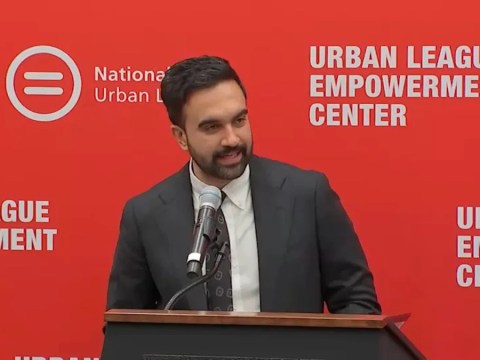
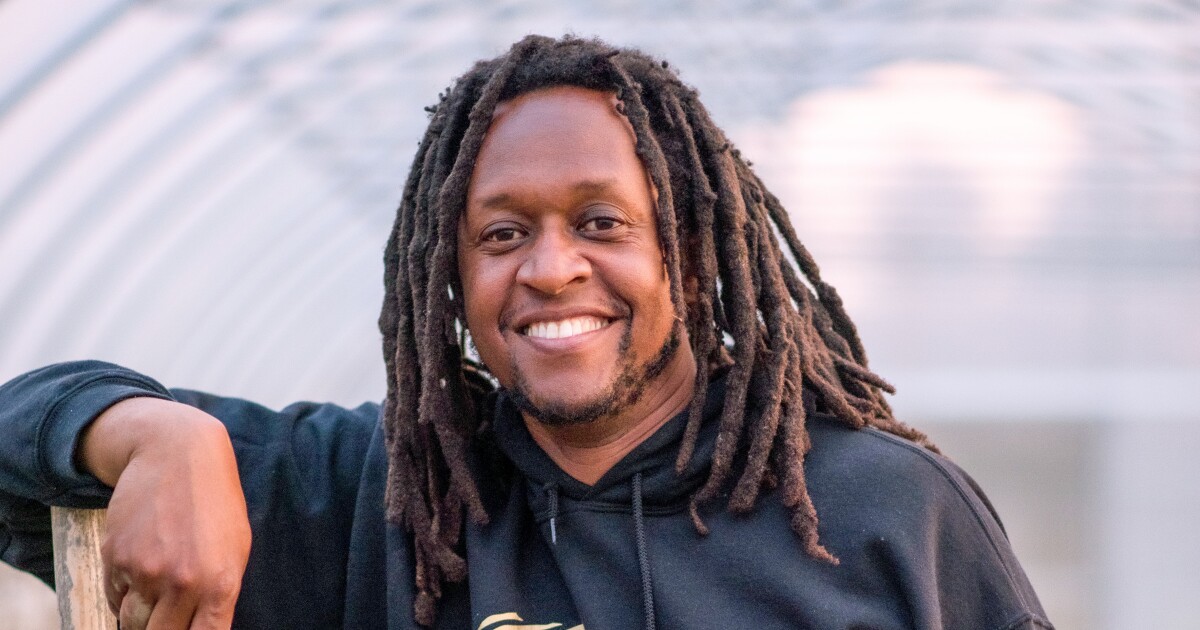
For more, we go to Bethesda, Maryland, where we’re joined by Justin Hansford, Howard University law professor, scholar, activist, founding director of the Ogletree Reparative Bar Association. He’s been on the frontlines of the legal battle for reparations, is the author of Jailing a Rainbow: The Unjust Trial and Conviction of Marcus Garvey.
Professor Hansford, welcome back to Democracy Now! Put what’s happening in Evanston in the context of this 250th anniversary of the United States.
JUSTIN HANSFORD: Sure. Happy to be here, Amy.
Well, what’s happening in Evanston right now is a trend sweeping the country. We have over 20 cities, five states — California, New York, Illinois, Maryland, Washington; also, Massachusetts is on the rise — cities and states around the country starting to explore the concept of reparative justice. And that includes looking at the sweep of history in their city, in their town, in their state, and trying to find a way to make things right and pursue racial justice.
Here in Evanston, we saw one of the more groundbreaking examples of that. We had a city that did the research and did an investigation, found itself guilty of engaging in redlining, zoning, deed restrictions that confined Black residents from 1919 to 1969 in just one part of the town, ultimately resulting in them being dispossessed from opportunities to gain equity and build wealth throughout half of the 20th century. And so, the city decided to create a program to provide redress for those people to the tune of $25,000 for direct descendants. And now the Department of Justice is seeking to intervene in a lawsuit that wants to stop people from making things right in that city.
AMY GOODMAN: And how do you respond to Assistant Attorney General Harmeet Dhillon of the Department of Justice’s Civil Rights Division? She said, “There are sound ways for a city to remedy past discrimination,” and this isn’t one of them, essentially.
JUSTIN HANSFORD: Right. Well, it’s a misreading of the record. She implies that people are just giving out reparations on the grounds of race. But we saw here that there was a report done, an impact study, that actually we at the Howard University Thurgood Marshall Center helped to produce, that showed specifically, in detail, that this was an intentional campaign that the city was involved in, and the city admitted to those facts, and the city itself is tying very specifically a remedy to the harms that it found in that report. And if you look at Students for Fair Admissions v. Harvard, the 2023 Supreme Court case, even though that case sought to end diversity programs, it very explicitly said that you can seek to remedy past harms if you detail the specific harms in a report that allows you to narrowly tailor the remedy to those harms.
So, what we’re seeing here is another situation where the 14th Amendment and the Fair Housing Act, which is what the government is using to try to say that this program is illegal and unconstitutional, these things that were part of the effort to reconstruct our country after the Civil War, some of the greatest racial justice tools in our 250-year history in the United States, are being being used as a sword against us. What was designed to shield people from racial injustice is now being used as a weapon. So, it’s a terrible way to bring in the 250th anniversary.
AMY GOODMAN: Robin Rue Simmons, who spearheaded Evanston’s reparations program and now chairs the Evanston Reparations Committee, criticized the Trump administration efforts, saying, quote, “This lawsuit is designed to intimidate and discourage other communities that are beginning their process of reparations, inspired by what Evanston has done.” Simmons added Trump’s lawsuit is, quote, “an attack on the revived hope that Black communities have felt having a path, through a hyperlocal process, to reparations,” unquote. In 2021, Democracy Now! spoke to Robin Rue Simmons, who was then an Evanston City Council member. She explained what Evanston achieved for Black residents impacted by historic housing discrimination.
ROBIN RUE SIMMONS: What we passed on this last Monday was the first disbursement or the first remedy, which is going to be in the form of a housing remedy, $25,000 direct benefit to eligible Black residents for home equity, home wealth, acquisition or purchase, any type of improvement, but something that will build wealth through home equity. And I have to say that in 2002, under the leadership of Judge Lionel Jean-Baptiste, who was the 2nd Ward alderman at the time, our city passed a resolution in support of H.R. 40. So, we’ve been working towards this for some time in Evanston.
AMY GOODMAN: So, that’s Robin Rue Simmons. And, Professor Hansford, if you can also put this in the context of President Trump at this point refusing to sign off on a bipartisan housing bill, since housing is such a critical issue for people across this country? Now, that is different from what’s happening in Evanston. At least at this point he is.
JUSTIN HANSFORD: Right. Well, you know, it’s all connected, because we know that throughout the 20th century and into 21st century, housing has been the primary way that families have built wealth, and we are in a country where there is 10 times as much wealth in the white community as there is in the Black community. And that’s not there through luck or hard work or through intelligence, but that gap is a result, primarily, of this type of dispossession on the grounds of housing.
And you have stories in Evanston, like the stories of Louis Weathers, who is a Korean War veteran, who came back in 1959 ready to buy a home for his family, but was forced into this contract that ensured that he would never actually own his home, never actually build equity, never ever have the opportunity to build wealth. And now this program is allowing his son to inherit at least some type of remedy, where the son might have inherited a home, equity, been able to help build generational wealth. Now there is an effort, at least, by the city to make things right for that family. And that’s just an example of what could be happening and will be happening all across the country.
And I just want to just add really quickly that what Robin Rue Simmons said — and we feel that she is, essentially, one of the leaders of this reparations movement, the Rosa Parks, if you will, of this movement. The effort to bring a lawsuit to stop this particular program is meant to send a message to programs in cities and states around the country that this is something that is dangerous or illegal. I want to send a message also and say that we have your back. At the Ogletree Reparations Bar Association, we are fighting back. We’re building an army of lawyers to fight these battles. We want to make sure that everyone knows that it is constitutional to pursue reparations in the United States under the U.S. Constitution.
AMY GOODMAN: I want to go back again a few years to 2021, when we spoke to the actor and activist Danny Glover, who served on the National African American Reparations Commission. In 2019, he testified before the House of Representatives in favor of reparations. This is Danny commenting on the reparations effort in Evanston.
DANNY GLOVER: I mean, we can’t tell you how. I mean, there’s no way to express how significant this is. This is part of the multiplicity of expressions by local communities. I mean, and we’ve talked about this on a local level. Imagine how that resonates beyond Evanston, Illinois. Imagine the kind of discourse that happens, the discussions in community by ordinary citizens about reparations.
AMY GOODMAN: So, that’s the legendary actor Danny Glover. It’s just been revealed today publicly on The Today Show that he’s been living with Alzheimer’s for a number of years. For people to see all our interviews with Danny, you can go to democracynow.org. But, Professor Hansford, if you can comment on what he says? And as we wrap up in this last minute, to also put it in a global perspective, Ghana has recently introduced a U.N. resolution calling for reparations throughout the diaspora for the legacies of the transatlantic slave trade.
JUSTIN HANSFORD: Yes, that’s correct, Amy. And that resolution received over 123 yes votes in support of the reparations movement. Fifty-some-odd countries stood to the side, and only three countries voted no, those countries being the U.S., Israel and Argentina.
So, what we’re seeing right now is a global consensus that this is the right thing to do. And when reparations for many years has been seen as some sort of marginal, radical program, the truth of the matter is, when you look at the world, what is radical is the effort to try to — to try to fight these programs, to try to turn back the clock and to try to ignore the inevitability of history.
And I actually — in addition to what Danny Glover said, I want to also assert that I believe that reparations is what justice will look like in the 21st century all across the world, because it is a — it’s a way to redefine for our people what it means to do the right thing. It’s a way to provide deterrence in a world that is in desperate need of it. And we need to move forward with this program expeditiously.
AMY GOODMAN: Justin Hansford, Howard University law professor on the frontlines of the legal battle for reparations, thank you for being with us.
Tune in to our July 3rd special with — and happy birthday to Isis Phillips. I’m Amy Goodman.